
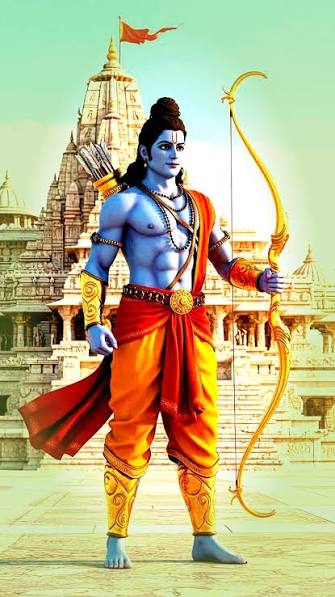
Any inquiry into dharma must begin with the determination of pramāṇa—the valid means by which dharma is known. Without this, the inquiry remains ungrounded. The opening of the Ramayana is precise in this regard: before the question is posed, the conditions that render it valid are already established.
The Nyaya Sutras (1.1.3) enumerate four pramāṇas: pratyakṣa, anumāna, upamāna, śabda. Of these, dharma is not available to the first three.
Dharma is not available to pratyakṣa (sense perception). What is perceptible is only action (karma) and its observable consequences, not that which makes an action dhārmic or adhārmic. The senses do not yield obligation, propriety, or alignment with ṛta; they yield only phenomena. Nor is dharma accessible through anumāna. Anumāna proceeds based on kārya–kāraṇa-sambandha—directly in pūrvavat and śeṣavat, and as generally observed causal relation in sāmānyato dṛṣṭa—whereas dharma is not established through any such relation. At most, anumāna yields consequence or utility, not normativity. Nor can dharma be known through upamāna, which operates through similarity between known and unknown objects; dharma admits no such perceptible analogue. Thus, pratyakṣa, anumāna, and upamāna are incapable of establishing dharma.
The śāstric position is therefore clear: dharma is known only through śabda, specifically the Veda as apauruṣeya-pramāṇa. This is expressed in the Mīmāṃsā Sūtras (1.1.2) as “codanā-lakṣaṇo artho dharmaḥ”—that which is enjoined by Veda is dharma. Here, śabda does not denote speech in general, but śruti as a valid means of knowledge. The Veda is not authored and is coeval with sṛṣṭi, like the order it reveals, and is accessed by the ṛṣis as mantra-draṣṭāraḥ. It alone is the means by which dharma is known.
This is reflected at the very opening of the Ramayana:
तपस्स्वाध्यायनिरतं तपस्वी वाग्विदां वरम् ।
नारदं परिपप्रच्छ वाल्मीकिर्मुनिपुङ्गवम् ॥
tapassvādhyāyanirataṃ tapasvī vāgvidāṃ varam |
nāradaṃ paripapraccha vālmīkir munipuṅgavam ||
— Vālmīki Rāmāyaṇa 1.1.1
The structure of the opening dialogue is therefore inevitable. A question concerning dharma must be directed to one established in śabda. Nārada is therefore described as vāk–vidāṃ varam—the foremost among those who know vāk. Traditional commentators interpret “vāk” here as śāstra-viṣayā vāk, with Nārada established as one grounded in Vedic knowledge and its proper articulation. The inquiry into dharma is thus directed toward one situated in śabda-pramāṇa.
Correspondingly, the questioner must be qualified. Vālmīki is presented as muni-puṅgava, while Nārada is described as tapas–svādhyāya–nirata and vāk-vidāṃ varam. Traditional commentators treat such qualifiers as intentional (viśeṣaṇānāṃ sābhīprāyatvam), establishing the adhikāra and pramāṇa-framework required for the inquiry that follows. The inquiry is therefore paripraśna—a deliberate and structured inquiry directed toward a valid pramāṇa concerning that which cannot be otherwise known. The prefix pari indicates completeness and thoroughness, suggesting inquiry undertaken with preparedness, seriousness, and orientation toward determinate knowledge.
Three conditions are thus satisfied:
- Viṣaya–niścaya: Dharma, not available through pratyakṣa, anumāna, or upamāna
- Pramāṇa–niścaya: Śabda (Veda) as the sole means of its knowledge
- Adhikāri–sambandha: A qualified inquirer addressing one established in śabda
Only within such a framework can the central question arise with legitimacy: does there exist a puruṣa in whom dharma, as known through śabda, is fully embodied?
This also satisfies the śāstric requirement of anubandha-catuṣṭaya: viṣaya (dharma), prayojana (the intelligibility of dharma in embodiment), adhikārī (a qualified inquirer and a knower of śabda), and sambandha (śabda as the means of its knowledge).
The opening functions as pramāṇa–sthāpana: the establishment of the valid means, qualified inquirer, and authoritative respondent necessary for a legitimate inquiry into dharma.
Viṣaya: The Nature of Vālmīki’s Inquiry
With pramāṇa established, the inquiry must be delimited in its viṣaya—what exactly is being asked. The opening question of the Ramayana is often read as a search for an exemplary individual. Such a reading is insufficient. The question is neither biographical nor merely ethical; it is an inquiry into the possibility of a puruṣa in whom dharma is fully present.
This structure is made explicit in the opening inquiry itself:
कोन्वस्मिन्साम्प्रतं लोके…
ko nv asmin sāmprataṃ loke…
— Vālmīki Rāmāyaṇa 1.1.2
एतदिच्छाम्यहं श्रोतुं परं कौतूहलं हि मे ।
महर्षे त्वं समर्थोऽसि ज्ञातुमेवंविधं नरम् ॥
etad icchāmy ahaṃ śrotuṃ paraṃ kautūhalaṃ hi me |
maharṣe tvaṃ samartho’si jñātum evaṃvidhaṃ naram ||
— Vālmīki Rāmāyaṇa 1.1.5
Vālmīki does not ask, “Who is virtuous?” or “Who is great?” Through a sequence of tightly defined qualifiers, he asks whether there exists a puruṣa in whom dharma—known only through śabda—is present without loss or contradiction. Each term restricts the field of possibility. Govindarāja similarly treats the repeated interrogatives (“कः… कः…”) as intentional rather than redundant, with each successive qualifier further delimiting the intended puruṣa. The sequence thus excludes partial adequacies: one in whom knowledge does not translate into action, one in whom action is not aligned with dharma, one in whom truth is not sustained across time, or one in whom capability is not governed.
The inquiry is therefore directed toward an “evaṃvidhaḥ naraḥ”—a person of specifically delimited and rare qualification. The concern is whether such guṇas can coexist without contradiction. Taken together, the qualifiers suggest an inquiry into a condition in which jñāna, vāk, and karma do not stand fragmented from one another, and in which no domain of functioning deviates from dharma.
The viṣaya is therefore precise: does there exist a puruṣa in whom dharma, as known through śabda, is present in integrated and non-contradictory form across all loci of functioning?
This framing shifts the discussion from admiration to ascertainment, from virtue to integrity, and from description to demonstrable embodiment.
Lakṣaṇa: The Sixteen as Necessary Conditions
The sixteen lakṣaṇas are introduced explicitly in the opening inquiry:
… गुणवान्कश्च वीर्यवान् ।
धर्मज्ञश्च कृतज्ञश्च सत्यवाक्यो दृढव्रतः
… guṇavān kaś ca vīryavān |
dharmajñaś ca kṛtajñaś ca satyavākyo dṛḍhavrataḥ
— Vālmīki Rāmāyaṇa 1.1.2
चारित्रेण च को युक्तः सर्वभूतेषु को हितः ।
विद्वान्कः कस्समर्थश्च कश्चैकप्रियदर्शनः ॥ 1.1.3 ॥
cāritreṇa ca ko yuktaḥ sarvabhūteṣu ko hitaḥ |
vidvān kaḥ kas samarthaś ca kaś caikapriyadarśanaḥ
— Vālmīki Rāmāyaṇa 1.1.3
आत्मवान्को जितक्रोधो द्युतिमान्कोऽनसूयकः ।
कस्य बिभ्यति देवाश्च जातरोषस्य संयुगे
ātmavān ko jitakrodho dyutimān ko ’nasūyakaḥ |
kasya bibhyati devāś ca jātarosasya saṃyuge
— Vālmīki Rāmāyaṇa 1.1.4
These are treated here not merely as guṇas in the sense of optional excellences, but as lakṣaṇas—defining conditions that must be simultaneously satisfied for dharma to be embodied. Their function is regulative.
Each lakṣaṇa excludes a specific mode by which dharma, though known, could be distorted, omitted, or contradicted in embodiment. They therefore constitute a niyata-samūha—a fixed and closed set characterised by non-redundancy, exhaustiveness, and minimality. No lakṣaṇa is derivable from another; removal of any one reintroduces a specific defect; addition yields only overlap.
Accordingly, terms such as dharmajñaḥ, satyavākyaḥ, dṛḍhavrataḥ, samarthaḥ, jitakrodhaḥ, and anāsūyakaḥ do not admit approximation through moral vocabulary. Each denotes a precise condition whose absence produces a definable failure: deviation from śāstra, distortion in articulation, instability across time, non-completion of action, reactive override, or doṣa-projection.
Taken together, the sixteen do not define dharma itself. They ensure that what is known through śabda is neither lost nor altered in embodiment. They are therefore conditions of transmission-integrity.
Vyavasthā: Manas–Vāk–Karma as Exhaustive Loci
The completeness of the sixteen lakṣaṇas rests on a prior śāstric insight: all human functioning relevant to dharmic embodiment is exhausted by three loci—manas, vāk, and karma. Whatever is known, expressed, or enacted must occur through one of these. No fourth independent locus is required.
Dharma can operate—or fail—only within these three. The sixteen lakṣaṇas are therefore to be understood not as a list, but as a systematic safeguarding across these loci.
At the level of manas, failure arises through loss of self-governance, reactive override, distortion, or instability. These are secured by ātmavān, jitakrodhaḥ, anasūyakaḥ, and dṛḍhavrataḥ—which together ensure that cognition is not subordinated to impulse, distortion, or temporal discontinuity.
At the level of vāk—encompassing articulation, communication, and relational expression—failure occurs through normative error, incompleteness of knowledge, distortion in speech, or misalignment with others. These are secured by dharmajñaḥ, vidvān, satyavākyaḥ, kṛtajñaḥ, sarvabhūteṣu hitaḥ, cāritreṇa yuktaḥ, and ekapriyadarśanaḥ, ensuring that what is known, expressed, and enacted in relation remains aligned with dharma.
At the level of karma, failure arises through lack of force, inability to execute, or absence of effective presence. These are secured by vīryavān, samarthaḥ, and dyutimān, which together ensure initiation, completion, and operative presence in action.
Two further conditions secure coherence across the set as a whole. Guṇavān ensures that these lakṣaṇas coexist without contradiction, while the condition “kasya bibhyati devāḥ saṃyuge” establishes that this coherence does not collapse under opposition. Thus, the set is both internally coherent and stable under stress.
Under this vyavasthā, no domain—inner, expressive, or active—remains unguarded. There is no locus in which dharma can fail without violating at least one condition. The completeness of the sixteen is therefore not asserted but demonstrated.
Avarodha–nivṛtti: Elimination of Fragmentation
Having established the loci (manas–vāk–karma) and the corresponding lakṣaṇas, it must now be shown that these are not merely distributed conditions, but constraints that remove fragmentation across loci. The defect is not absence of capacity, but disjunction—knowing without doing, speaking without truth, and acting without alignment.
The sixteen lakṣaṇas eliminate the specific modes by which such disjunction arises. Thus, where dharmajñaḥ is present without samarthaḥ, dharma remains unexecuted; where vīryavān is present without dharmajñaḥ, force operates without norm. Their co-presence removes both defects, ensuring that what is known is carried into action.
Similarly, satyavākyaḥ without dṛḍhavrataḥ permits truth to lapse under pressure, while dṛḍhavrataḥ without satyavākyaḥ stabilizes error. Together they ensure that truth, once apprehended, remains stable in expression across time. At the level of inner governance, ātmavān establishes self-possession, jitakrodhaḥ prevents collapse under provocation, and anāsūyakaḥ removes distortion through doṣa-projection, ensuring that internal deviation does not corrupt action.
In the domain of relation—where dharma is expressed toward others—kṛtajñaḥ, sarvabhūteṣu hitaḥ, cāritreṇa yuktaḥ, and ekapriyadarśanaḥ ensure that engagement does not deviate from dharma—neither through ingratitude, harm, inconsistency, nor aversion. In action, vīryavān, samarthaḥ, and dyutimān together remove the defect of initiation without completion, securing force, execution, and sustaining presence.
Finally, at the level of systemic coherence and stress, guṇavān ensures that these conditions coexist without contradiction, while the clause “kasya bibhyati devāḥ saṃyuge” establishes that this coherence does not collapse under opposition.
Accordingly, the sixteen do not enumerate excellences; they eliminate every mode by which dharma, though known, can fail in embodiment. The result is continuity across manas–vāk–karma: cognition, articulation, and action remain continuous, without contradiction or collapse.
Pūrṇatā: Demonstrating Completeness
The claim that the sixteen constitute a complete set must be established as pūrṇatā—the absence of both deficiency (nyūnatā) and excess (adhikatā).
There is no deficiency. For each locus—manas, vāk, and karma—distinct modes of failure have been identified and secured by non-reducible lakṣaṇas. If any one is removed, a specific defect reappears: without dṛḍhavrataḥ, commitment does not endure across time; without satyavākyaḥ, articulation deviates from what is known; without samarthaḥ, action does not reach completion; without jitakrodhaḥ, cognition is overridden under provocation. The set is therefore necessary.
Nor is there excess. Any proposed addition must either fall within the existing loci or posit a fourth. The latter is not required. If within the three, it can only be a restatement or recombination of existing lakṣaṇas, and therefore not independent. No further condition can be introduced without redundancy. The set is thus minimal.
Taken together, the sixteen form a niyata–samūha: a closed set in which all possible modes of deviation are precluded. What is known through śabda as dharma is neither lost nor altered across any locus of functioning.
In this sense, the set satisfies pūrṇatā precisely—nothing lacking, nothing superfluous. The sixteen lakṣaṇas are therefore not an open enumeration of virtues, but a complete condition-set for the embodiment of dharma.
The significance of pūrṇatā here is not merely numerical completeness. Dharma is first known through śabda and then encountered in embodied form. The sixteen lakṣaṇas are argued to secure this transition without loss, alteration, or contradiction. The structure thus reflects the śruti-expression of pūrṇatā, as expressed in the well-known śānti-mantra:
पूर्णमदः पूर्णमिदं पूर्णात् पूर्णमुदच्यते ।
पूर्णस्य पूर्णमादाय पूर्णमेवावशिष्यते ॥
pūrṇam adaḥ pūrṇam idaṃ pūrṇāt pūrṇam udacyate |
pūrṇasya pūrṇam ādāya pūrṇam evāvaśiṣyate ||
Pramāṇa–traya–saṃvāda: Śabda, Itihāsa, Loka
The established structure is not left at the level of definition; it is confirmed across three converging loci—śabda, itihāsa, and loka—without contradiction.
Within śabda, Nārada—designated as vāk–vidāṃ varam—does not modify or extend the sixteen. He acknowledges their rarity (bahavo durlabhāś caiva…) and proceeds to identify a single puruṣa in whom they are fully present. The condition-set is thus affirmed at the level of śabda without qualification.
Within itihāsa, what follows is not redefinition but pradarśana. Across varied situations—prosperity, vanavāsa, counsel, and conflict—the lakṣaṇas are shown in operation. No additional category is introduced; the narrative does not expand the structure, but expresses it.
Within loka, the same completeness becomes evident through recognition. In the Ayodhyā Kāṇḍa, the proposal for Rāma’s rājya-abhiṣeka (coronation) receives unanimous assent…from ministers, elders, and citizens. This is not preference but sustained recognition: no deficiency is perceived across time, context, or relation.
Thus, what is established in śabda is unfolded in itihāsa and recognized in loka. What is first known is then embodied, and what is embodied becomes publicly recognisable—without contradiction.
Lakṣaṇa–Guṇa Distinction
A decisive distinction must be maintained between lakṣaṇa and guṇa, for the force of the argument depends upon it. In śāstric usage, a thing is established through lakṣaṇa and pramāṇa (lakṣaṇapramāṇābhyāṃ vastu-siddhiḥ), and the sixteen articulated in the opening of the Ramayana are to be understood as lakṣaṇas—belonging to the level of definition (lakṣaṇa–pariccheda). The numerous excellences attributed to Rāma throughout the narrative, by contrast, are guṇas, belonging to the level of manifestation (vyavahāra–pradarśana).
A lakṣaṇa specifies what must be present for a thing to be what it is; it is necessary, non-additive, and non-redundant, and its absence entails asiddhi—the failure of the thing to be established as such. A guṇa, by contrast, is an excellence observed in context—situation-bound and indefinitely extensible—manifesting what is already established through lakṣaṇa.
Accordingly, the sixteen neither compete with nor are expanded by the many guṇas described in the text. The relation is one of priority: lakṣaṇa gives rise to guṇa, and definition precedes expression. Thus, when Rāma is described as compassionate, resolute, gentle in speech, formidable in battle, or unwavering in vanavāsa, these are not additions to the original set, but contextual unfoldings of one or more lakṣaṇas under specific conditions.
From this, two consequences are unavoidable. No accumulation of guṇas can compensate for the absence of a single lakṣaṇa; a defect at the level of definition cannot be repaired at the level of manifestation. Nor can any guṇa introduce a new definitional category; what appears new is either reducible to, or derived from, the existing set.
This distinction preserves the closure of the sixteen while allowing for the richness of narrative expression. The text does not discover Rāma’s qualities progressively; it displays, across contexts, what is already established.
Siddhānta: Rāmo Vigrahavān Dharmaḥ
With pramāṇa established, viṣaya delimited, lakṣaṇa defined, vyavasthā demonstrated, fragmentation eliminated, pūrṇatā established, and confirmation secured across śabda, itihāsa, and loka, the conclusion follows as siddhānta—that which remains when alternatives have been excluded.
The statement “रामो विग्रहवान् धर्मः” is therefore not alaṅkāra or devotional intensification, but a precise determination: dharma, known through śabda and not available to pratyakṣa, becomes directly intelligible through Rāma.
“Vigrahavān” does not reduce dharma to form; it indicates availability through embodiment without loss of śāstric content. What is otherwise known through śabda is encountered as lived, consistent, and non-fragmented conduct across manas–vāk–karma.
This is not merely inferred but explicitly attested within the narrative. Mārīca, speaking under conditions of fear and opposition, declares:
रामो विग्रहवान् धर्मः साधुः सत्यपराक्रमः ।
राजा सर्वस्य लोकस्य देवानामिव वासवः ॥
rāmo vigrahavān dharmaḥ sādhuḥ satyaparākramaḥ |
rājā sarvasya lokasya devānām iva vāsavaḥ ||
— Vālmīki Rāmāyaṇa 3.37.13
Here, dharma is not attributed as a guṇa but identified with the person of Rāma himself. Correspondingly, Rāma’s own statement affirms the same alignment:
नाहमर्थपरो देवि लोकमावस्तुमुत्सहे ।
विद्धि मामृषिभिस्तुल्यं केवलं धर्ममास्थितम् ॥
nāham arthaparo devi lokam āvastum utsahe |
viddhi mām ṛṣibhis tulyaṃ kevalaṃ dharmam āsthitaṃ ||
— Vālmīki Rāmāyaṇa 2.19.20
Thus, what is established in śabda, demonstrated in itihāsa, and recognised in loka is both affirmed externally and acknowledged internally, without deviation.
This conclusion stands because no lakṣaṇa is absent, no additional condition is required, no contradiction appears across loci or under stress, and no alternative account remains tenable. Rāma is therefore not one who follows dharma among others; he is that puruṣa in whom dharma is fully present, such that knowing, speaking, and acting do not diverge at any point.
The import is epistemic as much as it is determinative. What is known through śabda becomes directly intelligible through Rāma’s conduct. Dharma is no longer merely enjoined; it becomes available in embodiment without loss, alteration, or contradiction.
In Rāma, dharma is not illustrated; it is present as a coherent and complete embodiment. This, and not poetic flourish, is the force of the siddhānta: Rāmo vigrahavān dharmaḥ.
The sixteen lakṣaṇas, together with the functional conditions they secure in the embodiment of dharma, are summarised in Table 1.
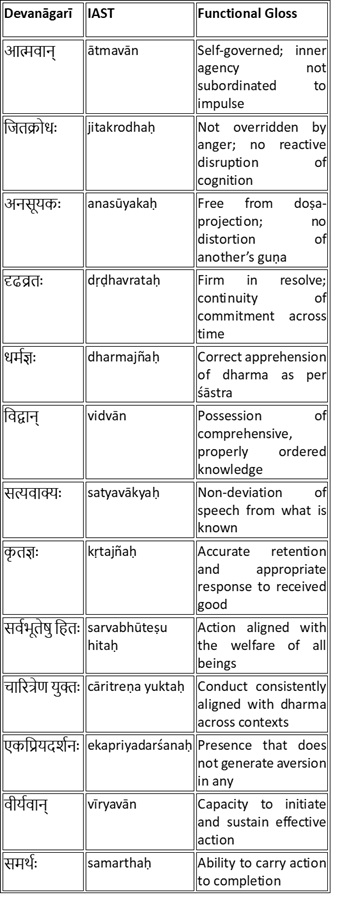
Table 1: Functional Delimitation of the Sixteen Lakṣaṇas
Structural Note (Vyavasthā)
- Manas (Inner Governance): ātmavān, jitakrodhaḥ, anasūyakaḥ, dṛḍhavrataḥ
- Vāk (Cognition, Articulation, Relation): dharmajñaḥ, vidvān, satyavākyaḥ, kṛtajñaḥ, sarvabhūteṣu hitaḥ, cāritreṇa yuktaḥ, ekapriyadarśanaḥ
- Karma (Execution): vīryavān, samarthaḥ, dyutimān
- Integration / Stress (Saṃyoga): guṇavān; kasya bibhyati devāḥ saṃyuge
Acknowledgements
I thank Prof. G. Narahari Sastry for his guidance in balancing traditional thought with contemporary insight. I’m grateful to Mrs. G. Songeeta for her philosophical clarity, and to my daughter Ms. Akanksha Garikapati for her subtle contributions to the contemplative tone of this work.
Leave a Reply