
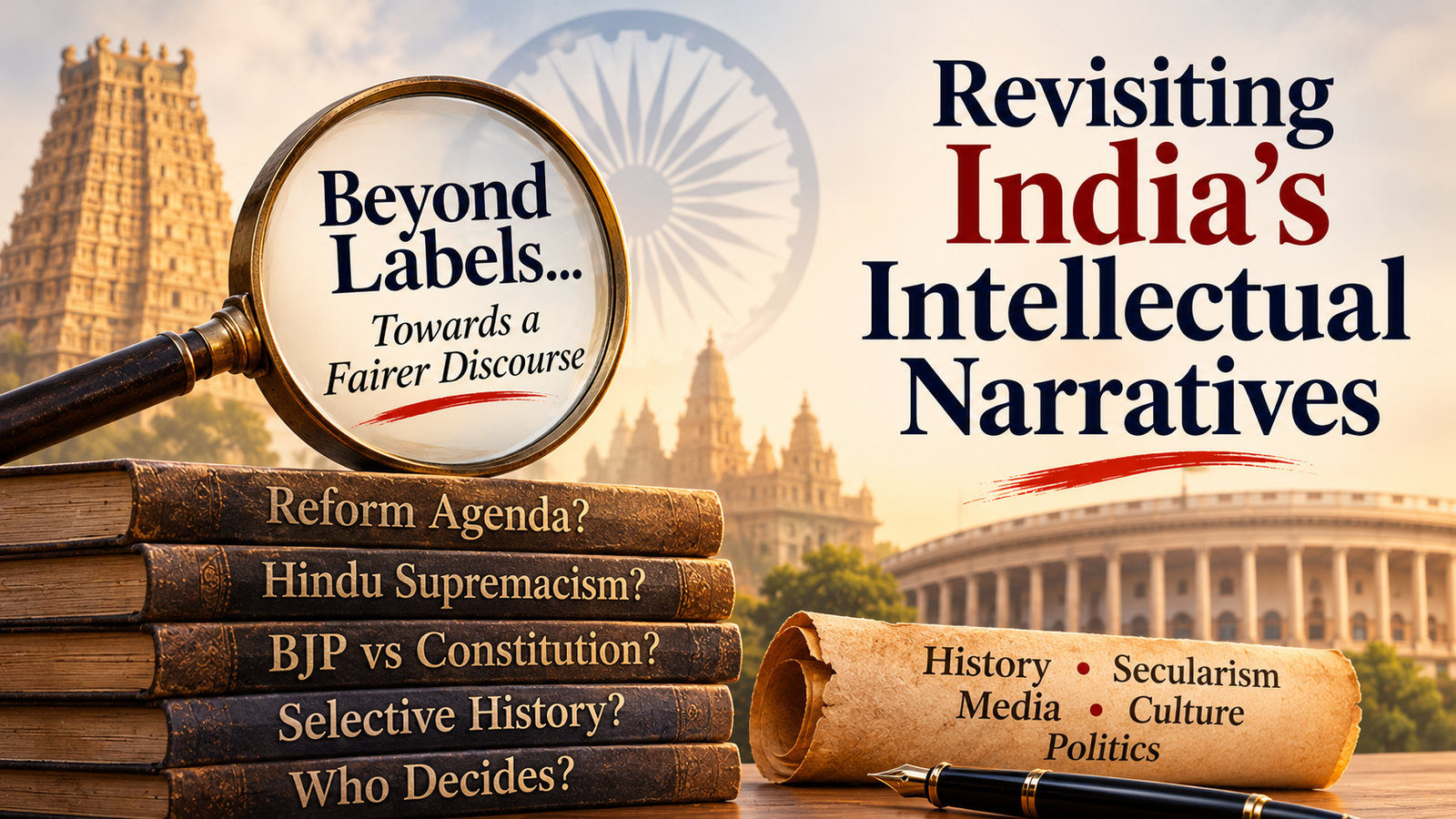
The first part of this essay series examined a set of familiar objections that arise when Hindu concerns are raised in debates about secularism, cultural influence, and Indian politics. These objections often work as shortcuts: rather than addressing an argument on its merits, they assign it a label and thereby avoid engaging with it.
This second part turns to the assumptions beneath those reactions. It considers the language of reform, the charge of religious supremacism, claims that the BJP threatens the Constitution, and the selective use of historical comparison. The central question remains the same: can public debate move beyond conditioned responses and apply its standards consistently?
Discomfort with the term ‘Purge Agenda’
In the very first article of my essay series, I presented scholarly work that revealed colonial and Hinduphobic assumptions that underpinned the ‘communalism’ debate in India. I also described how this thinking informed what passed for the supposedly-secular ‘reform agenda’ in post-Independence India–a cultural template where Hinduism was shown to be regressive, Western models of ‘progress’ were projected as the only ways forward, and minority religions and characters were depicted as unfailingly positive (tacitly in contrast with the majority). Foundational thinking on ‘communalism in India,’ which dominated post-Independence thinking as well, believed that a solution to communalism was possible only when Hinduism was reduced to a cultural quirk or ‘purged.’ This led me to state that ‘purge agenda’ better described the aims of the ‘reform agenda.’ Two friends objected saying that ‘purge agenda’ was hyperbolic.
They said it but made no attempt to engage with my reasoning, which built up an argument citing Prof Sufiya Pathan and Prof Vamsee Juluri’s scholarly papers and providing supporting evidence. In response, I mentioned my reasoning and added that ‘purge agenda’ was by no means hyperbolic when used to signify the agenda’s bigoted foundations and Hindu-subversive aims. I also pointed out that communists, rationalists, proselytizers, ‘secularists’ and pseudosecularists often speak of ‘eradicating’ one or all religions. These ‘ideals’ were actively implemented in Soviet Russia and are on display now in current-day China. So where, I wondered, was the scope for such surprise over the use of the word ‘purge? ’
The trouble with casual but passionate responses, such as those my friends held, is that they merely deal with surface-level phenomena like a controversy over a particular book or a celebrity utterance. Surface-level issues often have surface-level solutions–say ‘allow free speech’–but they lack the nuance to get to the underlying issue itself. For instance, the ‘victim’ not being allowed to speak in a situation might be passing off an ‘unsecular’ agenda as a secular one. Besides, seeming absolutes like ‘secularism’, ‘truth,’ and ‘freedom’ are more contextual than we would like to admit. They are also deeply rooted in 19th and 20th century attitudes when science and materialist ideologies were expected to march forcefully on, trampling ‘superstitions’ like religion underfoot. That triumphalism has not been borne out thus far, and therefore interpretation of terms like ‘rights’ or ‘freedom’ is proving to be a far more complex task than we imagined it to be.
In fact, even as technological progress achieves amazing things, the theoretical underpinnings of scientific subjects, like materialism, have been called into serious question. My aim in stating this is not to make a case for second-guessing science’s centrality but to make a case for accepting the limits of science’s understanding at present. More importantly, it is a call to reevaluate harmful materialist ideologies with their patently pseudoscientific extrapolations. Especially when they espouse disastrous aims such as wiping out a people’s history, culture, and belief systems.
This debate isn’t new to India either: it was very much on display even during the Indian freedom struggle. While wiser Indian leaders understood the dangers of ‘utopian ideologies,’ India’s post-Independence leadership displayed less discernment. For instance, rather than acknowledging identity-based conflicts and devising ways of resolving them, the age of Nehruvian Socialism sought to paper over them by demanding that everyone become ‘secular.’ The result was greater conflict. With realpolitik taking a hand, the preservation of minority cultural identity and conservatism became a ‘secular’ priority while the model of ‘secular citizenship’ pushed Hindus towards deracination. These resentments only gained force when pushed into the shadows.
Now at least, when the crude tools of materialist ideology have clearly failed to deliver, it is time to retire them. It is time to reevaluate more honestly the roles that religion and culture play in individual and social lives. It is time to look afresh at the traditional-wisdom systems that sustained civilizations through millennia–even with the most rudimentary of technologies–rather than sacrifice them ritualistically at the altar of pseudoscientific ideologies like Marxism.
Hindu Religious Supremacism
Early travelers to India found the locals unable to grasp the notion of ‘false gods.’ They were willing to accept others’ gods and practices as being sacred even as they remained faithful to their own. Semitic religions, however, came with claims to being exclusive paths to salvation. From these claims came declarations that local deities were ‘false gods’ and demands that the locals convert to their religion. Such attempts at mass proselytization continue to this day.
Contrast this with Hindu orders like the Ramakrishna Mission and Self-Realization Foundation or gurus like Sri Sathya Sai Baba, who prominently display symbols of other religions and accept them as paths to the divine. Shirdi Sai Baba is now largely worshipped by Hindus with Hindu rituals even though he himself was likely a Muslim. Hindus, to this day, visit Sufi shrines and churches with little inhibition.
Hinduism does not actively proselytize and has only recently made small efforts to retain its adherents. Yet this benign disposition has itself been twisted and misrepresented to attack it. The very Sufiya Pathan paper I quoted in my essay describes how Hinduism’s refusal to proselytize was interpreted–using highly suspect logic–to absurdly conclude that it didn’t believe in the ‘salvation of mankind,’ and was therefore ‘communal.’
The Hindu attitude stands in contrast even to some other Indic faiths that have adopted a standoffish attitude towards Hinduism. These systems seek to proselytize into their fold and insist on the forsaking of one’s Hindu beliefs. Some of these faiths have also become more conservative in recent times, replacing a fluid exchange of beliefs, customs, and interaction with Hinduism with hard lines of separation.
But what does it say about Indian secularism that neither the proselytizing zeal of the Abrahamic religions nor the growing rigidity of some Indic traditions were pacified during the supposed ‘golden age of secularism’? In fact, they all grew in stridency and antagonism towards Hinduism through this period. Yet Hinduism is accused of intolerance.
It is insincere to discuss secularism in India without first acknowledging supremacism, conversion, and fundamentalism amongst the minorities as well. Any attempt to take the discussion forward focused only on Hinduism is not an attempt made in good faith (pun intended).
‘BJP Threatens the Constitution’
The BJP formed a stable government at the Center for the first time in 1998. The Constitution of India had been amended 78 times by then. The Congress-led United Progressive Alliance government that succeeded that BJP government–between 2004 and 2014–brought an additional 7 amendments. Even accounting for the amendments brought by governments supported by the BJP’s predecessor party Bharatiya Jana Sangh, governments supported by the BJP itself, BJP governments, and Congress-supported governments, no single party has tinkered with the Indian Constitution as much as the Congress has.
No party has misused President’s Rule to dismiss elected state governments as much as the Congress has either. In recent years, the state of Andhra Pradesh was bifurcated despite a state assembly resolution expressly rejecting the move–and Congress MPs even resorted to disgraceful disorder in the Parliament. The offices of the Prime Minister and the Cabinet were undermined by subjecting them to extra-Constitutional oversight during the UPA years. And these instances don’t even factor in the Congress suspending the Constitution during the Emergency. The party even brought unilateral amendments to the Constitution in this period, including to the Preamble. The terms ‘secular’ and ‘socialist,’ which ‘secularists’ are fond of quoting, were added in this time without a proper Parliamentary process. The Congress even considered unilaterally creating a presidential system during the Emergency–in effect, doing away with the original Constitution in letter and spirit. So, what Constitutional propriety can one speak of now? It can mean little more than the ‘Congress way’ of circumventing the Constitution itself.
There is little evidence to support the claim that the Constitution is under threat under the BJP. No more so than it was under past-Congress governments, in any case. The argument that the BJP is going against the ‘spirit of the Constitution’ merely implies that it is going against the Congress or the Left’s way of doing things.
To take a broader perspective, the Congress party genuinely deserves credit–especially leaders like Sardar Patel–for uniting and keeping post-Independence India together against the odds. But the party must also accept blame for imposing a terrible socialist system that bankrupted India in the 1980s, created a corruption-ridden administration, severely restricted media and free speech, and deprived its citizens of facilities and technology that were commonplace elsewhere. Similarly, those extolling the supposedly independent institutions of the past must accept their shortcomings as well. They must answer why these so-called ‘independent’ institutions proved unable to moderate the ruling party’s disastrous economic and administrative policies.
‘Those living in glass houses’
A gentleman whose perspective I greatly value invoked the ‘glass houses’ metaphor to say that aspects of Hindu history might be as disturbing to our contemporary minds as are aspects of Islamic or Christian histories in India. An actual comparison of their troubling-pasts is a subject in itself, and one I won’t attempt. I am also happy to agree that the whitewashing of history by anybody is undesirable because it keeps a society from moving forward.
But I would ask why any such concern needs to trouble Hindus at all? Hindus have lived in a glass house for centuries now as massive boulders were hurled at it. That remains true to this day. What has changed is that questions are now being asked of other faiths as well.
No sooner did that reverse-trend begin, the old narratives started to fall apart and a surprising truth became abundantly clear: other faiths lived in glass houses as well, not in the stonemasonry forts that ideologues and a pliant intelligentsia made them out to be. In fact, the other identities were the ones in need of the advice that throwing rocks at Hinduism was neither acceptable nor wise while they lived in glass houses themselves.
This is by no means a call to limit serious study and discussion. But even this statement would appear hostile to some. For one, it suggests that scholarship so far hasn’t been rigorous or fair. This is a frivolous objection as no serious historian would bother to deny that Hindu history has been severely distorted by Middle-Eastern and Western colonialism, Leftist-Marxist writing of history, Nehruvian Socialism, postmodernism, and cynical realpolitik. The correction of these excesses would be a step forward.
Yet we’ve been conditioned to believe that politically-motivated and bigoted claims about Hinduism are true and that to question their truth is to be ‘unsecular.’ Two simple questions give the lie to such statements. One, would such an interpretation be acceptable in the case of any other colonized culture or religion? Two, is any other victim of colonization (including Marxist/Socialist rule) be told they must accept past-hegemons’ versions of history or be declared ‘unsecular’ or ‘illiberal’?
The answer to both is ‘no.’ So what explains the obvious distress in some circles about the prospect of writing a decolonized and politically-neutral history of India and Hinduism? The answer is laughably simple: despite all forms of calumny having been hurled at Hinduism, its damaged glass house still stands centuries later. The rocks are flying the other way now and the question is: will the others endure as well as this pre-Bronze Age culture has?
‘Uncomfortable truths’
A friend reacted to my criticism of Naseeruddin Shah’s opinions saying that artists, writers, and journalists were allowed to hold ‘uncomfortable truths’ up for people to see. I responded that my criticizing Shah didn’t amount to silencing him, and the friend readily agreed that it wasn’t. Mulling over this exchange later, it struck me that the implicit assumption was that certain categories of people bring alternative perspectives, even wisdom, to how we laypeople understand issues.
Having written in great detail about the many vested interests that distort journalistic reporting and opinion, this comment felt at once both deflating and also worth exploring. The general background in which this statement was made is that journalists, artists, and intellectuals have very vocally been claiming that the Right-wing today undermines or co-opts journalism.
Be that as it may, this outcry forgets that the Left has also made powerful attempts to undermine journalism’s credibility through intellectuals like Noam Chomsky and every Left-leaning university department. Their charge was that journalism distorted the truth to serve commercial and political interests–that is, to perpetuate a capitalist society. So, both political poles, it seems, agree that journalism distorts reality to serve vested interests. The current claim is that this skews Rightward.
It is true that in recent years previously unthinkable phenomena have come to be: journalists and media houses with openly-Right associations. Ironically though, having Leftist associations was never taboo in the press. Leftist journalists and media organizations dominated the space through India’s socialist experiment and are still influential today. The fact that Right-wing journalists were virtually nonexistent until recently shows the extent to which dissent was suppressed back then. So, we must ask questions about Leftist distortions as well: how did a partial worldview come to be passed off for ‘the truth’ by snuffing out alternate views? As I have stated earlier, this was a result of a dystopian project that involved the government, the media, and academia. So let us acknowledge that the issue of press independence is an important one that requires new and objective thinking. But let us not allow the Left-or-Congress-leaning press griping about losing prominence be the basis for it.
Perhaps a more mature approach is to accept that journalists are not assigned halos along with their ID cards. They are professionals who work in a fiercely competitive commercial industry that is highly susceptible to money and political influences. While individual journalists might display ethical substance and reject such inducements, they are the exceptions and not the norm. So, we must be willing to evaluate claims from both sides with equal skepticism rather than one with skepticism and the other with blind acceptance.
As for artists and writers, when was the last time they really stood up for a distinct point of view? ‘Socially-minded’ creatives almost always echo safe and cliched ‘progressive’ views. In fact, Indian cinema has very rarely produced art that challenged political correctness. Besides, much of what celebrities say is vacuous, and any controversial opinions they hold are expressed with an assurance of political support rallying behind them. So, must we really pretend that celebrities parroting lines like ‘casteism is bad,’ ‘communalism is bad,’ or ‘society should be progressive’ are sharing a profound and original insight?
Not only do these ‘socially-conscious’ pretenders fail to bring original insight to their art, they gang up against films like Dhurandhar which hold non-mainstream points of view. Quite clearly, the artistic community in India celebrates ideologically-Left conformity over original artistic vision. Having failed to bring forth a new, controversial, and insightful view of caste, religion, communalism, or any other subject through their art, why should anyone expect these hacks to have any insight that may uplift the public square ? They’re just as stuck in ‘conditioned responses’ as us ‘ordinary folk’ are.
It need not be the public space alone: let us accept that emotions and relationships are areas that artists have profound insight into. So why don’t we turn to film-stars for advice on relationships or emotional stability? Instead, we dismiss them as vain and dysfunctional in the real world even though they have undeniable ability in their areas of expertise. So why must we make an exception to believe that some artists have insight into public matters? I don’t believe we should, unless they display real prowess–which I personally haven’t sighted even remotely so far.
I would venture so far as to say that essays like mine–and those of more prominent, learned, and fearless others–do more to speak uncomfortable truths than anything celebrities do. Especially as non-celebrities are forced to rely on research and arguments, not just controversial lines that make the headlines and attract eyeballs.
Conditioned Responses
‘Where are the Right-wing intellectuals?’ is a question the Indian Left often taunts the Right with. The geniuses on the Left don’t realize that this is not a stinging jibe but a confession. It is an admission that the Left successfully and intolerantly choked out non-Left ideology from Indian campuses, media, and the cultural elite.
In the West, Right-leaning intellectuals often emerge from the same elite Left-leaning universities that mass-produce Leftists. The Indian academy, however, brooked no such dissent. Instead, it created an inbred, self-referential, and self-perpetuating environment where freethinking was snuffed out and replaced with ideological indoctrination. The academy, in fact, is the motherload of ‘conditioned responses.’ It shows no interest in teaching students to think, it only concerns itself with teaching them what to think.
Writing on the very subject of absent Right-wing intellectuals in 2015 Ramachandra Guha observes that all ‘prominent’ academics were at least anti-Right.’ He also dismisses Right-leaning writers as ‘ideologues’ and describes their writings as ‘rarely based on serious or extended research’ and with a ‘tendency to selectively invoke or suppress facts to buttress conclusions decided upon in advance.’
What Guha doesn’t address is the issue of ‘extended research’ being the luxury of the tenured, funded, mutually-referencing Leftist mediocrities who also dominate the publishing and journalistic space. What some Right-wing intellectuals have achieved despite being exiled from academia is in fact quite remarkable. Then Guha concedes that real ‘intellectuals’ have political views too, but adds that ‘unlike intellectuals, ideologues care little about the reception of their work by scholars.’ That, right there, is the giveaway line.
Observe how this circular-reasoning works: Guha himself claims there are nearly no prominent ‘Right-leaning’ scholars; therefore, the authority to declare whether a Right-leaning writer is an ‘intellectual’ or ‘ideologue’ rests with Leftist ‘intellectuals’ or ‘ideologues the Left certifies to be “intellectuals!”’
This is no exaggeration. In recent years Guha has identified Arun Shourie as the only ‘serious intellectual’ who is ‘also socially conservative.’ But hadn’t Guha earlier called the writer Arundhati Roy the ‘Arun Shourie of the Left?’ So Guha went so far as to use ‘Arun Shourie’ as a pejorative to put Roy down with as he found her to be a ‘vulgariser of the [L]eft [as Shourie presumably was of the Right]’ who ‘falsified, exaggerated, used hyperboles, suppressed fact, overwrote.’
So, what brought about Guha’s change of heart about Shourie’s scholarship? Does it extend to Guha’s opinion of Shourie’s book Worshipping False Gods? Guha’s somersault isn’t questioned–perhaps because he is a Left-leaning certifying authority empowered to decide who is an ‘intellectual’ and who is not–and his opinion-at-the-moment is the gold standard. But could it have anything to do with Shourie turning anti-Modi and anti-BJP? Is that really the abysmally-low standard people like Guha hold themselves to?
Conclusion
Outside the moated walls of academia and journalism, India’s intellectual environment has changed dramatically. With internet technology, educated nonspecialists have been calling out contradictions and hypocrisies in the works of so-called authorities. The Left’s response followed Guha’s template: it dismissed people as ‘ideologues’ or ‘amateurs’–people who weren’t ‘intellectuals.’ They even tossed around terms like ‘historiography’ and what not, but dodged the questions themselves. They also failed to provide convincing information that silenced their ‘amateur’ critics. At the same time, several well-researched works with Right-leaning points of view have also been published, enjoyed success, and not suffered sharp refutations.
These seem to me to be positive signs but not a solution. Not if the goal goes beyond replacing conditioned-responses of one ideology by another. If the ideal is to move away from a system of small, elitist groups deciding how an entire nation thinks and acts, then a deeper commitment is called for. A commitment to awareness and skepticism. It demands that one make the time to research issues one has strong opinions upon. It demands becoming interested in the issue itself rather than accumulating Left-certified cultural capital about it. In other words, it demands moving beyond accumulating ‘conditioned responses’ to it.
Leave a Reply