
Why Svadharma Cannot Be Reduced to Personal Choice
Introduction
A striking feature of contemporary Hindu discourse is that many of its inherited terms remain verbally alive even when the conceptual structures that once disciplined their use have weakened. Dharma is invoked everywhere, yet it is frequently made to answer questions framed in a vocabulary foreign to its own moral architecture. Svadharma is one such case. It is now often rendered as “personal purpose”, “authentic calling”, or the injunction to “follow one’s own path”. These formulations are not wholly false, but they are dangerously incomplete.
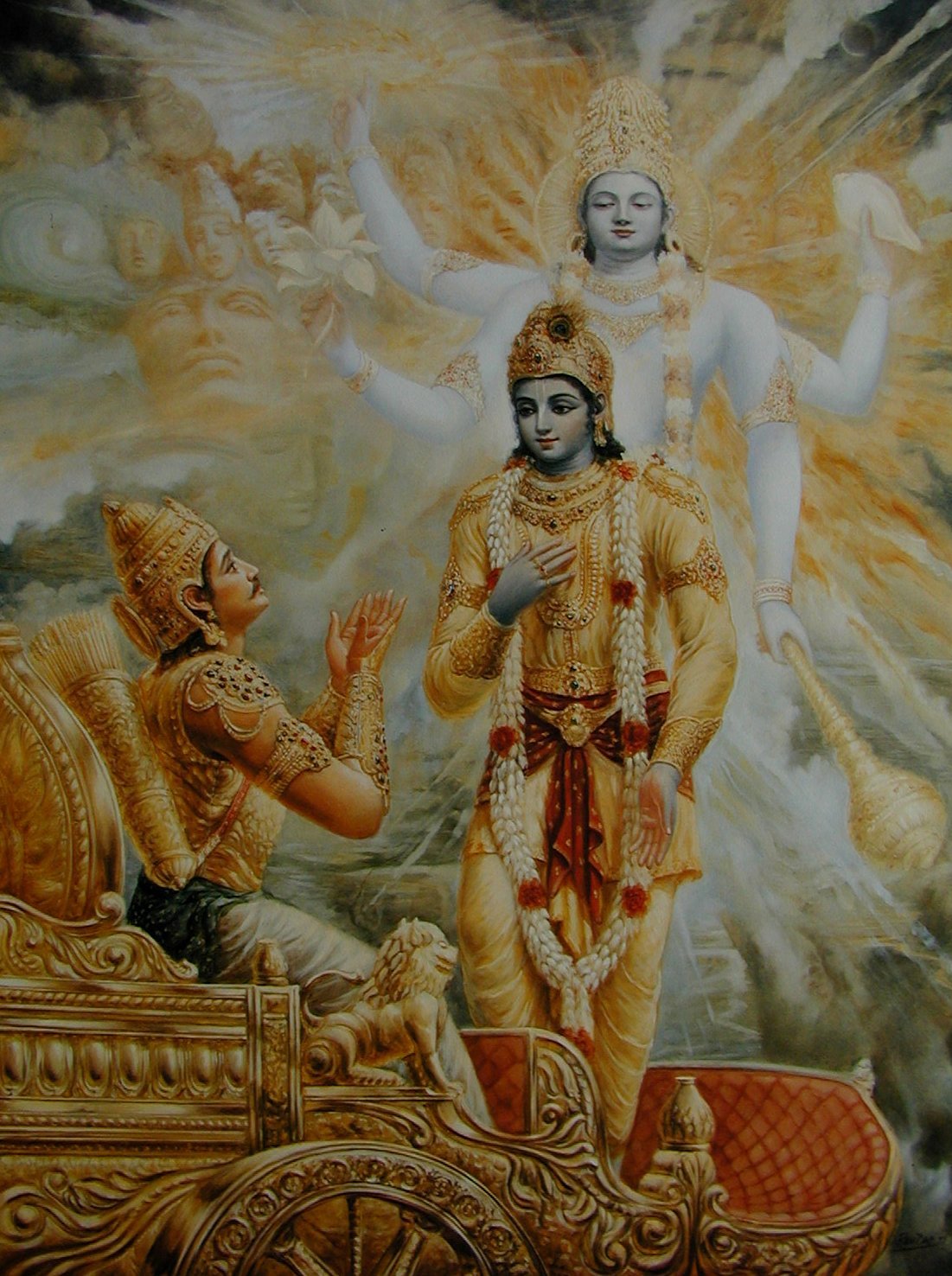
The Bhagavad Gītā’s famous formulation is more demanding: “Better is one’s own dharma, though imperfectly performed, than another’s dharma well performed” (3.35; cf. 18.47). The verse is frequently read as a defence of individuality against imitation. Yet Arjuna’s predicament makes clear that the text is not celebrating a sovereign chooser detached from inherited obligations. Arjuna is already a son, disciple, warrior, kinsman and political actor. His crisis arises because these identities do not point unambiguously in one direction.
The problem, therefore, is not simply whether one should follow svadharma. It is prior to that: how is svadharma known when inclination, social role, moral responsibility, consequence and spiritual aspiration do not coincide? If the concept is reduced to personal choice, the question disappears. If it is reduced to inherited prescription, the question is suppressed. The Gītā permits neither simplification.
From choice to discernment
Modern individualism tends to give moral priority to the chooser. A decision is presumed legitimate if it is sincerely owned, freely selected and does not obviously violate another’s rights. Within such a framework, inherited obligation appears secondary and authenticity appears primary. The moral question becomes: “What do I truly want?”
Dharmic reasoning begins elsewhere. The agent is never merely an isolated will. One enters a world already structured by relations: parents, teachers, spouses, children, dependants, communities, vows and institutions. Actions acquire meaning within these relations. The question is therefore not exhausted by desire; it is whether one’s action is fitting to one’s nature, responsibilities and place in a larger moral order.
This does not mean that every inherited expectation is sacred. That would turn dharma into social inertia. Indian traditions themselves preserve repeated examples of moral conflict, where different obligations become incompatible. Arjuna’s refusal to fight is not portrayed as a trivial lapse of courage; it is accompanied by arguments about kinship, teachers, social disorder and the destruction of family lineages (BhG 1.31–44). His self-description at 2.7 is especially important: he is dharma-saṃmūḍha-cetāḥ, bewildered about dharma. Social location is known; right action is not.
The distinction matters. If svadharma were identical with externally assigned role, Arjuna would require no sustained instruction. If svadharma were identical with inner preference, Kṛṣṇa would have no reason to interrogate and transform Arjuna’s preferences. The Gītā’s pedagogy presupposes that the self may be mistaken about itself.
Svabhāva is evidence, not permission
The later chapters of the Gītā deepen the problem by linking characteristic action to svabhāva. In 18.41–44, differentiated forms of work are associated with dispositions and qualities; in 18.47, one’s own work is said to arise from one’s nature; and in 18.59–60 Kṛṣṇa warns Arjuna that his own nature will impel him towards action even if egoically he declares otherwise.
These passages are often modernised into the language of personality or vocation. Yet such a move can obscure a basic philosophical distinction. What explains an action does not necessarily justify it. A temperament may predict conduct without authorising it. A person may possess a stable disposition towards anger, domination, vanity or avoidance. No dharmic account can simply baptise durable inclination as svadharma.
The same problem appears with talent. Ability is morally relevant, but it is not self-legitimating. A person may be exceptionally capable of persuasion, wealth accumulation, military action or political strategy. Skill establishes capacity; it does not settle right use. The Gītā itself blocks a crude meritocratic reading when it insists that imperfect performance of one’s own dharma can be superior to excellent performance of another’s. Success, therefore, cannot be the final test.
Svabhāva should instead be treated as one form of evidence within a wider act of discernment. It limits fantasies of total self-invention. It reminds the individual that a sustainable life cannot be built indefinitely through imitation. But nature requires education, purification and interpretation before it can carry normative weight.
The forgotten category of adhikāra
The traditional category of adhikāra further complicates modern translations of selfhood. In contemporary political language, “right” primarily signifies entitlement. In śāstric discourse, adhikāra often concerns fitness, qualification or eligibility for a practice, discipline or teaching. The question is not only “May I choose this?” but “Am I presently fitted for this?”
This shift is philosophically significant. A demanding path may be attractive because it appears prestigious, pure or spiritually elevated. Yet attraction does not establish preparedness. Renunciation may become a form of escape; activism may become vanity; scholarship may become self-display; domestic responsibility may become an excuse for fear. Adhikāra introduces a discipline of self-assessment that modern authenticity language frequently lacks.
It also prevents the hierarchy of paths from becoming a hierarchy of persons. A practice may be inappropriate to an individual at a given stage without implying diminished spiritual worth. Rāmānuja’s reading of karma-yoga and jñāna-yoga repeatedly attends to practicability and preparedness. What matters is not the abstract splendour of an ideal but the relation between the discipline and the agent who must actually live it.
Buddhi: the faculty that modern debates omit
The Gītā does not solve moral complexity by supplying an ever-expanding list of rules. It places unusual weight on buddhi: discriminative intelligence. In 18.30, sāttvika buddhi is described as that which knows engagement and withdrawal, what ought to be done and what ought not to be done, fear and fearlessness, bondage and liberation.
This verse is central to any serious account of svadharma because it shifts attention from possessing norms to seeing correctly. Rules do not apply themselves. Roles do not rank themselves. Consequences do not interpret themselves. The agent requires a cultivated faculty capable of determining which description of the present situation is morally salient.
This is precisely what is lost when dharma is translated either into obedience or into preference. The first says, “Society has decided.” The second says, “I have decided.” Buddhi asks whether either decision is well discerned.
The importance of discernment also explains why Hindu moral thought can be demanding without being reducible to legalism. Dharma may be objective without being mechanically available. The Mahābhārata’s enduring force lies partly in this tension: moral truth is real, yet the path to it is frequently obscured by competing duties, partial knowledge and the limits of human agency.
Guru, śāstra and the limits of authority
A similar misunderstanding affects the role of guru and śāstra. Modern debates often present authority and autonomy as opposites. Either the individual decides independently or authority decides on the individual’s behalf. The Gītā’s pedagogical structure is more complex.
At 4.34, Kṛṣṇa instructs the seeker to approach knowers through humility, service and paripraśna—questioning or inquiry. The presence of inquiry is crucial. The guru is not simply the person who assigns a life to another person. The guru assists in overcoming the ignorance through which an agent misreads self, world and duty.
This does not make authority infallible in practice. The language of tradition can be abused, and claims of spiritual authority can become instruments of domination. Precisely for that reason, the Gītā’s combination of humility and inquiry should be preserved. Genuine guidance forms judgement rather than abolishing it.
The arc of the Gītā ends in the same spirit. After expounding his teaching, Kṛṣṇa tells Arjuna at 18.63 to reflect upon it fully and then act as he chooses. The verse should not be converted into a modern doctrine of autonomous individualism, but neither should its deliberative structure be erased. Instruction culminates in reflective appropriation.
Lokasaṃgraha and the public test of a private calling
Any account of svadharma centred exclusively on inner authenticity encounters a further difficulty: other people bear the consequences of one’s choices. The Gītā’s notion of lokasaṃgraha—the maintenance or holding together of the world—introduces an explicitly public dimension into action (3.20–26). The conduct of those who occupy influential positions shapes the conduct and stability of others.
This is especially important for contemporary language about “walking away”, “choosing oneself”, or “following one’s calling”. A person may indeed be trapped in a role that should be left. But departure does not become dharmic merely because it feels inwardly authentic. Existing dependants, promises, institutions and foreseeable harms remain morally relevant.
Non-attachment to fruits does not imply indifference to consequences. The Gītā rejects possessive identification with outcomes; it does not require blindness to causal responsibility. A ruler cannot declare detachment while leaving disorder for others to endure. A parent cannot invoke self-realisation while treating dependants as disposable. A spiritual vocabulary that erases responsibility is not transcendence but evasion.
This also clarifies why svadharma cannot be equated with career. Vocation is only one site of dharma. The modern professional self often treats occupation as the central axis of identity, whereas dharmic personhood is relational and plural. One may have obligations as parent, teacher, citizen, neighbour and seeker that cannot be collapsed into a single “purpose” statement.
A more demanding account of svadharma
The concept that emerges is neither rigidly collectivist nor radically individualist. Svadharma is best understood as discerned under constraint. Several considerations must converge: svabhāva, existing responsibility, moral permissibility, cultivated buddhi, freedom from egoic attachment, guidance from trustworthy sources, and concern for lokasaṃgraha.
No one factor is sufficient. Inclination may support a path but cannot sanctify vice. Social role may create genuine obligations but cannot justify abuse. Talent may reveal fitness but cannot create moral permission. Scripture and guru can correct self-deception but cannot be reduced to unanswerable command. Consequences matter, but success is not the measure of righteousness.
Such a model also permits an uncomfortable possibility: sometimes more than one path may remain genuinely permissible. The Gītā’s teaching need not imply that every human being has exactly one hidden occupation encoded in the self. The modern obsession with “finding one’s purpose” can produce as much anxiety as liberation because it turns each choice into a test of whether one has discovered a metaphysical destiny.
The Gītā offers something more sober. One must act without complete certainty, but one must also become the kind of person capable of better judgement. The central spiritual task is therefore not merely to locate the correct external role; it is to purify the knower who interprets the role.
Why this matters for Hindu civilisational thought
A civilisation is not sustained only by retaining inherited words. It is sustained when those words continue to organise judgement. Dharma can survive as a slogan while ceasing to function as a category of thought. Svadharma can be repeated while silently translated into self-expression. Guru can be praised while inquiry is discouraged. Karma can be invoked while success becomes the only real measure of action.
The loss here is not linguistic but civilisational. Modernity does not defeat an older moral world only by prohibiting its vocabulary; it can also absorb that vocabulary and assign it new meanings. Once dharma means little more than ethics, svadharma means choice, mokṣa means wellness, and adhikāra means entitlement, an Indic lexicon may remain visible while its conceptual architecture has been replaced.
Recovering dharmic categories does not require romanticising every inherited custom. A living tradition cannot be preserved by freezing historical arrangements into permanent moral commands. Nor can it survive by translating every classical concept into the nearest contemporary equivalent. What is required is harder: to recover the questions that these categories were designed to ask.
Svadharma asks not merely, “What do I want to become?” but: What has my nature fitted me for? What responsibilities have my actions already created? Which desires are attachments rather than insights? What does śāstra illuminate that preference conceals? What can a teacher see that I cannot? Who bears the cost of my decision? And what kind of buddhi is making the judgement?
These questions are less flattering to the self than the language of personal choice. That is precisely their value. The dharmic person is not the sovereign self surrounded by optional relationships. Nor is the dharmic person an automaton of inherited convention. He or she is an agent formed within relationships, capable of judgement, answerable to an order larger than desire, and obliged to discern rather than merely to choose.
The recovery of svadharma, then, is not a call to abolish freedom. It is a call to recover a richer account of freedom: not the absence of obligations, but the capacity to recognise which obligations are truly one’s own and to inhabit them without imitation, resentment or self-deception.
References
Translations from the Bhagavad Gītā are the author’s own unless otherwise indicated.
Bhagavad Gītā. References in the text are by chapter and verse, especially 1.31–44, 2.7, 3.20–26, 3.35, 4.34, 18.30, 18.41–48, 18.59–63.
Śaṅkara. Bhagavadgītābhāṣya. Commentary on Bhagavad Gītā 3.35, 4.34, 18.47 and related passages.
Rāmānuja. Gītābhāṣya. Commentary on Bhagavad Gītā 3.35 and 18.41–48.
Malinar, Angelika. The Bhagavadgītā: Doctrines and Contexts. Cambridge University Press, 2007.
Matilal, Bimal Krishna. Moral Dilemmas in the Mahābhārata. Indian Institute of Advanced Study, 1989.
Gowans, Christopher W. Self-Cultivation Philosophies in Ancient India, Greece, and China. Oxford University Press, 2021.
Theodor, Ithamar. The Philosophy of the Bhagavad-Gītā. Cambridge University Press, 2025.
Leave a Reply