How does a civilisation forget its own philosophical grammar even while preserving its texts, rituals and traditions? This essay explores how words such as dharma, karma and avatāra can survive while the conceptual relationships that once gave them meaning gradually fade. It examines how translation, codification, institutional change and collective memory reshape inherited traditions, often making historical changes appear timeless. Using Hindu thought as its primary lens, the article argues that recovering an older philosophical grammar need not mean restoring the past, but recovering the questions and categories through which it understood human life. Ultimately, it asks whether a civilisation can recognise what it has forgotten - and understand the processes through which it changed.

Tag: Purusharthas
Elements of Indian Knowledge Systems and Heritage – A Review
Exploring the book ‘Elements of Indian Knowledge Systems and Heritage’, this review highlights the book’s distinctive presentation of Indic thought through the idea of cycles and the preservation of ṛtam-satyam. From dharma and the four states of consciousness to yoga, vidyā, kalā, puruṣārthas and aesthetics, the review traces how the book connects seemingly diverse aspects of Indian civilisation. Its use of analogies and practical activities makes complex concepts accessible while presenting IKS as an interconnected way of life.
Dharma and Development : A Civilizational Balance
When development is not rooted in culture, a nation is reduced to just a geographical landmass. Development and culture are not mutually exclusive in the Indian civilizational context. Sanatana Dharma doesn’t ask us to choose between development and devotion to faith — it asks us to integrate them. Its Purushartha framework enables human fulfillment in every aspect of life, with Dharma as the guiding principle. From the Ram Mandir to the Kumbh Mela, what critics dismiss as distractions are often engines of economy, culture, identity, and belonging.
Kama and the Nature of Sensual Desires
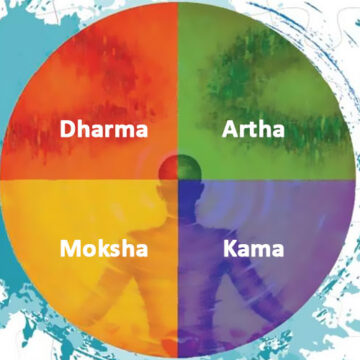
In this article, Rohan Raghav Sharma talks about degeneracy and blind gratification of carnal desires becoming the norm in the West and all modern societies inspired by the West, and suggests that the Hindu framework of the four Purusharthas - Dharma, Artha, Kama, and Moksha; can provide guidance for a balanced view of life.