
If you see a lone plant in a pot, it hardly matters whether it is a weed or a rose; whether you uproot it or water it might not matter much. But if the weed is among several roses, uprooting it would benefit the rose plants. This is dharma, protecting the cycle in nature. Such fascinating analogies from the book explain complex terms like ‘dharma’.
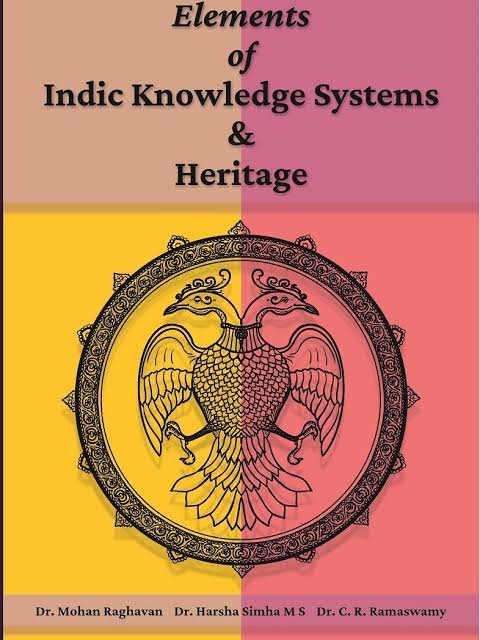
The book, ‘Elements of Indian Knowledge Systems and Heritage’ by Dr. Mohan Raghavan, Dr. Harsha Simha M S and Dr. Ramaswamy C R, consists of four chapters namely cycle – 0, cycle – 01, cycle – 02 and cycle – 03.
Gratitude
The book begins with a token of gratitude to the divine couple Sriranga Mahaguru and Vijaylakshmi Srimata. It places itself as an attempt to contribute to SamiKSHa (Sriranga Model of Indian Knowledge Systems and Heritage)
Cycle – 0: The Central Theme in Indic Heritage
The cycle begins with a happiness chapter. It highlights how our favourite things make us happy and even good memories, not just things, make us feel good. But Indic thought introduces a perennial source to achieve a state of ultimate bliss.
This is the fourth state, or Samadhi, other than the three commonly known states of sleep, awake and dreaming. The book has a special element called ‘class activity’ to explain the concepts practically. The third chapter presents a very fascinating activity to describe the concept behind the word ‘gy’.
If one is asked to blindfold one’s eyes and stretch the palm, and then an object is put on it, he or she traces the object with fingers, unaware of what it is, the face would have a certain anxiety or curiosity, but the moment one realizes that it is an apple or a ball, a spontaneous smile appears, this eureka moment, in Indic thought, is called ‘gy’. Words like pragya, gyan, vigyan are further derivations of this root word. This cycle – 0 ends with a beautiful illustration distinguishing between yoga and bhoga.
Cycle – 01: The Cycles of Life: Within and Without
The cycle highlights the existence of cycles in nature. Elements in nature like air, sun, moon, nitrogen and various physical processes in the body like digestion and respiration all work in cycles. Even our emotions work in cycles, where all emotions come to shanta rasa at the end. This natural cycle is called rtam-satyam. Dharma is all about protecting this rtam-satyam.
Almost all other civilizations other than India have known three states sleep (sushupti), awake (jagrat) and dream (swapna), but Indic thought refers to the fourth state, turiya or samadhi. Even modern science supports this state of bliss. Though already mentioned in cycle- 0, the fourth state is described in detail here.
Cycle – 02: Involution, Evolution and Cross Personal Cycles
The book moves ahead and distinguishes between Gyan, Karm and Bhakti Yog. The Gyan yog refers to stopping identifying with ‘I’. Karm yog involves giving stimulus to the mind, like chanting a mantra or a certain pattern of breathing, i.e. pranayama. Bhakti yog is a special case of karm yog. It aims for detachment from the senses while acting. Bhakti accepts that attachment for his or her beloved is so great that one’s actions are all done for the benefit and pleasure of the beloved. Thus his or her identity or I–ness becomes one with the beloved.
A person enjoying the fourth state of unbounded joy is sthitpragy. Such a person develops eight gunas like daya (compassion) and anayasa (a lack of hyperactivity). Interestingly, the book talks about body language as well. “Just as the words are a spontaneous outpouring of the state of mind or experience, the body has its own language – the body language.”
The book explains the ‘guru-shishy tradition’ through the concept of a coupling agent; an interesting example mentioned in the book is of drowsiness as a coupling agent. If one person feels sleepy and yawns, after a while, the person facing him or her does the same. This is called a cross-personal cycle. When the coupling agent is an oral mechanism between the guru and shishy, the system is called ‘vidya’; in case of an aesthetic action like a mudra or a drawing, this mechanism is called ‘kala’.
Vigyan is all about preserving such cycles of vidya, kala and atmagunas. Science (understanding) and engineering (design) are components of vigyan, so it is basically science driven by dharma. After chapters on devtas, the book throws light on trigunas, i.e. rajas, tamas and sattva. Rajas is a stimulant, the tendency that impels us to act.
When rajas dominates our minds, we feel active, in fact, overactive and restless. Tamas is the opposite of action; it restrains or opposes action; its dominance causes one to be heavy, dull and listless. Sattva is balance or peace. Given an example of riding a bicycle, the stationary position of the bicycle is tamas, the motion is rajas, while the tendency of balance is sattva. The three are complementary to each other; we cannot fall asleep and awake fresh without tamas.
Needless to say, the result of dharma is the preservation of natural order. Indic way of life is Santana dharma; santana is an adjective for liberal, social and faithful. On the other hand, a codified manual of dos and don’ts to protect is dharma shastra.
Cycle – 03: Institutions for Preservation of Cycles
The Indic civilisation has a way of life across three scales. The individual scale consists of the system of purusharthas and the system of ashramas. The second scale, ‘Family and Society ’, is a design required so that the work of each person protects and facilitates the cycles of the others while maintaining his own track. A common framework is required to bring society in a common pursuit. ‘Nation and society’ is the third scale; it consists of attempts to aggregate society into larger and larger units in a modular fashion. Thus every house has a chieftain, a small principality or state has a king, and there is a samrat or emperor to control several feudal states.
The book takes a very interesting and useful approach while talking about teaching methods or styles. It mentions three sorts of samhitas, which are prabhu samhitas, consisting of the Vedas and Upanishads that instruct as a king. Itihas and Puranas come under the category of mitra samhitas that teach as a friend. The third category is kanta samhitas that teach as a dear one. It has kavyas that teach by invoking rasas.
The pedagogy is further divided into fourteen vidyas and sixteen kalas; the fourteen vidyas are further divided into four vedas, six vedangas and four upangas described in dedicated chapters.
After a detailed description of brahmcharya, grahasthy, vanprasthy and sanyas, the book moves to an Indic concept of nitya karma or daily routine. Fascinatingly, the book mentions a karmyogi, the one who has experienced the state of gyan and performs the actions guided by the atmagunas. Such people may not have really studied the shastras conventionally, but their actions become shastras.
It is pathetic to see kids today say Diwali is celebrated in October or November and Holi in March, without realising that this calendar they refer to is Gregorian, while the festivals in their culture follow a calendar that is just as logical and scientific.
Even after such a sophisticated system to maintain dharma or way of life, some imbalance is expected, and here comes a provision for corrective measures. Such corrective measures are called samskaras. Out of the sixteen, the first three are done before birth, the next four in infancy, two in childhood, and the last one at the end of life.
Aesthetics and Entertainment
People naturally look for relaxation, enjoyment and sensual indulgence; however, this can be a slippery slope. Hence, the response of the Indic Civilisation to this need is to create the Natyashastra as the fifth Veda, fashioned out of the four Vedas, inner states of yoga and conducive to the ideas of life, the purusharthas, led by dharma. It satisfies the base cravings of the common populace but demonstrates an ideal template for such enjoyment. The book further highlights the concept of devalaya, tirtha, enlisting fourteen tirtha kshetras.
The Indic spirit behind the institution of a king or raja and his rashtram or kingdom is very unique. Raja is himself associated with light; thus the king is one who is lustrous, in the image of devas.
Towards the end, the book depicts Bharat as personified divinity – two river systems, mountain ranges and tirthas kshetras. The book finally ends with a summary called ‘epilogue’ and several problem statements for bringing the concepts into practice.
In a nutshell, this beautifully crafted book on the Indian Knowledge Systems and Heritage is a tool to guide the readers with how to keep the cycle or rtam styam moving for the welfare of the world not just people of a nation or a religion.
Leave a Reply