
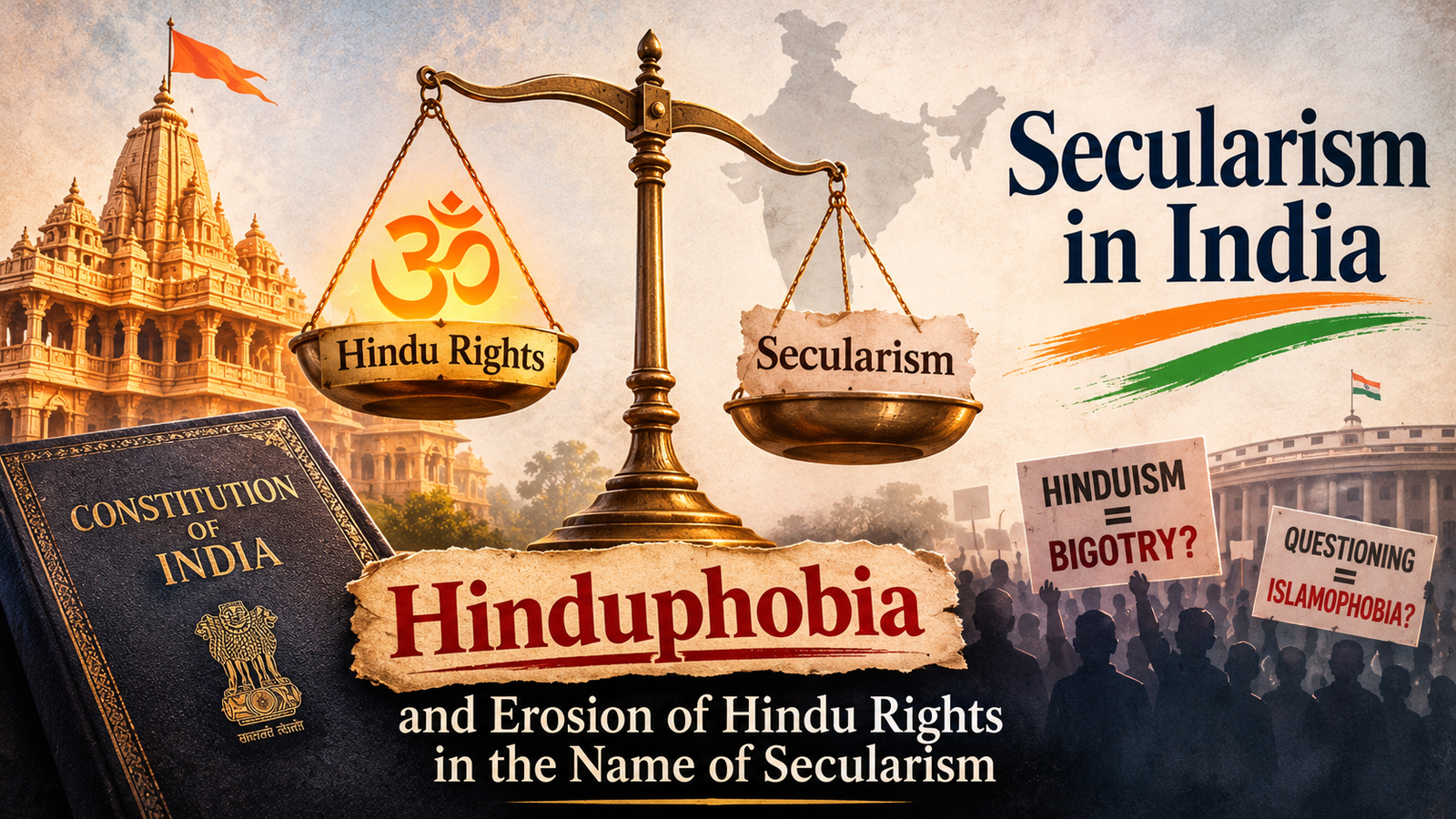
In recent months, my essay-series on the politics of minority-progressive-celebrities (MPCs) led to some interesting conversations with friends, insightful feedback from elders, and a few general comments. These gave me much to think about but not as much that would change my mind. However, the arguments my interlocutors advanced bothered me even after the conversations were done–not because of their merits but the assumptions that underlay them. To me these assumptions represented the deep ruts that the communalism issue in India remains confined to–ruts that have stranded it in an unhelpful, disharmonious place.
Particularly frustrating to me was the fact that while my arguments were based on research, analysis, and supporting evidence–not to mention a massive commitment of time–the ‘secular high ground’ was often claimed on the back of passive media consumption, hackneyed generalizations, and personal anecdotes.
This tendency puzzled me initially; but I quickly came to see that the tendency itself was key to understanding the communalism-debate lockjam. What I was receiving as feedback from these friends–all much smarter people than me–were ‘conditioned responses.’ Being high-achievers with busy lives they didn’t have the time or inclination to research these issues by themselves, so they fell back on ideas imbibed through the education system and reinforced by cultural institutions. But India’s political and intellectual life post-Independence was hardly objective, diverse, or robust–it was entirely dominated by the Congress Party and the Left. Needless to say, these conditioned-responses that pervaded public life were designed to serve those particular political interests. Ideology, by definition, tries to keep broader perspectives and contrary views out of the debate. This is what creates the deadlock: no new information or perspective is allowed into the discussion. Placed in a broader perspective, however, these conditioned-responses start to fall apart.
‘Islamophobia?’
While no one I interacted with accused me of anything as odious, an unease about my motives seemed to hover in the background. This isn’t surprising because, in some circles, calling out minority celebrities and supposedly secular discourse are sufficient grounds to label a Hindu a bigot. The irony that pointing out Hinduphobia – as my essays did – is equated with Hindu-chauvinism wasn’t lost on me but it certainly is lost on some people. A further irony that went unmentioned was that minority members calling out Islamophobia (or any other bigotry) or just railing against Hindutva are not only deemed victims but also secular!
Being an Indian who cherishes the idea of a composite nation where religions, communities, ethnicities, cultural strands, languages, and regional identities coexist on the basis of mutual respect, this suspicion about my motives left a bitter aftertaste. Even so, I stand by my view that genuine respect is never one-sided and that the post-Independence discourse–which expected Hindus to be respectful without receiving any respect in return–was elitist and unfair.
The central thesis of my essay-series was that Independent India’s ‘secularist discourse’ and the minority-progressive-celebrity (MPC) activism that piggybacked on it were Hinduphobic and provided cover for minority fundamentalism. Nowhere does this imply widespread fundamentalism amongst minorities or insinuate any relative shortfall in patriotism. What it does not shy away from stating though is that while the ‘secular’ Hindu is expected to condemn the tiniest whiff of Hindu fundamentalism, the ‘secular’ Muslim routinely denies or diminishes the threat of Islamic fundamentalism while chiming in on any whiff of Hindu extremism. This ‘smell-test’ mentality has resulted in a hound-like hypersensitivity amongst ‘secular’ Hindus, ‘secular’ Muslims, and ‘progressives’ that has them sniffing fundamentalism in everything Hindu! Some bizarre conclusions result from such thinking.
One such is the assertion that Hindu fundamentalism is the greatest challenge to India’s integrity and national security. In truth, Islamic fundamentalism is the far greater threat -: a conclusion even someone who personally rejects majoritarian, minoritarian, and ‘progressive’ fundamentalisms can reasonably come to. After all, this particular ideology led to the Partition and the holocaust that followed, it still animates the politics of Pakistan and Bangladesh, and now finds supporters in globalized Islamic radical movements. Similarly, fundamentalism in smaller minorities and the resultant social and security problems are also legitimate concerns for the Indian state, especially if they involve collusion with foreign governments or entities.
The solution to the communal issue, in my view, is not a binary choice between majoritarianism or performative ‘secularism’–or appeasement by another name–but rigorous evenhandedness: a situation where a harsh view of Hindu extremism is taken but equally harsh gazes are trained upon extremism in other communities. When such even-handedness is absent in political or popular cultural contexts it is rational and necessary, not chauvinistic, to call it out. At the same time, terming it ‘chauvinism’ in order to intimidate and suppress dissent from the prevailing version of ‘secularism,’ is itself a chauvinistic act.
The wide use of such tactics today is worrisome because appeasement-as-secularism has historically encouraged, not deterred, Islamic separatism. In its pre-Independence iteration, the Congress and its leaders like Gandhi and Nehru made desperate attempts to appease but were still deemed ‘too Hindu’ to coexist with. And even if the post-Independence emphasis on ‘Hindu accommodation’ is explained away as idealistic, it is abundantly clear that these secular ideals quickly degenerated into appeasement due to ideological excess and electoral cynicism. ‘Secular’ ideals soon became a smokescreen for promoting Hindu disunity, for the State interpreting and interfering antagonistically in Hinduism (in the name of ‘social reform’), and for creating minority vote-banks. The coupling of this discourse with the Muslim elites’ eagerness to pile-on to this project explains many present-day Hindu resentments and the tectonic political shifts of recent decades.
In fact, for much of the post-Independence era the traditional political media, and academic ‘elites’ hubristically believed they could suppress all discussion of appeasement. To this day, these elites make excuses for the hostile acts of minority fundamentalists such as anti-India sloganeering, hate-crimes, and hate-speech. They also normalize Muslim-League-like rhetoric for ideological or political gains. These are not mere signs of an ideological inclination but an elaborate propagandist attempt to suppress the Hindu voice–a propaganda project more Gobbelesian and dystopian than any project the Indian Right has mounted.
These Left-leaning elites would have been wiser–and consequently closer to power today–to have allowed Hindu grievances more space and to have accommodated them in some measure. Instead, their approach, which reeked of cynicism and undemocratic intent, was to gaslight the majority community into silence. Works that question this agenda–including my essays–are not merely a rejection of this elitist approach but an invitation to a fairer, more honest discussion.
So long as Hindus objecting to Hinduphobia continue to be branded Islamophobic (or some other phobic) we may take it as evidence that this elitist gaslighting carries on. Given that this name-calling carries on, let us ask what it is that these elites ask of Hindus. They ask that Hinduism be singled out for criticism, that Hindus not contest misinterpretation of their religion and heritage, and that they accept ‘secularism’ as a duty while all other communities demand it of them as a right. It seems to me that a person who believes such expectations to be reasonable is the one truly deserving of the label ‘bigot.’
Prejudice Against Islamic Influences on Indian Culture
In a recent article I pointed out that the film Dhurandhar celebrates Islamic influences on Indian culture even as it remains unapologetically nationalistic. That the film was labeled Islamophobic–for the crime of depicting Pakistan’s malevolence towards India and its weaponization of Islamic radicalism–reveals a great deal about how this ideology works. Few instances of ‘secular’ discourse invoking ‘Islamophobia’ to defend extremists are more blatant. Given that Bollywood celebrities and the industry as a whole have traditionally favored appeasement-friendly political parties, we can call out this ‘Islamophobia’ labeling for what it really is: a propaganda attack.
The term ‘hegemony’ helps to understand this better. In the context of culture and ideology ‘hegemony’ refers to elites passing off their interests as the interests of society. Bollywood elites–and their media environment–are no different: they seek to pass their interests off as public interest. This elite, along with its political patrons, is heavily invested in appeasement messaging. Bollywood, in recent years, has faced challenges from South Indian cinema and appeasement-rejecting Hindi cinema. At the same time, their own films have failed in significant numbers.
This signals a move away from its content and, therefore, its revenue models. These models depend on Pakistani audiences, the Pakistani diaspora, and Persian Gulf audiences as markets. This is why these Bollywood barons, who claim to be India’s ‘soft power,’ are eager to pander to these foreign markets–for profit. They show little concern about their content running contrary to India’s geopolitical interests in the process. So how do the elites push back when on the backfoot?
The ‘Bollywood barons’ pass off their crisis as a crisis of ‘Indian identity.’ That is, they generate hegemonistic propaganda to reestablish Bollywood’s usual themes and stars. A prime example of this is the suggestion that rejecting Bollywood’s themes and embracing anti-appeasement content is a sign of Islamophobia–in fact, even an attempt to qualify or contextualise acceptance of Islamic influences on Indian culture attracts the charge of Islamophobia. They will have us believe that this phobia can only be remedied by embracing Bollywood’s themes, models, and ideology as a whole. But shouldn’t we ask why cultural appreciation cannot be more nuanced?
What, for instance, prevents one from appreciating the beauty of Mughal architecture or Urdu poetry without pretending–as Bollywood does–that Mughal-period excesses did not occur? Similarly, appreciating Javed Akhtar’s lyrics in Jodha Akbar need not prevent one from swatting aside some of his claims about the Mughals with disdain. For instance, Akhtar proclaims Akbar and Jehangir to be so liberal that they did not convert their Rajput-princess wives to Islam. Akhtar’s shallow reasoning goes like this: he claims that no mausoleums exist for Rajput Chief Consorts of Mughal emperors; that, he concludes, is proof that they did not convert.
In truth, both queens were buried in masoleums–Akbar’s queen, Mariam-uz-Zamani’s, mausoleum survives and is a popular tourist attraction; and ample textual evidence of Jehangir’s queen Jagat Gosain’s mausoleum and its sad fate also exists. What is genuinely nonexistent is evidence that the queens were allowed to remain Hindu. The very academic and literary elites, who even demand material proof for Hindu beliefs about Lord Ram, are eagerness personified when peddling such fairytales about their Mughal heroes. But, once again, why must one believe such misleading assertions in order to appreciate music, art, and poetry? Whom does it benefit to frame this as an ‘either/or choice’ between despising Islamic influences or accepting Bollywood on its own unreasonable terms?
No prizes for guessing that it is Bollywood elites, their adjacent media system, and their political patrons. Therefore, they demand that Bollywood’s themes, revenue models, and people must be affirmed in order for one to be deemed ‘secular.’ Or is the word ‘tolerant?’ The time for such blind adherence is certainly past, but Bollywood appears blind to the damage it’s doing itself by insisting that its works can only be appreciated in one ideological context: it doesn’t seem to grasp that this is an admission that its works are propaganda pieces.
‘They’ll think you’re a BJP guy!’
This warning from a well-meaning friend pretty much summed up the shame and guilt ‘polite society’ attaches to support–real or imagined–for the Bharatiya Janata Party (BJP). I have no particular interest in defending the BJP but would like to ask what political alternative is available to any Indian Hindu who feels ‘secularism’ is being misused to target Hinduism?
While Nehru’s paranoia about ‘Hindu revivalism’ in Independent India is well-known, concern about the ‘Hindu sentiment’ wasn’t always absent in ruling circles. Even in Nehru’s years, his conservative contemporaries occasionally managed to moderate some of his policies. Nehru’s Congress-party successors like Indira Gandhi, Rajiv Gandhi, and P.V. Narasimha Rao also feared antagonizing Hindus as a whole. Over the past three decades, however, such subtlety has become anathema to ‘secular’ parties and ‘secular’ people. Simultaneously alarmed by the rise of the BJP and smug about their control over discourse, their disregard for the Hindu identity increasingly grew openly brazen.
Consider the instance of the Ram temple at Ayodhya. The temple was constructed as a result of a protracted judicial process. Despite the vandalism involved in the Babri Masjid’s demolition, all parties–political and nonpolitical–agreed to accept the Supreme Court’s verdict. But to this day, ‘secular’ leaders like Rahul Gandhi and Akhilesh Yadav refuse to visit the temple for fear of alienating their Muslim votebanks. The extent of the shift in the Congress’s position is even starker when one considers that it was Rajiv Gandhi who allowed shilanyas to be performed at the disputed site, that too in order to offset Hindu anger at Muslim appeasement in the Shah Bano case. So, what makes his political successors willing to alienate the Hindu vote in a Hindu-majority country while being so fearful of alienating the minority vote?
So-called secular parties have long come to power by consolidating minority vote-blocks and heightening divisions amongst Hindus. The anti-Hindu rhetoric and stances have yielded results for them–even if these were in past times with severe media limitations. That being the case, what political option is left to anyone concerned with the protection of Hinduism other than the BJP?
Hinduism=Hindutva=RSS=BJP
As a South Indian Hindu who only heard of ‘Hindutva’ in his teens–in the context of the Ram Janmabhoomi issue–the notion that Hinduism equals Hindutva is laughable. Besides, Hindu thought influencing political ideas is hardly a RSS-BJP invention. That history is deeper and richer, being one that includes Gandhi, Sri Aurobindo, Lokmanya Tilak, Bankim Chandra Chatterjee, and many others.
Even today, politically-aware Hindus are hardly a monolithic group. Many sections of Hindu society strongly differ with the BJP on issues like civilizational revival, perspectives on history and society, the role of the minorities, economic policy, and a host of other core issues. What drives their support for the BJP is not necessarily a positive identification with the party but a sense that the BJP, unlike other parties, is not anti-Hindu! All an opposition party needs to do in order to appeal to the ‘Hindu vote’ is to reject appeasement and embrace nationalism.
That should be simple enough. But the fact that opposition parties refuse to accommodate even these to win over Hindus reveals the extent of their alienation from Hinduism as an identity. So why should any concerned Hindu trust political parties that wear ‘minority appeasement’ tags as badges of honor but recoil with terror at the mere mention of ‘soft-Hindutva?’
‘BJP is giving Hinduism a bad name’
An odd but consistent complaint is that media coverage of the BJP’s ‘Hindu-Nationalism’ hurts the perception of Hinduism overseas. My first response to such a statement is to point out that labeling an entire culture and religion based on one party’s ideology is itself bigoted. I then ask why Sri Lankan or Myanmarese strife doesn’t affect Buddhism’s pacifist image–even Japan’s World War Two record didn’t achieve that! One might also wonder why mentioning radical Islam’s terror-connections is prejudice while tainting Hinduism is considered ‘liberal.’ And finally, I wonder why Indians take upon themselves such ill-informed and motivated opinions as though they were standards to live up to?
The bulk of these impressions are generated by Indian and Western media houses, think tanks, and other ideologues. Most Indians are quite aware of Western bias but display a strange paradox in their responses to it: they aggressively call it out in matters of national security but pretend no bias exists when it comes to Hinduism.
On a more positive note, there is greater understanding in India now about how global powers use information strategically. How they generate negative stories, quote them incestuously and incessantly until it saturates the media space. And then they use that perception for geopolitical leverage.
This method’s paradoxes are everywhere. For instance, the Western media doesn’t attach negative labels to the Congress party for the 1984 anti-Sikh riots while it applies them to the BJP. It also doesn’t attribute zealotry or dictatorship to the Pakistani military, which has subverted democracy altogether and talks of waging jihads. These examples by themselves should convince Indians to disregard programmed foreign perceptions. They should be able to recognize them for what they are: propagandist interference in their political system.
‘Indian politics were secular until the rise of the BJP’
What one is really referring to is a time when the Hindu voice was excluded from formal discourse. It is difficult to fathom how people can make such statements seriously having grown up in the 1980s and 90s–having watched desperate national-integration pleas like ‘mile sur mera-tumhara,’ saw a bloody insurgency bring Punjab to the brink, grieved an assassinated Prime Minister, witnessed the horror of the 1984 anti-Sikh riots, saw Kashmir and the Northeast caught up in insurgencies with religious angles, rumblings of Tamil nationalism echoing off of Sri Lankan separatism, and social crises like Mandal and Mandir pull the social fabric apart?
So, is ‘secularism’ in danger only when the Hindu voice is expressed and not when minorities express themselves? And what explains such rampant minority separatism or sectarianism in the pre-BJP ‘golden age of secularism’ when India remained, with an exception of two years, virtually a one-party democracy at the Center?
The answer–apparent to all but those who refuse to see–is, quite simply, communal politics. The Punjab issue makes for an excellent example. Significant evidence now shows that the Punjab crisis was, in large part, the result of the Congress’s ploy of propping up the radical Bindranwale to break the Akalis’ hold over the Sikh-vote. The move backfired, spiraled into violent secessionism, and then became a national crisis. A well-reasoned analysis also suggests that the Congress then tried to cash in on Hindu insecurity in Punjab and Haryana–communal politics once again. The Assam issue, similarly, has a sharp communal angle–as politics in Eastern India do even today–with illegal immigration from Bangladesh being misused for political purposes. Other communal issues were also in play in the Northeastern states and especially in Jammu & Kashmir. By 1989, Kashmir was in full-blown crisis. Even the Tamil-nationalism issue in Sri Lanka affected Tamil Nadu politics and created security concerns–it would ultimately result in the assassination of former-Prime Minister Rajiv Gandhi.
These few examples should put to rest any claim that ‘communal politics’ was a post-1980s phenomenon. In fact, minority religious extremism and its political manipulation have always been a part of Independent India’s politics. It is equally important to dispel the notion that ‘Hindu sentiment’ was not a factor in Indian politics until the rise of the BJP.
In the early years of freedom, stalwarts like Sardar Patel gave voice and space to some Hindu concerns. Indira Gandhi’s intuitive understanding of Hindu sensibilities even drove her to give Nehru a Hindu cremation disregarding his express wishes to have a ‘secular’ ceremony. Indira Gandhi also used her personal religiousness to garner Hindu votes in the post-Emergency period. Rajiv Gandhi’s concern about the Hindu vote was reflected both in reported secret meetings with the RSS in the 1980s and his decision to pacify Hindu anger over Muslim appeasement by allowing shilanyas at the Ram Janmabhoomi site. Even P V Narasimha Rao reportedly sought to wean Hindus away from the BJP and back into the Congress fold. These instances make the point at the national-level, while numerable state-level communal tensions and riots long before the BJP attained its 1990s dimensions make the case at state-levels.
The Congress’s engagement with Hindu sentiment was largely an attempt to diffuse pent-up Hindu anger and prevent the emergence of a ‘Hindu- vote.’ Even so, it represented a degree of engagement. The anger over Shah Bano and the support for the BJP’s Rath Yatra indicates that Hindu resentment of this form of ‘secularism’ was already high and difficult to suppress.
These political forces were then let loose and define politics today in the post-Babri and post-Mandal era. The elites dropping any pretense to being centrist–that is, pretense at being secular–only intensified Hindu anger. The elites, for their part, went on to equate Hinduism with caste and other such absurdities.
This brand of politics, with active media and academia collusion, saw ‘secularism’ become equated with appeasement and the weaponization of caste against Hinduism. Whatever token space existed for the expression of Hindu issues in the ‘Left/Liberal’ sphere has now also been wiped clean: making it all the more clear that the ‘Hindu-vote’ had no place in ‘secular politics,’ only minority religious vote-banks did. With this ‘looney-Left’ takeover, a sizable section of practicing and liberal Hindus were giftwrapped and handed over to the BJP.
Conclusion
The objections discussed here reveal a pattern: questions about minority fundamentalism, cultural influence, Hindutva, and the history of Indian secularism are often met with labels rather than counter-evidence. To question the dominant narrative is treated as evidence of prejudice and to raise Hindu concerns as proof of partisan allegiance. Such reflexes shut down the very discussion they claim to protect.
To seek that the same standards of scrutiny apply across communities and political formations or to object to one community being expected to be endlessly self-critical while others are regarded as being beyond examination isn’t chauvinism, rather it is expecting society to be genuinely pluralistic. Yet, so deeply entrenched are these conditioned responses that otherwise intelligent people have internalised them.
The harm from this conditioning runs deep: It decides which questions can be asked, which histories can be discussed, and which political choices are deemed legitimate. In the second part, I turn to the deeper premises behind these responses: the reform agenda, claims of religious supremacism, arguments about the Constitution, and the authority to decide which voices count as intellectual or credible.
Leave a Reply