
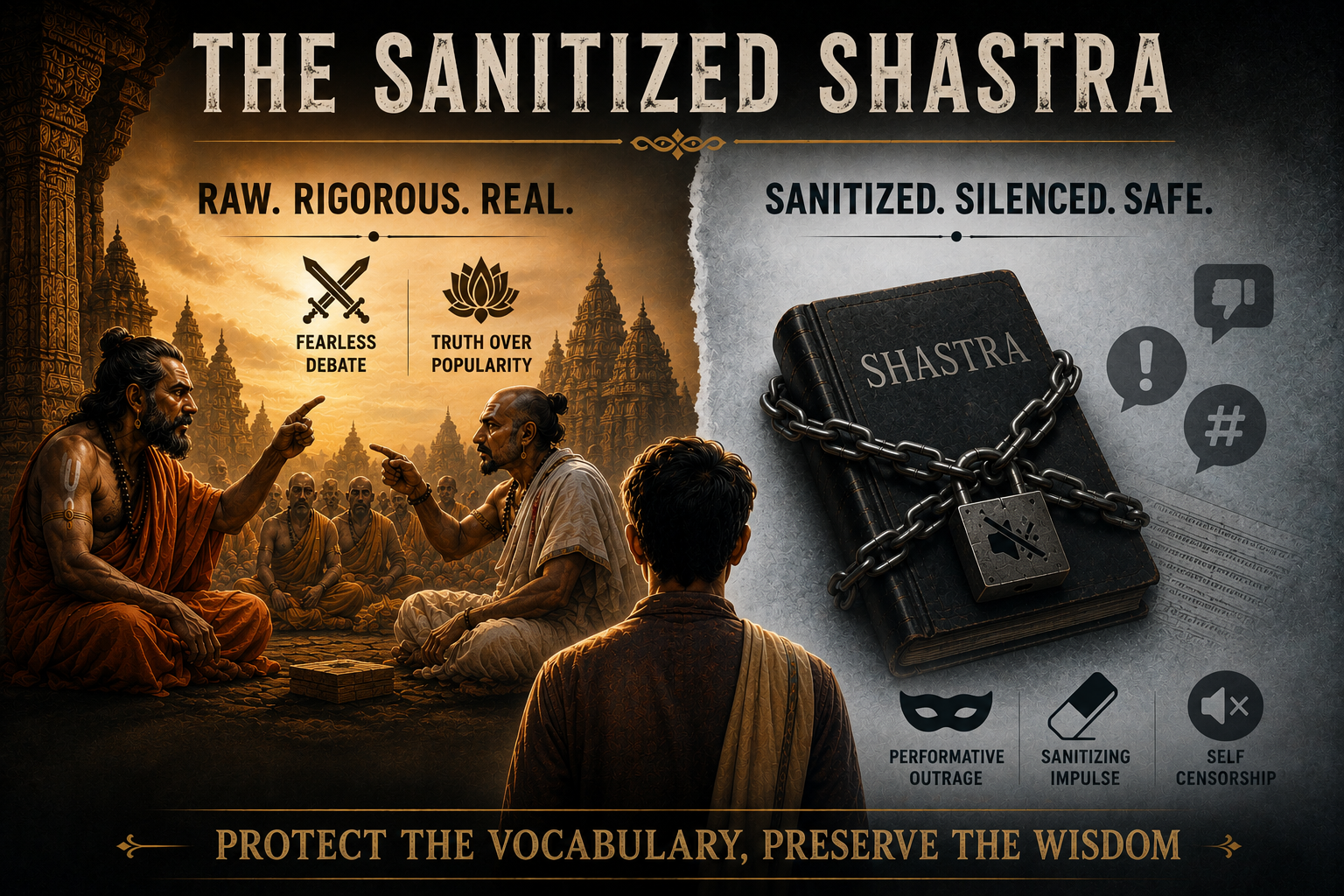
A recent storm in a teacup in the temple town of Udupi has laid bare a profound, existential crisis brewing at the heart of India’s intellectual revival – a crisis of civilisational confidence to use categories and vocabulary that it inherited.
During a cultural program hosted by a prominent Madhva matha, two young girls trained in the traditional art of Harikatha delivered a performance based on canonical texts. As generations of Madhva scholars before them have done, they described Sri Madhvacharya as having descended to restore the true understanding of Vedānta after it had been led astray by Śrī Śaṅkarācārya’s Advaita. Drawing from standard polemical frameworks within their sampradaya, they attributed Advaita’s nirguna theorization (which strips the Supreme Being, in absolute sense, of noble attributes) to Sri Shankaracharya’s “asura-bhava” (“demonic nature”), drawing directly from canonical Madhva texts.
The backlash was swift, loud, and thoroughly modern. Some followers of Sri Shankaracharya got enraged, took to social media, labelling the traditional discourse “defamatory” and “unparliamentary.” Panicked by the digital outrage, the host matha issued a hasty clarification, distanced itself from the performance, and pressured the young girls into a public apology. Predictably, the digital battlefield has since devolved into a toxic mudslinging match of mutual recriminations.
To the casual observer, this clash might look like a petty medieval feud spilling over into the 21st century. But to anyone invested in the survival and revival of Indian Knowledge Systems (IKS), this episode is a canary in the coal mine. It reveals how the forces of colonial morality, the performative outrage culture and the intellectual laziness that conflates social harmony with theological uniformity have penetrated our last standing traditional spaces.
The Raw and the Rigorous: Pre-Modern Polemics
To understand the tragedy of the Udupi apology, one must first understand how intellectual debates actually functioned in pre-modern India. For over two millennia, Indian philosophical schools did not survive by playing nice; they survived by fighting tooth and nail. Intellectual rigour was forged in the fires of uncompromising, unvarnished debate.
Within this ecosystem, trading sharp barbs, and even engaging in what modern eyes would mistake for personal abuse, was par for the course. The categorisation of individuals, not just ideas, into divine (daiva) and demonic (asura), based on the ideas they propagate, is found in the Bhagavadgita itself. The idea of asura in these contexts is not of a physical monster, but of spiritual danger. Most schools claimed the divine path for themselves and viewed their opponents’ doctrines as spiritually ruinous.
When Madhva scholars labeled their opponents “demonic,” or when Smartha-Shankara circles directed equally sharp polemics outward, calling Madhva teachings as equivalent to “cosmic toxin” they were operating within a recognised, high-stakes rhetorical framework. In fact, a popular video circulating on social media, whose authenticity hasn’t been denied by the concerned, shows an eminent Advaita scholar, decorated by the Shringeri Sharada Peetham, quoting traditional Advaita texts that compare Sri Ramanujacharya to the womaniser demon king Ravana.
To a modern observer, calling an Acharya “demonic” or comparing him to “Ravana” sounds like direct, malicious slander. But historically, these apparent personal attacks were understood as legitimate, dramatic boundary-markers. They were used to signal that the opponent’s darshana, if accepted, would lead the seeker to ultimate spiritual ruin. They understood that in an ultimate battle for truth, the language had to be raw and unvarnished. The intensity of the critique matched the gravity of the philosophical stakes.
The Double Threat: Public Emotionalism and the Sanitizing Impulse
Why, then, are these ancient terms causing such fragile meltdowns today? The answer lies in how modern socio-political constructs have corrupted our relationship with our own inheritance.
First, we have imported the thin-skinned emotionalism of modern electoral politics into the sacred realm of ideas. Just as political factions amplify minor gaffes into existential threats for electoral gain, religious groups now weaponise ancient theological debates and inconvenient vocabulary to build digital cartels of outrage. Metaphors are flattened into “hurt sentiments,” and rigorous philosophy is degraded into identity politics.
Second, and far more dangerously, this outrage culture feeds directly into a prominent strand of the Western Indological project: the “sanitising” of Indian traditions. For decades, academic Indology has viewed Indian texts, such as the Dharmashastras, through a highly selective, reformist lens—cherry-picking passages, de-contextualising them from their metaphysical frameworks, and demanding they be canceled based on modern sociological categories.
Instead of rejecting this shallow, external framework, traditional circles are succumbing to it. To protect themselves from being labeled “backward,” “discriminatory,” or “offensive” by the arbiters of modern political correctness, traditional institutions are choosing pre-emptive surrender. They are actively sanitising their own traditions, erasing the sharp edges, and sweeping uncomfortable polemical history under the rug.
Targeting Ideas vs. Persons
One may argue that we can continue intellectual debates without making them personal. But the point is, they were never personal, in the modern sense, to begin with. Confusing the traditional rhetoric of daiva and asura with the modern category of defamation or the Western construct of blasphemy is a category error.
The fact that the followers of the three major schools of Vedanta, i.e., Dvaita, Advaita, and Vishistadvaita, have engaged in rigorous, unsparing refutations of one another for close to 800 years without disrupting their shared social fabric is a testament to the intellectual maturity of these traditions. Traditional memory recalls that great medieval scholars like Sri Vijayindra Tirtha of the Dvaita Sampradaya and Sri Appayya Dikshita of the Advaita Sampradaya debated vehemently against each other’s positions using the sharpest possible vocabulary, all while maintaining cordial, deeply respectful personal relations. They fought like tigers in the assembly of debate, but sat as peers outside it. The hallmark of Indian civilisation has historically been civilisational unity in spite of philosophical diversity, and social harmony coexisting with intellectual warfare.
The jump from avoiding “personal” remarks to avoiding traditional debates altogether is a short one. After all, the same logic of “hurting sentiments” applies to ideologies as well. Consider the Saguna-Nirguna debate at the heart of the Dvaita-Advaita discourse. Calling the Supreme Being Nirguna (attribute-less) in an absolute sense is a strict taboo according to the Dvaita worldview, akin to what might be called blasphemy in Abrahamic religions. Does it mean that all Advaita discourses are therefore blasphemous or defamatory? How, then, does one differentiate a theological stance from a personal remark?
Furthermore, whether ideas possess an independent ontological existence from the person propagating them is a serious philosophical question in Indian traditions. Some schools of thought equate the idea directly with the person, completely blurring the boundary between an intellectual war and a personal one.
Finally, because Indian philosophical schools typically seek systemically closed frameworks, their ontologies cannot exclude a discussion on the nature of the individual soul. Thus, while insulting a living opponent across a debate table is uncivil, utilising the traditional vocabulary of daiva vs. asura to describe original thinkers or authors is simply how these traditional systems operate. By ignoring this, we will force an artificial, polite uniformity onto our traditions, killing the very mechanism that made them robust.
The Great Flattening
The immediate casualty of this category error and defensive posture is India’s greatest intellectual asset: its pluralistic rigor.
If we decide that no school can criticise another, or that equating an opponent to Ravana is “unparliamentary,” we destroy the internal dynamism of all schools. If we continue down this path of sanitisation, we will be left with a bland, homogenised, “interfaith-style” spirituality entirely devoid of philosophical muscle. It will be a Disneyfied version of Sanatana Dharma: all sweet sentiments, zero intellectual substance.
We already see the logical end-point of this sanitising agenda in political movements where traditional narratives, such as Vamana defeating Bali or Durga slaying Mahishasura, are challenged as “discriminatory” to the losing side. When we allow modern identity politics to dictate how we interpret our epics and philosophies, we lose the capacity to understand them at all.
Reclaiming the Authentic Mind
If Indian Knowledge Systems (IKS) are to be truly revived, not as dead museum exhibits, but as living, breathing traditions capable of addressing contemporary global challenges, we must rescue them from both Indological sanitisation and the stifling grip of modern political correctness.
Our ancestors were not fragile. They did not need safe spaces, trigger warnings, or institutional apologies to survive a debate. They argued passionately, sometimes brutally, because they believed that the pursuit of truth mattered above all else. But civility cannot demand that living traditions renounce the conceptual language through which they have parsed truth and error for centuries.
While modern civic spaces, such as universities, corporate offices, or political rallies, may have to abide by modern sensibilities, it is time for our traditional mathas, scholars, and artists to embrace traditional vocabulary and stop apologising for the raw, unvarnished diversity of our civilisation. We must reclaim the right to disagree, to debate, and even to intellectually offend one another in the pursuit of higher knowledge. Only then can IKS regain its authentic vitality, free from the sanitising filters of a colonised imagination.
A civilisation confident in itself does not preserve its heritage by domesticating it. It preserves it by allowing its traditions to remain intellectually alive, even when they challenge one another in language that modern ears find uncomfortable. The real question raised by the recent events in Udupi is therefore not whether a traditional Harikatha was offensive. It is whether India still possesses the confidence to let its own civilisation speak without first asking permission from the moral vocabulary of the present.
Leave a Reply