
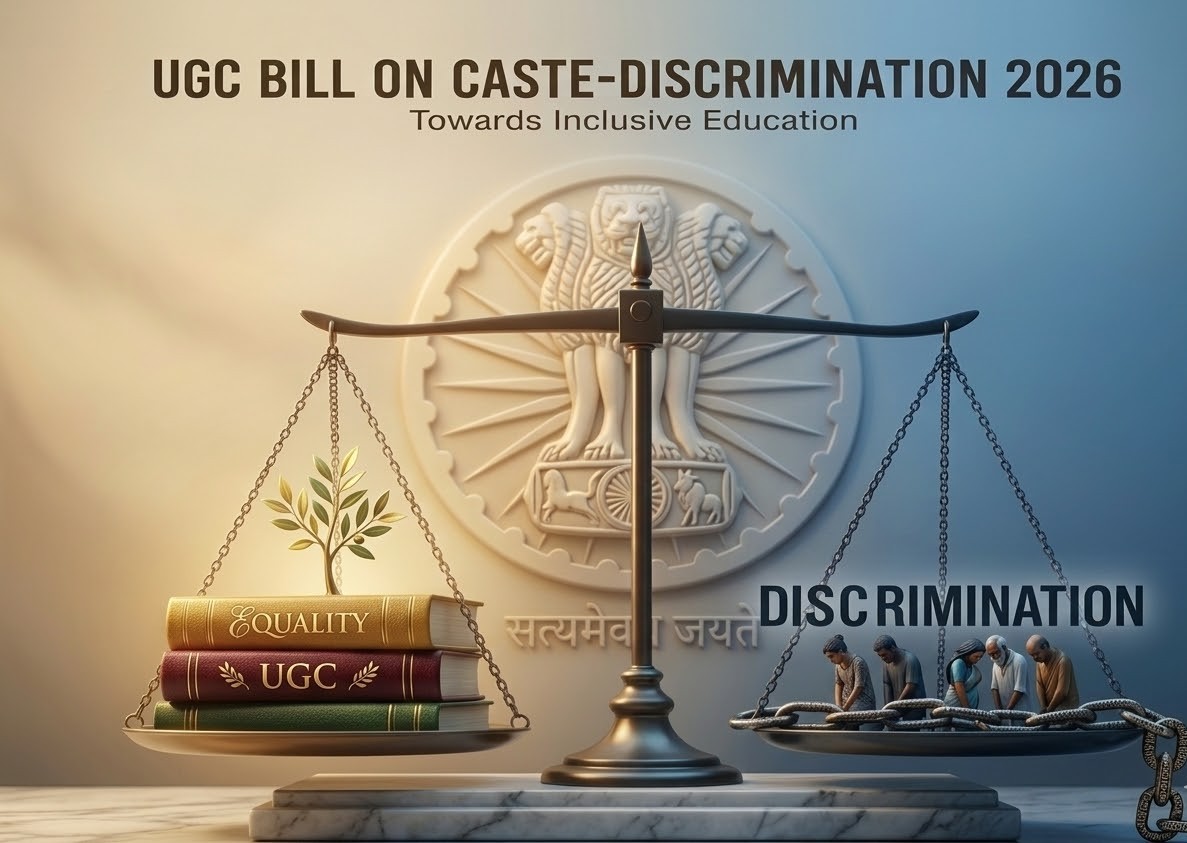
“The Road to Hell is Paved with Good Intentions”
The debate around the recent UGC regulations in India has largely remained trapped within immediate political reactions. Supporters and critics are mostly arguing over intentions, outcomes, and party interests. What often goes missing, however, is a deeper examination of the intellectual structure that allows such regulations to be imagined, justified, and institutionalised in the first place. To understand the UGC regulations properly, we must move beyond surface politics and look at the social theories that shape policy-making today.
Modern social theory has long functioned through binaries. From Marx’s division of society into the “haves” and “have-nots”, to colonial theory’s coloniser versus colonised, and later feminist and racial theories that operate on oppressor and oppressed frameworks, the simplification of social reality into opposing camps has been a recurring method. Historically, these binaries were never fully accurate. Social relations were always complex, layered, and often contradictory. The work of intellectuals was to “complicate and/or dismantle the reductive formulae” as noted by Edward Said arguing “it would seem to be a vital necessity for independent intellectuals always to provide alternative models to the reductively simplifying and confining ones”, in the 2003 Preface of the very famous Orientalism (Said xvii-xviii). Yet binaries survived because they were useful. They made society legible and, more importantly, mobilisable.
From the mid-twentieth century onward, various strands of continental philosophy and social theory began to challenge grand narratives and universal claims. Over time, these intellectual developments fed into what is now broadly described as critical social theory.
The term “Critical Theory” is often used loosely today, but historically it refers to distinct intellectual traditions that do not fully overlap. The early Frankfurt School, associated with thinkers such as Max Horkheimer, Theodor Adorno and later Herbert Marcuse, sought to analyse how capitalism, mass culture, and bureaucratic rationality reproduced domination even within formally democratic societies. Their project remained rooted in a Marxian concern with ideology and material power, and they retained a normative commitment to emancipation grounded in reason and critique.
By contrast, later poststructuralist thinkers such as Michel Foucault and Jacques Derrida were sceptical of grand historical narratives and suspicious of universal foundations. Rather than focusing primarily on economic structures, they turned attention toward discourse, knowledge, and the subtle, dispersed operations of power within institutions and everyday practices. While the Frankfurt School aimed to unmask ideology in order to recover the possibility of rational emancipation, poststructuralists often questioned whether such universal emancipatory grounds could be secured at all.
Despite these differences, both traditions converged on a crucial insight: power is not merely located in the state or in overt coercion, but embedded in social structures, cultural forms, and systems of knowledge that present themselves as neutral. It is this expanded understanding of power that has profoundly shaped contemporary academic discourse and laid much of the conceptual groundwork for present debates around identity, privilege, and structural inequality.
Interestingly, some of the major thinkers associated with postmodernism were themselves critical of rigid binaries. Yet their concepts and terminologies have often been mobilised in support of contemporary identity politics. One such figure is Michel Foucault. Foucault is frequently invoked for his influential analysis of power and social institutions, but he was equally sceptical of what he described as “dividing practices”. As Paul Rabinow notes at length:
“The most famous examples from Foucault’s work are the isolation of lepers during the Middle Ages; the confinement of the poor, the insane, and vagabonds in the great catch-all Hôpital Général in Paris in 1656; the new classifications of disease and the associated practices of clinical medicine in early-nineteenth-century France; the rise of modern psychiatry and its entry into the hospitals, prisons, and clinics throughout the nineteenth and twentieth centuries; and finally the medicalization, stigmatization, and normalization of sexual deviance in modern Europe.
In different fashions, using diverse procedures, and with a highly variable efficiency in each case, “the subject is objectified by a process of division either within himself or from others.”” In this process of social objectification and categorization, human beings are given both a social and a personal identity. Essentially “dividing practices” are modes of manipulation that combine the mediation of a science (or pseudo-science) and the practice of exclusion-usually in a spatial sense, but always in a social one. These dividing practices form a substantial part of the subject matter of Foucault’s earlier books, Madness and Civilization and The Birth of the Clinic, as well as later ones like Discipline and Punish.” (The Foucault Reader 8).
This critical notion towards ‘dividing practices’, might have come to Foucault through a direct engagement with the French Communist Party, where he realised something uncomfortable, as highlighted by Yascha Mounk,
“In 1950, Foucault joined the French Communist Party, which was unquestioningly loyal to Joseph Stalin. Unlike many of his contemporaries, Foucault quickly chafed at the intellectual orthodoxy required to remain in good standing with his comrades. When Soviet papers blamed an imaginary plot of Jewish doctors for Stalin’s illness in 1953, inspiring a vile anti-Semitic campaign both in the Soviet Union and in the French Communist Party, Foucault found that he could no longer toe the line. “Over anyone who pretended to be on the left,” he would later complain, the party “laid down the law. One was either for or against; an ally or an adversary.” Henceforth, he would be an adversary” (Mounk 30).
Foucault was a complex figure, as most intellectuals are. They rarely fit into neat moral categories; their ideas often resist simple classification. Our engagement with such thinkers should therefore avoid romanticisation and instead remain critically attentive. Over time, however, certain strands of thought gained institutional dominance within Western academia, narrowing the space for sustained internal critique. With this in mind, let us return to the broader framework of critical theory.
One of the most consequential claims of critical theory is the idea that neutrality does not exist. If one is not oppressed, one is necessarily privileged and participates in the system of oppression. This framework radically alters how social interactions are interpreted. In American academia, this is visible in ‘White Studies’, where being white itself is treated as a position of inherent privilege and perceived oppressors. As explained by Pramod K Nayar,
“Postcolonial studies has encouraged, in the USA, ‘white studies’—the cultural history of whiteness. Based on the idea that whiteness constructs itself at the socio-economic costs of the minorities (especially Blacks), white studies foreground the ideological and political roots of white cultures.
Whiteness studies suggest that to deconstruct categories of ‘blackness’ it is necessary to highlight the construction of whiteness and to dismantle ‘white’ as a category” (Nayar 16).
This assumption encourages the scrutiny of everyday interactions between whites and people of colour, which are interpreted as occurring within structurally unequal contexts. Such a framework gives rise to what are described as “microaggressions”, where speech, opinions, and even unintended remarks are analysed for implicit harm. As a result, expression itself becomes suspect, contributing to what is commonly referred to as “cancel culture”. This development presents a tension within progressive traditions that historically defended expansive free expression. Yet this tension is not entirely new. Certain strands of critical thought, most notably Herbert Marcuse in his essay on “Repressive Tolerance”, argued that genuine tolerance may require the restriction of views deemed oppressive. Within such a framework, regulation is justified not merely in response to overt harm, but on the grounds that structural inequality itself renders certain forms of speech injurious.
What is equally worrying is how this theoretical shift has altered the very idea of academic institutions themselves. Universities were once imagined as spaces of critical thinking, where disagreement was not only allowed but encouraged, and where ideas were tested through friction. With the rise of concepts such as microaggression, and ‘Standpoint Theory’ this ethos has slowly weakened. The aim of intellectual life no longer appears to be the pursuit of truth, a notion already destabilised by early postmodern thinkers, but the production of safety. Academia now increasingly prioritises emotional comfort over intellectual challenge. This raises a serious question: should universities exist as zones of intellectual safety, or as spaces where one’s beliefs are constantly questioned, unsettled, and even made uncomfortable in the process of thinking? When speech itself is treated as potential harm, the scope for genuine inquiry shrinks. This is the logic behind the current UGC regulations.
The regulations appear to draw upon strands of contemporary critical theory without sufficiently adapting them to the specific sociological context of Indian society, resulting in some fundamental problems. First the obvious one, Indian intellectuals and policy makers first need to tell how they come to the conclusion that caste is like race. The racial reading of caste emerged within colonial philology and was shaped by Aryan race theory and has been discarded by serious historians. As Romila Thapar has noted in a talk at JNU,
“There was Max Muller and a whole range of people from William Jones onwards who were analysing the texts, the Sanskrit texts and particularly the Vedic texts, and arguing for what they called the Aryan theory of race, that the Aryans were a superior race, superior to every other in India. The Aryans, the Hindus are in fact descendants of the Aryans, Hinduism is rooted in Aryan religion. So Aryanism became the important feature of this theory and this understanding of pre-modern early Indian history.
Now these two theories, the two-nation theory and the theory of the Aryan race became absolutely foundational to the history that was constructed by colonial writers. And as I said, some of these ideas seeped into Indian historical writing, some were questioned. And slowly and gradually, the questioning got bigger and bigger until in fact, by the 1950s, both theories were seriously discarded or beginning to be discarded by professional historians.”
Secondly the regulations make a clear distinction between the so called ‘upper castes’ and the so called ‘lower castes’ which is again not so simple. Caste in India does not function like race in the United States. As sociologist Dipankar Gupta has convincingly argued, caste dominance in India is deeply regional and contextual. Different castes hold power in different regions, and historical discrimination has not followed a single, linear direction. To impose a rigid oppressor-oppressed binary onto such a context dependent system is not only intellectually careless but socially dangerous.
Lastly the idea of an age-old caste system, as rooted in Hindu society and religion is again not true. There is a substantial body of research that argument quite convincingly, that “caste, as we know it today, is not in fact some unchanged survival of ancient India, not some single system that reflects a core civilizational value, not a basic expression of Indian tradition…caste is a modern phenomenon, that it is, specifically, the product of an historical encounter between India and Western colonial rule” (Dirks 5). I have explored this issue elsewhere and conclude,
“The colonial era in India was not merely a hiatus in the history of an ancient civilization; it was a crucible in which modern India was forged. The caste system, as we know it today, is a product of this forge. Colonialism “reinforced, codified, and rigidified” a system that was previously fluid, context-dependent, and politically regulated.
Through the “investigative modalities” of the census, the survey, and the law, the British transformed the “practical division of labour” of the Jati and the theoretical model of the Varna into a rigid, all-encompassing administrative grid. They “textualized tradition,” freezing dynamic customs into static laws. They “enumerated” the population, forcing fuzzy identities into discrete boxes. They “criminalized” and “martialized” specific groups, embedding caste into the very apparatus of the state.
As Nicholas Dirks powerfully concludes, “Colonialism seems to have created much of what is now accepted as Indian ‘tradition,’ including an autonomous caste structure with the Brahman clearly and unambiguously at the head” (Dirks 5). This “freezing of the wolf in sheep’s clothing” changed things fundamentally. It depoliticized the old regime only to repoliticize caste in a new, modern form as a competing interest group in a pluralist society.
The “post-colonial predicament” is that India continues to grapple with this colonial invention. The politics of reservation, the violence of caste conflict, and the debates over the caste census are all legacies of the colonial project. By understanding the historical mechanisms of this transformation from the displacement of kingship to the tyranny of the census we can begin to see caste not as an eternal curse of Indian culture, but as a historical formation with a specific beginning, and perhaps, a possible end” (Anand 2025).
Another implicit but dangerous assumption underlying this theoretical framework is the moral division of society into a necessarily evil group and a necessarily good group. On this basis, special legal protections are demanded for the former, without sufficient reflection on the possibility of misuse. This belief in an inherently moral group is deeply flawed. As Said noted, “victimhood, alas, does not guarantee or necessarily enable an enhanced sense of humanity”. Human behaviour does not change with social labels. Individuals across all groups, privileged or marginalised, oppressor or oppressed, majority or minority, are equally driven by in-group loyalty. Empirical research supports this. A study published in Nature, titled Ingroup favouritism overrides fairness when resources are limited, shows that while humans do care about fairness, this concern is conditional rather than absolute. When resources are abundant, people attempt to behave fairly across groups, but when resources become scarce and threaten their own group’s interests, fairness is readily abandoned in favour of protecting the in-group. In such a context, centuries of social theory that repeatedly frames one group as perpetually vulnerable and another as perpetually exploitative does not reduce injustice, such narratives instead intensify perceptions of threat. It hardens group boundaries, amplifies suspicion, and legitimises in-group bias in the name of protection. The result is not equality, but a deeper and more enduring social division.
This intellectual framework does not merely describe society; it actively creates moral categories of good and evil. The oppressor becomes a permanent figure, not defined by action but by identity. When this logic enters institutions, it reshapes policies in fundamental ways.
Now’s let’s take on the objectives of the regulations directly to see how by simply adopting the western theories, it will cause more harm than help:
First, the UGC regulations claim to prevent caste-based discrimination, yet it never offers an objective or operational definition of what discrimination actually is. The guidelines largely rely on subjective perception, where an act can be labelled discriminatory if it is experienced as such by members of particular social categories. This collapses the crucial distinction between intentional harm, institutional bias, and individual discomfort. Without clear criteria, due process becomes fragile, and institutions are left to adjudicate feelings rather than actions. A regulatory framework that does not define its core concept risks becoming arbitrary, and such ambiguity ultimately weakens, rather than strengthens, justice.
Second, the regulations speak repeatedly of equal treatment and dignity for all students, but this claim sits uneasily with its heavy reliance on social identity as the primary lens of governance. Dignity, if it is to be meaningful, must attach to the individual as a moral subject, not as a representative of a collective identity. By prioritising group membership over individual circumstance, the framework reinforces in-group consciousness and social fragmentation while simultaneously claiming to transcend them. This concern is reflected in the paper titled Group Identity and Ingroup Bias: The Social Identity Approach, that highlights how group thinking is a common human phenomenon and is not necessarily hostile but the problem becomes worse when society pushes binary thinking, where there is only “us” and “them”. This is exactly what these regulations are doing. This internal contradiction makes the promise of equality hollow, because a system that continuously foregrounds difference cannot plausibly claim to treat individuals as equals.
Third, the language of inclusion employed by the regulations rests on an assumption that Indian higher education remains structurally dominated by a single caste group. This assumption ignores the empirical reality of extensive reservation in both admissions and faculty recruitment. With legally mandated quotas governing entry, representation, and promotion, domination by any one caste is structurally implausible. Inclusion, in this context, becomes a rhetorical abstraction rather than a measurable condition. When policy is driven by ideological narratives instead of institutional facts, it risks addressing imagined hierarchies while overlooking the real sources of academic stress and alienation.
Fourth, the very notion of “inclusion” adopted by the regulations is conceptually flawed because it treats SCs, STs and OBCs as a single, homogeneous category of disadvantage. This assumption is not only sociologically inaccurate but also historically dishonest. The Indian caste system is not a simple binary of upper versus lower. In many regions and social contexts, OBC communities have themselves exercised caste power and discrimination against SC and ST groups, often positioning themselves hierarchically above them. By collapsing these distinct social locations into one administrative category, the regulations erase internal hierarchies and lived realities of caste relations. This flattening of complexity reveals how removed the policy framework is from the actual functioning of caste in Indian society, replacing grounded social analysis with a crude moral taxonomy.
Jonathan Haidt, in The Coddling of the American Mind, warns how moral certainty combined with institutional power often leads to outcomes opposite of original intentions. What begins as protection transforms into control, and justice into suspicion.
Bertrand Russell once remarked that a philosopher’s value lies in the refusal to divide the world into absolute good and absolute evil. Social binaries do not exist in nature; they are constructed frameworks that simplify complex realities. When such binaries are institutionalised, they transform from analytical tools into regulatory instruments. If policy is built upon moral simplifications rather than sociological complexity, it risks entrenching division under the language of justice.
Works Cited
Anand, Aryan. From Jati to Caste: Colonial Knowledge, Classification, and the Reorientation of Social Identity in India. SSRN, 13 Feb. 2026, papers.ssrn.com.
Chae, Jihwan, et al. “Ingroup Favoritism Overrides Fairness When Resources Are Limited.” Scientific Reports, vol. 12, article 4560, 16 Mar. 2022, doi:10.1038/s41598-022-08460-1.
Dirks, Nicholas B. Castes of Mind: Colonialism and the Making of Modern India. Princeton University Press, 2001.
Gupta, Dipankar. Interrogating Caste: Understanding Hierarchy and Difference in Indian Society. Penguin Books India, 2000.
Haidt, Jonathan, and Greg Lukianoff. The Coddling of the American Mind: How Good Intentions and Bad Ideas Are Setting Up a Generation for Failure. Penguin Press, 2018.
Marcuse, Herbert. “Repressive Tolerance.” A Critique of Pure Tolerance, Beacon Press, 1965.
Mounk, Yascha. The Identity Trap: A Story of Ideas and Power in Our Time. Penguin Press, 2023.
Nayar, Pramod K. Postcolonial Literature: An Introduction. Pearson Longman, 2008.
Rabinow, Paul, editor. The Foucault Reader. Pantheon Books, 1984.
Said, Edward W. Orientalism. Penguin Books, 2003.
Thapar, Romila. “History for the Young: Why and How.” Jawaharlal Nehru University lecture. YouTube, uploaded by Samim Asgor Ali JNU, 11 Nov. 2025.
Verkuyten, Maykel. “Group Identity and Ingroup Bias: The Social Identity Approach.” Human Development, vol. 65, no. 5-6, 2021, pp. 311-324, doi:10.1159/000519089.
Leave a Reply