
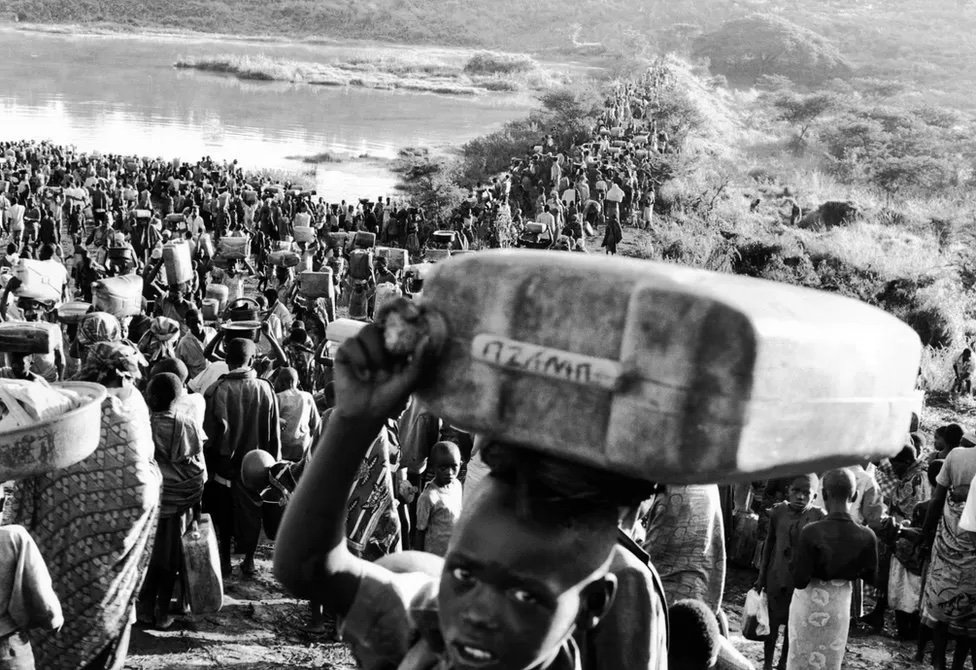
April 1994 — Rwanda: The Day the Black Man’s Gods Wept:
In April 1994, five thousand terrified Tutsi men, women and children sought refuge in churches across Rwanda. They went there because a church was supposed to be a sanctuary. They trusted the walls, the altar, the priesthood and perhaps, in those final hours, God himself. At Nyange parish in western Rwanda, that trust ended in one of the most horrifying episodes of the Genocide. The parish priest was Father Athanase Seromba. Tutsi refugees had gathered in and around his Church while militias and local authorities closed in. Eventually, they decided to destroy the building. According to the International Criminal Tribunal for Rwanda, Seromba approved that decision, encouraged the bulldozer driver and advised him about the weaker parts of the Church. The building collapsed on the refugees trapped inside. More than 1,500 people were killed. Seromba was eventually convicted of committing Genocide and extermination as a crime against humanity and sentenced to life imprisonment.
The horror of Nyange is difficult to comprehend, in part because of where it happened. The people inside had not sought refuge in a military camp. They had gone to a church. And Nyange was not an isolated aberration. Churches became major sites of massacre. Some members of the clergy protected Tutsi and, in certain cases, risked or lost their own lives doing so. Others remained silent. Still others collaborated with the killers or were later prosecuted for crimes connected with the Genocide. Human Rights Watch documented this disturbing spectrum from courageous resistance to complicity and participation.
That history raises an uncomfortable question.
How did a country in which Christianity had become so deeply rooted descend into a genocide in which Christians killed other Christians, sometimes inside churches and, in some cases, with the participation of clergy?
The answer cannot be reduced to religion.
Nor can it be reduced to an ancient tribal hatred between Hutu and Tutsi. To understand Rwanda, we must look further back: to colonialism, racial anthropology, missionary politics and the transformation of flexible social distinctions into rigid ethnic identities.
The Creation of Race
The Hutu and Tutsi existed before European colonialism. It would be historically inaccurate to suggest that the two names were invented by Europeans. However, colonial rule fundamentally altered the meaning of these identities.
Rwandans shared a language, Kinyarwanda, lived within the same cultural world and practised many of the same customs. Distinctions existed around cattle ownership, political position, lineage, and status, but they did not correspond neatly to the biological racial categories Europeans later imagined. European explorers and anthropologists came with the racial theories prevalent in the nineteenth century. One particularly influential idea was the so-called Hamitic hypothesis. Europeans speculated that Tutsi were racially different from Hutu: taller, supposedly more “Caucasian”, more intelligent and naturally suited to rule. These theories told Europeans more about Europe’s racial obsessions than they did about Rwanda. Nevertheless, colonial government turned speculation into administration.
By the end of the nineteenth century, Germany colonised Rwanda. Then Belgium took the control during the First World War and later governed it under a League of Nations mandate. Belgian administrators favoured Tutsi elites for positions within the colonial administration. Catholic educational institutions often reinforced this hierarchy. While Tutsi children were given an education that prepared them for administrative roles, many Hutu children were directed towards manual labour. The bureaucracy then did what bureaucracies do best: it made these categories permanent. Belgium introduced identity cards in the 1930s that categorised people as Hutu, Tutsi or Twa. A wealthy Hutu could previously have become a Tutsi, but this card made it harder for people to move up in society because their identities became fixed. The United States Holocaust Memorial Museum notes that Belgian colonial rule privileged Tutsi and amplified the division by requiring Rwandans to carry ethnic identity cards.
Meanwhile, the Catholic Church gained significant influence in Rwanda. The clergy’s in-depth knowledge of local issues was extremely valuable to the Belgian administration. An increasing number of Rwandans converted to Christianity, seeing it as a pathway to social progress. Initially, the Church favoured the Tutsi aristocracy. They enrolled Tutsis in their schools and provided them with a French education. The landscape in Rwanda shifted dramatically after the Second World War. Some Catholic missionaries began to feel a divine calling to uplift the oppressed Hutu population. Basically, as colonies all over the world were becoming independent and democratic governments were being formed, the Church changed its strategy. Much like the “angels in white robes” who arrived to uplift marginalised Hindus oppressed by severe caste discrimination, these missionaries in Rwanda channelled funds to establish churches, schools and hospitals in Hutu regions, aiming to rescue the ‘persecuted Hutu’ tribe. This was not merely a theological transformation. It also realigned political power.
The Church, which had previously helped to sustain a Tutsi-dominated hierarchy, now presented itself as a defender of the disadvantaged Hutu majority. But at the same time, Hutu intellectuals were increasingly challenging Tutsi political dominance.
The consequences were profound. In 1957, Hutu intellectuals published what became known as the Bahutu Manifesto, framing the political problem through ethnic categories. Hutu political leaders flipped the colonial script. Instead of viewing Tutsis as ‘Superior rulers’, they used the Hamitic myth to frame Tutsis as ‘Oppressors and foreign invaders’. Violence erupted in 1959. Thousands of Tutsis were killed or driven into exile. A revolution followed.
Belgium and influential sections of the Catholic establishment moved away from their former Tutsi allies and supported the political ascendancy of Hutu leaders.
Rwanda became independent in 1962 under a Hutu-dominated republic. The colonial racial hierarchy had been inverted. But the racial categories themselves survived. That is one of colonialism’s most poisonous legacies: the rulers may leave, while the architecture through which people have learned to see one another remains.
From Classification to Extermination
Following independence, cycles of persecution and exile continued. A large number of Tutsis lived as refugees in neighbouring countries. Juvénal Habyarimana seized power in 1973. His government initially promised stability but continued institutional discrimination. The Church remained influential. A Human Rights Watch investigation found that the Church was connected to the Habyarimana regime; for example, the Archbishop of Kigali had served on the ruling party’s central committee before resigning.
Then came economic crisis, political instability and war.
In October 1990, the largely Tutsi-led Rwandan Patriotic Front invaded Rwanda from Uganda. Civil war followed. Political extremists increasingly portrayed all Tutsi civilians as accomplices of the RPF. Propaganda transformed neighbours into enemies.
On 6 April 1994, the plane carrying Rwandan President Juvénal Habyarimana and Burundian President Cyprien Ntaryamira was shot down near Kigali. Within hours, organised killing began. For approximately one hundred days, extremist political leaders, soldiers, militia members and civilians participated in the extermination of the Tutsi people and the murder of Hutu people who opposed the campaign. The International Criminal Tribunal for Rwanda calculates that between 800,000 and one million individuals were slaughtered. This was not just tribal rage, but genocide, which needs more than hatred; it needs categories, propaganda; institutions; people willing to see their neighbours differently; and, most frighteningly, ordinary people to accept murder as duty.
Church authorities did not act as one body. Many clergy were themselves murdered. Some protected the persecuted. Others appealed desperately for an end to the killings. But the record also contains silence, political collaboration and direct participation. Human Rights Watch later concluded that while some clergy defended Tutsi even at great personal risk, others refused help, participated in local security structures or were accused of delivering people to killers and participating directly in atrocities. The point is not that Christianity “caused” the Rwandan Genocide. Such an explanation would be intellectually lazy. The deeper problem is institutional power. Religious institutions do not exist outside history simply because they speak of eternity. Once intertwined with political authority, ethnicity and state power, they can reproduce the prejudices of the society around them. The cassock does not immunise a man against ideology. Nor does a church wall prevent human beings from becoming killers.
The World turned a blind eye.
There was another betrayal. The international community knew that a massacre was taking place. Yet nobody really interfered. Although Belgium and France evacuated many of their nationals, an inadequate mandate and a reluctance to become politically involved hampered the United Nations’ peacekeeping mission. Officials hesitated to use the word ‘genocide’, partly because acknowledging genocide raised uncomfortable questions about the obligation to act. Human Rights Watch’s archival work has documented how international actors received warnings yet failed to stop an increasingly obvious campaign.Colonial powers had once entered Africa claiming the right to reorganise societies. When one of those reorganised societies descended into catastrophe, those powers suddenly rediscovered the principle of non-intervention. History has a cruel sense of irony.
For many years after the Genocide, the question of institutional responsibility remained deeply contested. Individual priests, nuns and lay Christians had behaved in radically different ways, from extraordinary courage to horrifying criminality. The Catholic Church consequently resisted attempts to assign collective guilt to every Christian or to the Church as a whole. However, institutional memory is important. During a meeting with Rwandan President Paul Kagame in 2017, Pope Francis acknowledged the Church’s failures. He asked God to forgive priests and religious men and women who had succumbed to hate, violence, and betrayal of their evangelical mission. This acknowledgement cannot resurrect the dead, though.
Colonialism and the Dangerous Seduction of Categories
For an Indian reader, parts of this history are unsettlingly familiar. European colonial anthropology also attempted to classify India’s bewilderingly complicated populations into supposedly scientific racial and social categories. Colonial ethnographers measured bodies, catalogued castes and tribes, and sorted identities that had often been contextual and locally negotiated into bureaucratic categories. Although the histories of India and Rwanda are not comparable, the academic pattern deserves comparison. Colonial learning often presented itself as neutral, yet simultaneously reorganised the society it described. A classification recorded by an administrator can become the seed of political movement. A theory proposed in academic writing can perpetuate an identity through generations. An administrative distinction can become a source of grievance. Under the right conditions, a grievance can become a weapon. This is why we should be cautious when history is narrated entirely through permanently antagonistic racial blocs. Aryan against Dravidian, Brahmins against Dalits. Those instigating five thousand years of vengeance can be like the proverbial wolf who wanted to drink the blood of the mutually fighting sheep.
History contains not only conflicts, but also relations, movement, compromise, memory, dialogue and shared belonging. Human beings are usually more complicated than the categories created to govern them. Rwanda teaches us what can happen when people forget this. First comes classification. Then preferential treatment. Then grievance. Then political mobilisation. Then dehumanisation. And eventually someone asks who truly belongs. Rwanda demonstrates the extreme danger of believing that administrative identities are neutral. Once the state teaches generations to weaponise inherited social categories as political tools of retribution, those categories can outlive the circumstances under which they were formalised and acquire new political meanings.
Examining contemporary Indian politics reveals the precise manifestation of institutional feedback and the boundary paradox. When administrative categories become the primary norms of resource allocation and political power, they do not disappear. Instead, they weaponise social boundaries, creating a landscape of hyper-mobilisation, systemic co-optation and escalating social friction. The University Grants Commission’s (UGC) Equity Regulations clearly show how administrative classifications become a battleground for state-enforced identity boundaries. The state’s intervention has ignited warfare in educational institutions. Rigid caste divisions have been further entrenched by state surveillance.
When state resources and dignity are tied exclusively to identity, grassroots mobilisation inevitably becomes militant. ‘Blue Armies’ like Bhim Army founder Chandrashekhar Ravan mark a departure from electoral Dalit politics towards confrontational, violent activism. Hindutva’s appropriation of Ambedkar is not merely an act of commemoration. It is an ideological manoeuvre. Ambedkar was a thinker who subjected the Hindu religion to devastating criticism. He publicly renounced Hinduism and converted to Buddhism. Yet now he is folded into a neo-nationalist pantheon, with the sharper edges of his critique carefully removed. Central to this transformation is the language of reverence. Memorials become Panchteerth. Political homage adopts the vocabulary of pilgrimage. Ambedkar is elevated to the status of a national icon, while the parts of his intellectual legacy that resist absorption into a Hindu civilisational narrative are selectively muted. This is not reconciliation. It is shrewd revisionism. The political usefulness of such revisionism is obvious. Ambedkarite symbols carry enormous moral and electoral weight. This creates a contradiction that is rarely confronted directly: the same political formation that seeks to subsume caste identities within a larger Hindu identity also depends on caste blocs and symbolism for electoral consolidation.
Ambedkar is therefore not merely commemorated. He is repurposed. In this process, caste conflict is exacerbated.
Journalist Dilip Mandal’s appointment as the Media Advisor to the I&B ministry illustrates this perfectly: we are witnessing the reversal of Hindutva and upper-caste hegemony into a colonial, racial idea of payback for a ‘vice’ from five thousand years ago. Having once tasted political, financial and state power, these so-called saviours of the Hindu community are reproducing the prejudices of the surrounding society.
What I find unsettling in contemporary Hindutva is not that it resembles the Catholic Church doctrinally, but that it increasingly resembles the Church’s political behaviour in colonial and postcolonial Rwanda: an institution adapting itself to shifting social blocs, sanctifying new political symbols, and embracing identities it once kept apart to maintain and expand its influence. The Catholic Church in Rwanda first legitimised one social hierarchy, then repositioned itself alongside the group that had challenged it. Today, Hindutva performs a comparable political manoeuvre by canonising Ambedkar while retaining a civilisational framework fundamentally at odds with much of his own critique. In both cases, the survival of the institution requires not the abolition of social categories, but their strategic management.
An institution that claims to stand above social divisions can become especially dangerous when its survival depends on manipulating those divisions. The state’s categories have outlived their original justifications. Now, they primarily serve to facilitate political survival, state co-optation and societal fragmentation.
Leave a Reply