
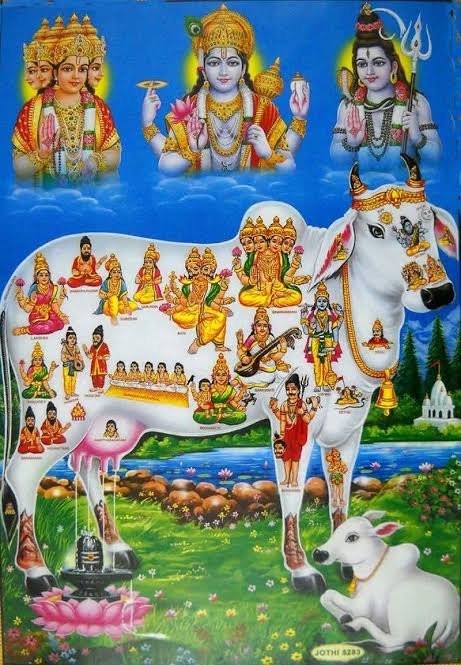
The cow occupies a position in Hindu civilisation that is difficult to understand if it is viewed merely as a question of food. For Hindus, the cow represents nourishment, generosity, motherhood, non-violence, and the sustaining relationship between human beings and nature. The avoidance of beef, therefore, cannot be explained simply as a modern political preference. It has deep roots in Hindu religious thought, sacred texts, and centuries of cultural practice. When the Vedas, Dharmashastras, Mahabharata, and Puranic traditions are considered together, the religious basis for this practice becomes clear. History needs to be discussed honestly. Hinduism has never had a single dietary code applicable in exactly the same way to every community and in every period. Early texts contain references to animal sacrifice and the consumption of meat, while later Hindu traditions increasingly emphasised ahimsa and abstention from meat. Nevertheless, Hindu religious texts provide a powerful ethical basis for protecting the cow and avoiding its slaughter.
The Vedas provide an important starting point. The Rig Veda repeatedly presents cattle as valuable and closely connected with prosperity, nourishment, and social well-being. In the famous Cow Hymn, Rig Veda 6.28, cows are described as bringing prosperity and nourishment to the household. The hymn also asks that the cows remain safe and free from injury. This imagery is significant because cattle are not treated merely as economic commodities; they occupy a protected and valued position within the ritual and social imagination of the Vedic community. The Vedic vocabulary itself also contains the important term aghnya, literally meaning “not to be killed” or “not to be slain”, which is used in connection with cows in several passages. The existence and interpretation of these passages have been debated by Atheist and Muslim scholars of Hinduism. Nevertheless, the terminology demonstrates that the protection of cows had a recognised place in Vedic thought.
The Atharva Veda also contains strong language concerning cattle and the consequences of harming them. Atharva Veda 8.6.23 condemns those who consume animals indiscriminately, including male and female animals and their young. The passage belongs to a broader Vedic concern with protecting living beings and maintaining the moral order of society. It is therefore relevant when considering the gradual development of the Hindu ethic of non-violence. The Yajur Veda contains perhaps an even more direct expression of this protective principle. Yajur Veda 14.8 is traditionally understood as calling upon human beings to protect both bipeds and quadrupeds. The Vedic corpus thus demonstrates a strong concern for the protection of animals, particularly cattle, which later Hindu traditions developed into a more pronounced ethic of cow protection. Thus, the Vedic evidence proved as a simple legal code that “beef is forbidden”. Rather, it demonstrates the early foundations of a cultural attitude in which cattle were regarded as exceptionally valuable, worthy of protection, and closely connected with human prosperity.
Although the Vedas are the principal and oldest texts of Hinduism, Hindu religious ethics did not end with the Vedas. Over the centuries, the concept of ahimsa became increasingly important. Ahimsa literally means non-injury or non-violence, and its influence extends across several Indian religious traditions. The significance of ahimsa is particularly visible in the Dharmashastra tradition. The Manusmriti does not provide a simple vegetarian code applicable in every circumstance; indeed, it contains passages permitting the consumption of meat under particular ritual or exceptional conditions. This complexity is important to acknowledge. Nevertheless, the same text contains remarkably strong arguments against the consumption of meat.
Manusmriti 5.48 states:
“Na kṛtva praninam himsam mamsam utpadyate kvacit |
Na ca pranivadhaḥ svargyas tasman mamsam vivarjayet ||”
The verse explains that meat cannot be obtained without violence against living beings and therefore recommends abstaining from meat. Manusmriti 5.49 continues this argument by urging a person to consider the origin of meat and the suffering involved in binding and killing living beings before choosing to abstain from meat consumption.
Even more striking is Manusmriti 5.51:
“Anumanta visasita nihanta krayavikrayi।
Samskarta copaharta ca khadakas ceti ghatakah ||”
The verse includes those who permit, kill, buy, sell, prepare, serve, and consume meat among those morally implicated in the act of killing. It establishes an ethical framework in which the killing of animals for food is increasingly viewed through the principle of ahimsa. When this developing ethic is combined with the exceptional status accorded to the cow, the religious statement against beef consumption becomes considerably stronger.
The Mahabharata provides some of the clearest evidence for the elevated status of cattle in Hindu tradition. In the Anushasana Parva, Bhishma repeatedly explains the religious significance of cows and the duty to protect them. The text describes cows as sources of nourishment and prosperity and praises the gift of cows as one of the highest forms of religious generosity. In one passage, the cow is described as contributing to the welfare of living beings through the nourishment obtained from her milk. More directly, another passage states that a cow should not be given to someone who intends to slaughter her. The text therefore moves beyond simply praising cattle and establishes a moral expectation that cows should be protected from slaughter.
The Mahabharata also develops a broader argument against the consumption of meat. In the Anushasana Parva, Section 115, Bhishma explains that abstaining from meat is closely connected with ahimsa. He argues that, because obtaining meat involves the death of a living creature, a person who wishes to practise compassion should abstain from consuming meat. The passage is particularly important because it recognises several participants in the process of slaughter, including those who kill, purchase, and consume meat. This resembles the ethical reasoning found in the Manusmriti. Another passage is even more explicit regarding cattle. The Mahabharata states that those who kill or consume the flesh of a cow incur grave religious consequences. Anushasana Parva, Section 74, condemns the killing, selling, and consumption of cattle in extremely strong terms. Taken together, these passages demonstrate that cow protection was not simply a modern political invention. Rather, it was already deeply embedded in the moral and religious of classical Hindu civilisation.
The Puranic tradition further strengthened the sacred status of the cow. Puranic history repeatedly associates cows with prosperity, religious merit, divine protection, and the maintenance of dharma. The cow thus becomes not merely a useful domestic animal but also a significant religious symbol. The Bhagavata Purana, for example, places cows alongside Brahmins and Vedic values within its vision of a righteous social order. In Bhagavata Purana 10.4.41, cows and Brahmins appear alongside Vedic knowledge, austerity, truthfulness, mercy, and sacrifice as elements associated with a godly civilisation. The Puranic world is also closely associated with Krishna’s identity as Gopala and Govinda, the protector and lord of cows. Lord Krishna’s life among cowherds and his protection of cattle became one of the most enduring representations of the sacred relationship between Krishna and the cow. This is one reason why the status of the cow cannot be reduced to economics. Even if cattle were enormously useful to agrarian society, Hindu religious texts transformed this practical usefulness into a moral relationship: the cow provides nourishment, and therefore human beings owe her protection.
This development can be understood as a gradual ethical movement. Vedic reverence for cattle, the increasing importance of ahimsa, Dharmashastric restrictions on killing and meat consumption, the Mahabharata’s exaltation of cows and opposition to slaughter, and the Puranic elevation of the cow into a powerful religious symbol. The result was a religious tradition in which the cow became qualitatively different from ordinary livestock.
The term go-mata, or “mother cow”, expresses this relationship particularly well. The expression is not merely sentimental; it reflects the traditional perception of the cow as a giver of nourishment. Milk, curd, ghee, and other cattle products were historically important in household, agricultural, and ritual life. Cattle dung was also used as fuel and in domestic and ritual contexts. The bull played a major role in agriculture and transport. In a traditional agrarian economy, therefore, cattle contributed to human life in numerous ways without necessarily being killed for their meat. Religious reverence emerged from this relationship. The cow became a symbol of giving without an immediate expectation of return. Hindu society developed this relationship through dharma. If an animal sustains society, society has a moral responsibility to protect it. This principle is closely connected with the broader Hindu idea that human beings have duties towards other forms of life. Dharma is not merely concerned with individual rights; it also encompasses obligations, restraint, and responsibility.
Modern debates about beef in India often become polarised. One side may portray cow protection entirely as an expression of religious majoritarianism, while another may present the prohibition as an absolutely uniform rule throughout all of Hindu history. A more historically responsible position recognises two facts simultaneously: religious reverence for cows and moral opposition to their slaughter have deep and powerful roots within Hindu civilisation, while Hindu dietary practices have also varied across communities and historical periods. Many Hindus believe that eating beef violates dharma. At the same time, many Indians recognise the religious importance of cow protection while engaging seriously with questions of individual liberty, pluralism, and public policy. Understanding the religious basis of a practice should therefore come before judging its political implications.
The Hindu prohibition of beef is best understood not as an isolated rule that appeared suddenly in a single scripture, but as the outcome of a long religious and civilisational development shaped by Vedic traditions, ahimsa, Dharmashastric ethics, Puranic traditions, and religious practice. The Vedic texts establish an important foundation for the reverence and protection of cows. The Atharva Veda and Yajur Veda contribute to a broader ethic of protecting living creatures. The Manusmriti develops a powerful moral critique of killing and meat consumption. The Mahabharata accords the cow an exceptionally high religious status and explicitly condemns the killing and consumption of cattle. Puranic literature then deepens the association of the cow with divinity, prosperity, and dharma.
This history does not require us to pretend that every Hindu has always followed an identical dietary rule. Rather, it demonstrates that Hindu attitudes towards food and animal life have developed over time and have varied across communities and historical periods. For this reason, beef cannot be understood in Hinduism merely as another item of food. For many Hindus, it represents a violation of a relationship shaped by scripture, religious practice, social memory, and the principle of ahimsa. The sacredness of the cow is therefore not simply about what Hindus eat. It concerns what they believe human beings owe to a living creature that has traditionally nourished, supported, and accompanied human society. In this sense, cow reverence reflects a broader Hindu understanding of dharma: receiving from nature creates an obligation to protect rather than destroy.
Thus, the cow occupies a distinctive and respected religious position in Hinduism, and the prohibition against consuming its flesh can be understood as the result of religious teachings, ethical principles, and cultural practices.
References :
- Rig Veda, Book 6, Hymn 28 (Gāvo Sūkta).
- Manusmriti, Chapter 5, Verses 48–51.
- Mahabharata, Anushasana Parva, Sections 74 and 115.
- Bhagavata Purana, Book 10, Chapter 4, Verse 41.
Leave a Reply