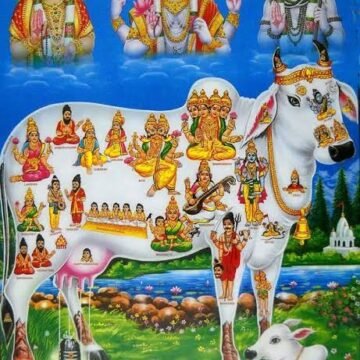
Why is the cow regarded as sacred in Hindu civilisation? The article examines the religious and civilisational foundations of cow reverence and the avoidance of beef in Hinduism. It draws upon the Vedas, Manusmriti, Mahabharata, and Puranic traditions, while also acknowledging the historical diversity of Hindu dietary practices. The article argues that the religious significance of the cow should be understood through concepts such as ahimsa, dharma, religious practice, and the traditional relationship between cattle and human society.
Tag: dharmashastras
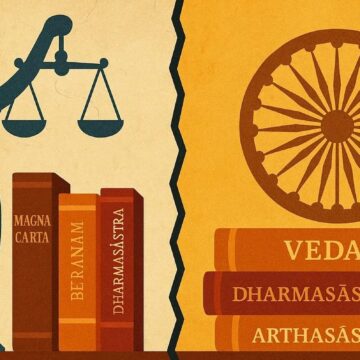
Justice Beyond Colonial Laws: The Case for Dharmic Judiciary
India’s judicial system, still anchored in colonial frameworks, often appears disconnected from the spirit of Dharma when adjudicating on matters of faith, family, and tradition. Judges with little understanding of Hindu philosophy or scriptures frequently issue rulings on matters of Dharma. From casual remarks on our deities to misguided interpretations of temple customs, such decisions reveal a deep cultural disconnect. It’s time to restore balance by establishing Dharmic courts, grounded in our own civilizational wisdom and moral vision, to decide on matters of Dharma, culture and family.
Stree Dharma & Why the Bharatiya Naari is Revered
Hindu Dharma envisions men and women as two halves of a whole, each essential in fulfilling the four Purusharthas, Dharma, Artha, Kama, Moksha. A wife is not a bystander but a Sahayogi, without whom even Yajnas lose their merit. While our Shastras elevate a virtuous Bharatiya Naari to the same position of reverence as a Teertha, they also bind men with strict codes of Dharma. Together, such men and women uphold a society rooted in balance, respect, and true Shakti that arises out of virtuous living.
In search of Dharmic unity with Dr. Nagaswamy
The common culture that Hindus share cuts across time and space.