
What Barbarik can teach us about power, justice, and the danger of confusing weakness with moral innocence
In the autumn of 1978, Michel Foucault went to Tehran twice and came back convinced he had seen something new. The uprising against the Shah struck him as a genuinely collective will, unarmed against an army, and in his dispatches he called what was being born there a political spirituality.
On 6 November, Le Nouvel Observateur published a letter under the heading “An Iranian Woman Writes.” The writer used the pseudonym Atoussa H., a leftist Iranian in exile in Paris, and she was writing to tell the French left, the Western liberal left specifically, that it had no idea what it was cheering for. She pointed to the punishments handed down under Islamic law elsewhere. She said Islamic rule could sit on a society that wanted change and crush it. She warned them not to be seduced by a cure worse than the disease.
She turned out to be right about nearly all of it. Within months of the revolution, veiling was made compulsory, and women were in the streets protesting against it. Executions of homosexuals began. The secular left that had marched alongside the Islamists was destroyed by them.
Foucault replied the following week. He did not engage her prediction, examine her evidence, or concede that she might know something about Iran that he did not. He said what he found intolerable was her merging of every form of Islam into a single thing and her dismissal of it as fanatical.
Read that exchange slowly, because the mechanism this essay is about is fully visible in it, in the space of two magazine issues. Counter-evidence about the favoured party did not fail to arrive. It arrived, from a member of the group that party would go on to persecute, in print, in time to matter. And it was not weighed and rejected. It was reclassified. Her warning stopped being a claim about Iran that might be true or false, and became an offence against a people who were, at that moment, the weaker party in a confrontation with a Western-backed autocracy. Once reclassified, it did not need an answer.
Scholars still dispute what Foucault was doing, and some read the Iran writings as description rather than endorsement. None of that touches the exchange. The question is not whether he approved of what Iran became, but what he did when someone inside the situation told him what was coming.
When Weakness Becomes a Standard
Extract the operating principle, and it reads: in any conflict, allegiance follows relative weakness.
Notice what it measures. Not who is in the right. Not who began the injury. Not what either party intends to do with victory. It measures one relational variable, the balance of power between the parties as the observer has classified them, and it returns a verdict.
That last clause is not padding. The rule cannot run until someone has decided which parties are in the conflict and at what scale, and the rule says nothing about how to make that decision. In Foucault’s Iran, there were at least three parties: the Shah’s state, the revolutionary movement, and the women and minorities and leftists inside the movement who would be destroyed by it. The rule saw two.
I want to be exact about the target. This is not what liberal political philosophy says. Rawls, whose difference principle asks that inequalities be arranged to benefit the least advantaged, is answering a question about how institutions distribute goods, not about who is in the right when two parties collide. Foucault was not a liberal at all, which is why he is the right opening example. The reflex is the property of no doctrine. It crosses them.
So this is a critique of a method, not a philosophy. A shortcut keeps making the decisions before the principles arrive, and wins those collisions because it is faster. Working out who wronged whom takes weeks. Working out who is smaller takes a glance.
Two fences. This concerns how we judge conflicts, not how we distribute resources. And nothing here argues for the strong. The refutation of “the weaker party is right” is not “the stronger party is right.” It is that strength and weakness were never the right variables.
The reflex fails in three ways. It treats a fact about position as a fact about desert. It cannot survive its own success, because allegiance indexed to power must reverse when power reverses. And it cannot say who counts as weaker without smuggling in an answer.
The alternative is not indifference. Weakness sets the magnitude of what we owe a party and never the direction of our allegiance. Direction is set by conduct: what was done, by whom, to whom.
Barbarik’s Paradox
The most rigorous refutation of this reflex was produced long ago, in our own tradition, by a man who took the rule more seriously than any of its modern adherents do.
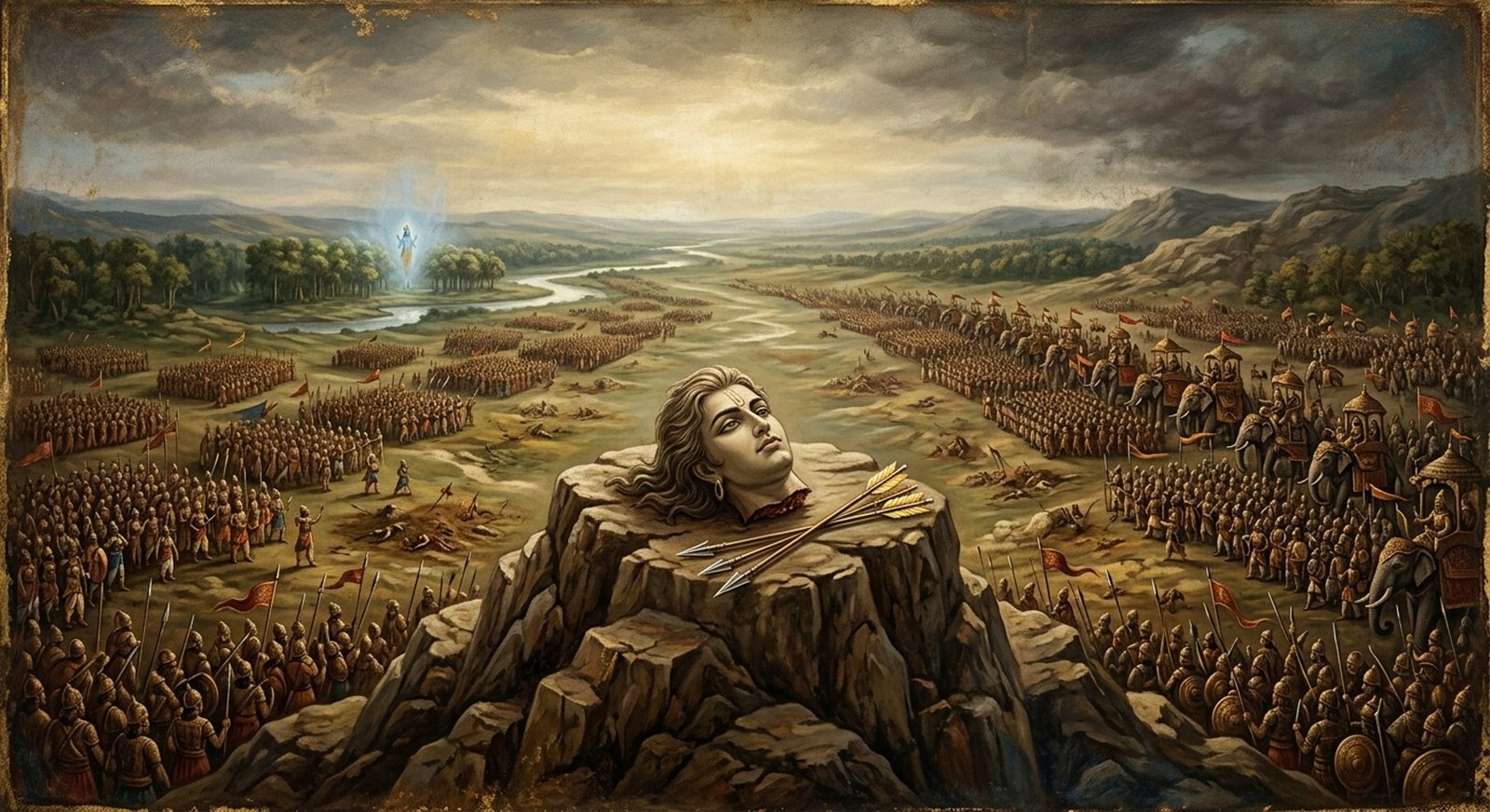
On the eve of the Kurukshetra war, a young warrior walks toward the battlefield carrying three arrows. His name is Barbarik. Three arrows sound like poor equipment for the largest war of the age until you learn what they do. The first marks everything the archer intends to destroy. The second marks everything he intends to spare. The third destroys what the first has marked.
Krishna, who knows what is walking up that road, intercepts him and needles him. Three arrows, for this war? Barbarik offers a demonstration. Krishna points at a peepal tree and asks him to pierce every leaf with a single shot. The arrow hisses through the crown, punching through leaf after leaf, then drops and hovers over Krishna’s foot, waiting. Krishna moves the foot. Under it is a leaf he had quietly plucked and hidden. The weapon does not hit what the archer sees. It hits everything that qualifies.
Satisfied, Krishna asks the question he came to ask. Which side will you fight for? And Barbarik gives the answer his mother made him promise: I will always fight for the weaker side.
Most people’s first reaction to that vow is approval. It sounds like chivalry distilled into a sentence, which is why Krishna’s reply deserves to be better known. He does not question the boy’s sincerity or argue that the weaker side is unworthy. He runs the vow forward, like a proof.
Suppose you join the weaker side. With your arrows, its defeat becomes impossible, so it becomes the stronger side. Your vow now binds you to the men across the field, so you must cross over and turn your arrows on the army you have just saved. Which reverses the balance again. And again. The vow reaches equilibrium in exactly one state: both armies dead, and you standing alone among them, promise unbroken, on a field where the pledge to defend the weak has killed every human being who might ever have been weak.
Barbarik does not appear in the critical edition of the Mahabharata. He belongs to the Skanda Purana and to the folk tradition of Rajasthan. That provenance does not weaken the argument. Folk tradition is where a civilisation keeps the thought experiments it has decided are too important to lose.
Krishna then asks for the boy’s head, and Barbarik, the truest giver in the story, gives it. We will return to what the tradition did with that head, because it is the best part.
Weakness Is Not Innocence
Begin with why the reflex feels reliable. Cruelty usually flows down gradients of power, so the wronged and the weak are very often the same people, and a heuristic trained on that overlap will look wise for decades at a stretch. But overlapping categories are still two categories, and the reflex collapses them.
A concession before the demolition, because it is sincere. The impulse underneath is a virtue, and nothing here asks anyone to unlearn it. The argument is that it answers a question it was not built for. Weakness is a claim on our help. It is not a verdict on anyone’s rightness.
Bertrand Russell caught the confusion in 1937, in an essay whose title does most of the work: “The Superior Virtue of the Oppressed.” Moralists credit the powerless with special virtue only for as long as they remain powerless. The halo is a consolation prize awarded in place of justice, and it evaporates the moment the oppressed acquire power and turn out to have been, all along, merely people. Suffering can deepen human beings, and it can deform them. What it cannot do is certify them.
South Asia supplies the case, and it is not a soft one. The Liberation Tigers of Tamil Eelam were throughout their existence the weaker party by every measure Barbarik knew how to take. Fewer men, no air force, no navy worth the name, against a sovereign state. They also had a genuine grievance behind them, a real history of majoritarian legislation and anti-Tamil violence that no honest account can wave away. And in October 1990 they gave the Muslims of the Northern Province, tens of thousands of people whose families had lived in Jaffna for centuries, a matter of hours to leave with what they could carry. They pioneered the suicide vest as a systematic instrument. They conscripted children. They killed a former Indian prime minister at a campaign rally.
Run the reflex on Sri Lanka in 1990, and it returns the Tigers, cleanly, because on the only variable it consults, they were unambiguously the weaker side. Weakness has never made anyone right. It has only ever made them weak.
Two serious defences exist. The first is about testimony: the powerful own the megaphones and fund the histories, so their account deserves discounting. Granted entirely. But that is a rule about how to weigh evidence, not about where to place allegiance. Suspicion toward the strong man’s account is diligence. Automatic absolution of the weak man’s deeds is superstition wearing diligence’s clothes.
The second is stronger. Persistent weakness, it says, is itself evidence of prior wrongdoing, since groups do not end up powerless at random, so the presumption is an inference from a base rate rather than moral arithmetic. This survives contact with the facts more often than not. But a presumption is by definition the thing you hold until evidence arrives. Having been wronged in the past is not evidence of being in the right in the present quarrel. The Tigers had a real historical grievance and still emptied Jaffna of its Muslims at gunpoint, and the first fact does not touch the second. A presumption that cannot be defeated by conduct is not an inference. It is an article of faith with statistical decoration.
Whether the presumption is ever defeated in practice, ask Atoussa H.
What Happens When the Underdog Wins
Krishna’s objection is not moral but mechanical. Allegiance indexed to power reverses itself at the moment of its own success.
In the story, the reversal is instant, because three arrows settle wars in an afternoon. History moves more slowly, which lets us watch what adherents do when their underdog wins. They have two options. Transfer allegiance, as the rule demands, and spend a lifetime in perpetual defection. Or deny the victory ever occurred. Switching costs friends, identity and the pleasant continuity of one’s own past, so denial became the signature move of the twentieth century.
The Soviet Union ran the longest version. Bolshevism earned its Western sympathy when it was genuinely weak, a hunted fringe of pamphleteers and exiles. By the early 1930s it governed an empire and was engineering a famine in Ukraine that killed millions, which Walter Duranty of the New York Times assured his readers was exaggeration or malignant propaganda. He kept his Pulitzer, and has it still.
Sidney and Beatrice Webb, the most respected social researchers in Britain, published a two-volume tribute in 1935 under the title Soviet Communism: A New Civilisation? Two years later, with the Great Terror at full throttle, they issued a second edition with one revision. They deleted the question mark.
Sit with that, because it is the mechanism in miniature. The evidence had moved in exactly one direction and so did they, and not the same one. The label gets nailed to a party once, early, then defended against everything that happens next. Barbarik, at least, would have crossed the field.
Who Counts as the Underdog?
Barbarik had a luxury we do not. His measure was public and countable. The Pandavas fielded seven akshauhinis to the Kauravas’ eleven, each a full division of foot, horse, chariot and elephant, and anyone could stand on a hill and verify the count. Our conflicts publish no census.
“Weaker” is not a well-defined property. Weaker where? Measured across which population, at which scale? Barbarik counted soldiers on a field that had edges. Real conflicts have no edges, so the answer changes with the frame, and the frame is chosen, silently, by whoever is judging.
The Kashmir Valley, January 1990, is the starkest illustration. The Kashmiri Pandits, under five per cent of the Valley’s population, faced targeted assassinations of their prominent men, ultimatums broadcast from mosque loudspeakers and notices on their doors. Within months most of the community had fled, and nearly forty thousand families would eventually register as migrants. The state’s own count of Pandits murdered stands at 219. The community’s organisations count 399 and insist even that is low.
Now run the rule. In the Valley frame, the Pandits are a minuscule religious minority facing an armed insurgency patronised by a neighbouring state. Weaker on any measure, and wronged. Shift to the national frame and the same people become Hindus, members of an eighty per cent majority in a country with a large army. Same families, same doors, same notices, opposite verdicts. Nothing inside the rule tells you which frame to use.
In India this is not merely a habit of commentary. It is written into administration. Minority status is conferred by a central notification under the National Commission for Minorities Act, which in 1993 designated five communities nationally, with Jains added in 2014. Yet in TMA Pai Foundation, in 2002, an eleven-judge bench of the Supreme Court held that for the purposes of Article 30 the unit for identifying a minority is the state, not the nation. The Court said local, the notification stayed national, and more than two decades later the gap is still being litigated. A community can therefore be a small and vulnerable local minority and hold no minority status whatsoever, because the count that matters is taken at a scale where it disappears.
Much of India’s commentating class ran the national frame in 1990, and I want to be precise about the accusation, because it is damning enough without inflation. Almost nobody celebrated the exodus. What happened was quieter. A hundred thousand people fell through the gap between two frames into three decades of near silence, because their tragedy embarrassed the template instead of confirming it.
The Facts That Survive the Frame
The obvious objection is that this proves too much. If frame choice is unconstrained, then my frames are as arbitrary as anyone else’s.
Except that only one variable in these disputes is frame dependent. Zoom out from the Valley to the nation and the Pandits change from minority to majority. Zoom out again to South Asia and they change back. But the 219 murders do not change. The notices on the doors say the same words at every scale, because they were addressed to specific people by specific people for specific reasons. Zoom out from Tehran to the Cold War and the Shah acquires a superpower patron. Nothing about compulsory veiling is altered by it.
That is the whole case. Weakness is a relation between a party and whatever population you compare it against, so it cannot return a determinate answer until someone has already made a choice the rule does not govern. Conduct is a fact about events. A rule whose verdict depends on an unconstrained choice of frame is not a principle. It is a permission slip with a philosophical accent, tuned to return whatever its user already believed.
Judge Conduct, Not Power
The context of the Barbarik story supplies the alternative, and it is usually missed. Krishna was not neutral at Kurukshetra. He had already committed to the Pandavas, the side with seven armies against eleven. The weaker side. If the vow were sound, he and Barbarik would have been allies, and there would be no story.
Krishna backed the weaker side, but not because it was weaker. He backed it because it was wronged: a kingdom swindled in a rigged dice game, a queen dragged by her hair into open court, thirteen years of exile served in full and the agreed restitution refused anyway, every avenue of peace exhausted last, with Krishna himself as the final failed ambassador. The weakness and the wrong happened to coincide. The allegiance tracked the wrong.
The Gita states the criterion in Krishna’s own voice. He arrives, age after age, for the protection of the virtuous and the destruction of evil-doers. Both are conduct words. They ask what a party has done, not where it sits on a gradient of force.
An honest objection: Krishna is hardly disinterested, and protecting the virtuous is what every combatant has claimed to be doing. Quite so. The conduct criterion does not hand out correct answers. It is contestable, laborious and frequently abused. What it does is put before you a question that has an answer somewhere in the world, rather than one whose answer depends on where you chose to stand. Who broke the agreement is hard. Who is smaller is arbitrary. Only one of those defects is fatal.
Which is why the reflex keeps winning. Conduct must be investigated. Power can be eyeballed from the road. The underdog reflex is morality with the judgment amputated, and any rule that spares you the labour of judging was never a moral rule to begin with.
So where does weakness belong? Where the older instinct always kept it. In deciding how much help the wronged require and how urgently. Weakness sets the size of the obligation. It does not set its direction. Side with the wronged. Succour the weak. And refuse, at any price, to let the second calculation impersonate the first.
The Refuge of the Defeated
Which returns us to the head. Krishna granted the boy’s last wish, to watch the war he was not permitted to join. The severed head was set on a hilltop above Kurukshetra and for eighteen days it watched. When it was over and the victorious brothers fell to arguing about which of them had really won, someone proposed asking the only impartial witness on the field. The head laughed. It had seen no heroes, it said. Only the discus of Krishna falling like a wheel of light, and the goddess drinking the blood. From the wide view, the outcome had never depended on the balance of forces Barbarik knew how to count.
And then the tradition did something more interesting than refute the boy. It enthroned him. In the town of Khatu in Rajasthan stands one of the busiest temples in north India, where Barbarik is worshipped under Krishna’s own name as Khatu Shyam, and where millions of pilgrims a year address him by his epithet: Haare ka Sahara. Refuge of the defeated.
That transformation is this entire argument compressed into a devotional formula. The vow has been kept and corrected in one gesture. He no longer fights for whoever is losing. He shelters whoever has lost. The combat rule became a mercy rule. The compassion was retained in full, the criterion of allegiance surgically removed, and folk devotion managed this centuries before political theory noticed there was a problem. The defeated deserve shelter. Shelter is not a verdict. A god for the broken, who takes no side in the breaking.
Which is what the second arrow was always for. The quiver could mark for destruction and it could mark for protection, and the vow needed only one of those. Everything worth keeping in Barbarik is in the arrow he never had to fire.
Krishna’s question on that road remains the cleanest test available for any politics of the underdog. What will you do on the day your side becomes stronger? If the honest answer is “switch,” then allegiance reverses forever and the war never ends. If the honest answer is “deny it,” the rule has already rotted into apologetics, and you are the Webbs with your pen through the question mark.
The tradition’s answer was to give the boy’s compassion a temple and his rule a burial. Ours, so far, has been to march the whole boy back to war.
Leave a Reply