
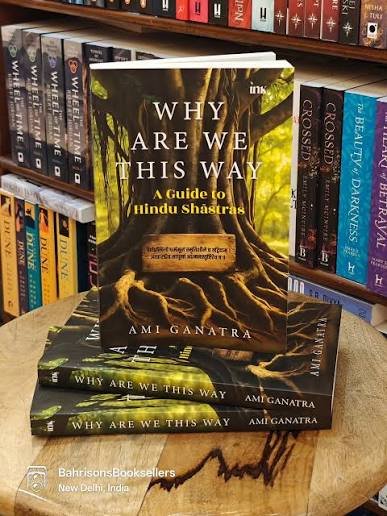
In recent years, Ami Ganatra has emerged as one of the prominent contemporary writers introducing Hindu scriptures and India’s civilizational knowledge traditions to a wider audience. Through works such as Mahabharata Unravelled, Ramayana Unravelled, and numerous public lectures, she has sought to present Indic texts through accessible language while engaging with questions of history, philosophy, and tradition.
An engineer by training with a management background, Ganatra transitioned from the corporate world to independent research on Hindu scriptures and civilizational studies. Her work has earned recognition for making complex scriptural traditions more approachable without losing sight of their original sources.
Her latest book, Why Are We This Way: A Guide to Hindu Shastras, arrives at a time when many Hindus remain connected to inherited practices but are increasingly disconnected from the scriptural frameworks that shaped them. Rather than offering an academic treatise or a polemical defence of tradition, the book serves as a structured introduction to the vast landscape of Hindu Shastras for students, seekers, and general readers.
Ganatra explains that the idea for the book emerged from a conversation during the Kumbh Mela in Prayag, where she was encouraged to write a simpler guide to Hindu scriptures for ordinary readers. That objective shapes the entire work. The book is organised as an accessible entry point into one of the world’s richest knowledge traditions rather than as an exhaustive scholarly study.
One of the greatest strengths of Why Are We This Way is the way Ami Ganatra simplifies complexity without reducing nuance. Hindu Dharma does not revolve around a single canonical text. Instead, it encompasses an enormous and intricate body of literature — the Vedas, Upanishads, Smritis, Puranas, Agamas, Itihasas, Darshanas, Vedangas, Tantras, and more. For many readers, the sheer scale of this knowledge tradition can appear intimidating. Ganatra succeeds in organizing this seemingly overwhelming corpus into a coherent and understandable framework.
Equally commendable is the author’s repeated emphasis that Sanatana Dharma is not static. She demonstrates how Hindu civilization continuously evolved while remaining anchored to foundational principles like Dharma, Rta, and Satya. This dynamic quality, according to the author, is one of the greatest reasons behind the survival and continuity of Hindu civilization despite centuries of invasions, colonial distortions, and cultural disruptions.
The chapter titled The Shastra Pantheon: An Overview is particularly illuminating. The author presents Hindu civilization not merely as an ancient religion but as one of the world’s oldest continuously living civilizations whose traditions remain active in everyday life through rituals, chants, festivals, sacred geography, and social ethos. She beautifully highlights how Vedic mantras such as the Gayatri Mantra, Mahamrityunjaya Mantra, and Shanti Mantras continue to resonate across Indian households even today. This continuity between past and present is presented not as nostalgia but as living cultural reality.
Importantly, the author repeatedly reminds readers that genuine scholarship requires openness, nuance, and intellectual humility rather than ideological rigidity. In today’s polarized climate, such balanced writing deserves special appreciation.
The structure of the book is one of its notable strengths. The detailed contents reveal the vast range covered by the author: the Vedas, Yajnas, Ayurveda, Darshanas, Dharmashastras, Itihasas, Puranas, Agamas, Tantra, social structures, adhikara, and contemporary relevance. Yet despite this enormous scope, the writing never becomes inaccessible or excessively academic.
Ami Ganatra’s style is lucid, engaging, and reader-friendly. She often uses examples, anecdotes, explanatory notes, and contextual clarifications to help readers navigate difficult concepts. Her use of transliteration and pronunciation guidance also reflects sensitivity towards readers unfamiliar with Sanskrit terminology. The book therefore becomes not merely informative but deeply inviting.
Perhaps the most important contribution of the book lies in its attempt to restore civilizational confidence among Hindus. For generations, many Indians were educated through frameworks that disconnected them from their own intellectual heritage. Hindu traditions were either reduced to rituals devoid of meaning or viewed through colonial and ideological distortions. Ami Ganatra’s work challenges that disconnect gently yet firmly. This is not a book of blind glorification. Nor is it apologetic. Instead, it is an attempt to encourage informed engagement with one’s own civilization.
The title itself — Why Are We This Way — captures a profound civilizational inquiry. Why do Hindus think differently about time, divinity, knowledge, life, duty, and existence? Why does Hindu civilization embrace diversity without demanding uniformity? Why has it survived for millennia while many ancient civilizations disappeared? Ami Ganatra does not offer simplistic answers. Rather, she opens the doors for readers to begin asking those questions seriously.
Why Are We This Way may well be one of the more significant recent attempts to introduce Hindu scriptural traditions to a general readership. At a time when public discourse is often dominated by superficial debates and inherited misconceptions, the book helps reconnect ordinary people with the philosophical depth, cultural continuity, and spiritual sophistication of Bharat.
This book deserves to be read widely — especially by students, young professionals, educators, parents, and every Hindu seeking a clearer understanding of the foundations of Sanatana Dharma. It is equally valuable for non-Hindus and international readers who genuinely wish to understand India beyond stereotypes and media caricatures.
The book demonstrates that scholarship rooted in authenticity, humility, and devotion can illuminate minds far more effectively than ideological aggression.
Why Are We This Way is not just a guide to Hindu Shastras. It is an invitation to rediscover Bharat itself.
Reclaiming Scriptural Literacy in an Age of Civilizational Amnesia
One of the most significant achievements of the book is that it addresses a crisis rarely discussed in mainstream discourse—the growing disconnect between Hindu society and Hindu knowledge systems. Millions of Hindus continue to celebrate festivals, visit temples, perform rituals, chant mantras, and participate in inherited traditions. Yet comparatively few possess a structured understanding of the scriptural foundations that inform these practices.
This disconnect is not accidental. It is the cumulative result of colonial education, decades of intellectual deracination, and the gradual replacement of indigenous categories of understanding with externally imposed frameworks. For generations, Hindus have often been taught to view their traditions through lenses developed for studying Abrahamic religions or through ideological narratives that reduce a vast civilization to simplistic stereotypes.
Ami Ganatra’s book directly addresses this gap. It neither assumes prior knowledge nor speaks down to the reader. Instead, it serves as an intellectual orientation manual for anyone who has ever asked a deceptively simple question: Why do Hindus think, worship, celebrate, and live the way they do?
One of the strengths of the book lies in its recognition that Hindu civilization cannot be understood through isolated texts or doctrines. Unlike traditions centred around a single scripture, Hindu Dharma emerged from a vast ecosystem of interconnected knowledge traditions. The Vedas, Upanishads, Itihasas, Puranas, Agamas, Darshanas, Dharmashastras, and numerous regional traditions together constitute a living civilizational matrix. The book helps readers appreciate this interconnectedness without becoming overwhelmed by complexity.
Ganatra repeatedly emphasizes that Hindu Dharma is fundamentally a knowledge tradition rather than a belief system in the narrow sense. This distinction is crucial. Throughout the book, readers encounter a worldview that encourages inquiry, debate, interpretation, contemplation, and experiential understanding. The author demonstrates that questioning has never been alien to Hindu thought; rather, it has been one of its defining characteristics.
Beyond Rituals and Stereotypes
Another important contribution of the book is its effort to restore meaning to practices that are often dismissed as mere ritualism. Contemporary discussions on Hindu traditions frequently oscillate between two extremes—uncritical glorification on one side and uninformed dismissal on the other. Ganatra avoids both.
She explains that rituals, festivals, samskaras, temple traditions, pilgrimage networks, and sacred geography evolved within a sophisticated philosophical framework. These practices were not arbitrary inventions but expressions of deeper civilizational principles relating to dharma, cosmic order, social harmony, and spiritual growth.
In doing so, the author helps readers appreciate an important truth: Hindu civilization survived not merely because of philosophical texts preserved in libraries but because those ideas became embedded in everyday life. The village temple, the family altar, the annual festival, the recitation of sacred verses, and the observance of traditional customs all became vehicles for transmitting civilizational memory across generations.
Scholarship Without Polemics
Another remarkable aspect of the book is its treatment of contentious and politically sensitive subjects. The chapter discussing the origins of Vedic civilization — whether indigenous or externally influenced — is handled with notable restraint and scholarly balance. Ami Ganatra neither indulges in aggressive polemics nor blindly accepts colonial-era narratives. Instead, she carefully presents the evolution of theories such as the Aryan Invasion Theory (AIT), Aryan Migration Theory (AMT), and the Out of India Theory (OIT), while also discussing archaeological, linguistic, and genetic evidence.
This intellectual restraint is perhaps one of the book’s greatest virtues. The author does not seek to manufacture outrage. Instead, she encourages readers to examine evidence, understand context, and approach complex questions with humility. In an era dominated by social-media certainties and ideological echo chambers, such an approach deserves appreciation.
A Book for the Twenty-First Century Hindu
The book’s greatest relevance lies in the fact that it speaks to contemporary Hindus navigating modernity. Young Indians today are exposed to global influences, digital information, academic debates, and competing narratives about their heritage. Many seek authentic answers but do not know where to begin.
Why Are We This Way provides precisely that beginning. It does not claim to offer final answers. Nor does it attempt to replace primary scriptural study. Rather, it functions as a roadmap—a guide that introduces readers to the landscape of Hindu knowledge and encourages them to continue their exploration independently. In that sense, the book performs a service far beyond the boundaries of conventional religious literature. It contributes to the revival of civilizational self-understanding.
In an age when civilizations across the world are grappling with questions of identity, continuity, and cultural memory, Ami Ganatra’s book arrives as a timely and necessary intervention. It reminds readers that Hindu civilization is not merely a relic of the past but a living, evolving tradition sustained by an extraordinary body of knowledge accumulated over millennia. More than a guide to Hindu Shastras, this book is a guide to understanding Bharat itself. It deserves a place not only in the libraries of scholars and seekers but in every home where future generations wish to understand the civilizational foundations that have shaped India.
Leave a Reply