
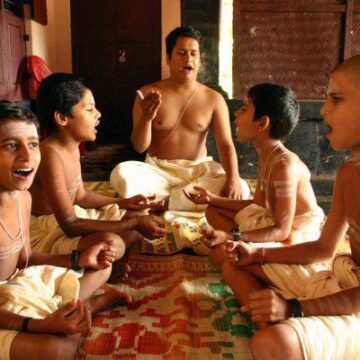
What can India’s ancient traditions of learning teach us about the art of truly knowing? Rajat Kanti Satpati explores how Vedic recitation, Upaniṣadic inquiry and Yogic practice trained the faculties of hearing, memory, reflection and sustained attention. From the precision of oral transmission to the contemplation of the Self, the article examines how knowledge moves beyond mere retention towards deeper understanding. Though rooted in distinct intellectual traditions, these practices share a recognition that learning requires disciplined engagement. Ultimately, the essay presents knowledge not merely as information to be acquired, but as a capacity cultivated through practice.
Tag: Memories Traditions
How Civilisations Forget Themselves: Can a Civilisation Forget Its Own Philosophical Grammar?
How does a civilisation forget its own philosophical grammar even while preserving its texts, rituals and traditions? This essay explores how words such as dharma, karma and avatāra can survive while the conceptual relationships that once gave them meaning gradually fade. It examines how translation, codification, institutional change and collective memory reshape inherited traditions, often making historical changes appear timeless. Using Hindu thought as its primary lens, the article argues that recovering an older philosophical grammar need not mean restoring the past, but recovering the questions and categories through which it understood human life. Ultimately, it asks whether a civilisation can recognise what it has forgotten - and understand the processes through which it changed.