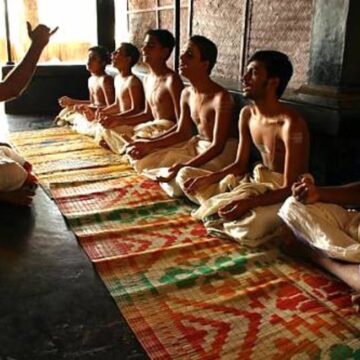
What can India’s ancient traditions of learning teach us about the art of truly knowing? Rajat Kanti Satpati explores how Vedic recitation, Upaniṣadic inquiry and Yogic practice trained the faculties of hearing, memory, reflection and sustained attention. From the precision of oral transmission to the contemplation of the Self, the article examines how knowledge moves beyond mere retention towards deeper understanding. Though rooted in distinct intellectual traditions, these practices share a recognition that learning requires disciplined engagement. Ultimately, the essay presents knowledge not merely as information to be acquired, but as a capacity cultivated through practice.

Tag: Indic traditions
Category Errors in the Study of Bharatīya Jñāna Paramparā
Modern scholarship often misreads Bharatīya Jñāna Paramparā by forcing it into text-centric, innovation-driven frameworks that do not match its transmission-based nature. This article argues that the confusion arises from deep category errors about what knowledge is and where it resides. Rather than a collection of texts, the tradition functions as an integrated epistemic architecture sustained through guru–śiṣya paramparā. Recognising this distinction reframes continuity not as stagnation, but as disciplined preservation of valid knowing.
Why all religions are not the same
A synopsis of "The heathen in his blindness", in which Professor S. N. Balagangadhara demolishes the idea of analyzing non-Abrahamic cultures through the western religious framework obsessed with theory-making.
Nature in Indian and Western Traditions
Nature loving Indic traditions should not tread the path of western materialism which is enforced by a greedy god and his urge to consume the earth's resources.