Sindhu Saraswati Civilisation

On Fortresses In The Rigveda, Atharvaveda Śaunakiya And (Pre)Harappa And The Dating Of The Samhitas – A. A. Semenenko – Translation

This paper was originally written in Russian by Dr. Aleksandr A. Semenenko, a historian based in Voronezh, Russia.
Dr. Semenenko is one of the few Western scholars who have defended the Out-of-India theory which purports to explain the spread of the Indo-European languages. His work is ground-breaking, because he relies not only on textual or linguistic proof, but also on archaeological and material evidence. His researches have now provided a very solid archaeological underpinning for the OIT.
Dr. Semenenko has recently presented summaries of his findings at Sangam Talks:
Steppe Route of Indo European Dispersal:Preliminary Findings (https://www.youtube.com/watch?v=lgRdwkZnGqA)
The Tarimian Trace of the Indo European Dispersal (https://www.youtube.com/watch?v=jyY7EHotXto)
The Rigveda Chronology And The Indo European Homeland (https://www.youtube.com/watch?v=S1Bsm79cVvk)
Dr. Semenenko's original and far-reaching work has been endorsed by such pioneers of the OIT such as Shrikant Talageri and Koenraad Elst: see for example, the Sangam Talk "Getting serious about the "Aryan" debate" (https://www.youtube.com/watch?v=rDSy9gPAB3s)
The bulk of Dr. Sememnenko's work is in Russian. However, he has also written extensively in English as well, and interested readers can find his path-breaking papers at:
https://independent.academia.edu/AlexandrSemenenko/Articles-in-English
or at:
https://www.researchgate.net/profile/Aleksandr-Semenenko-2
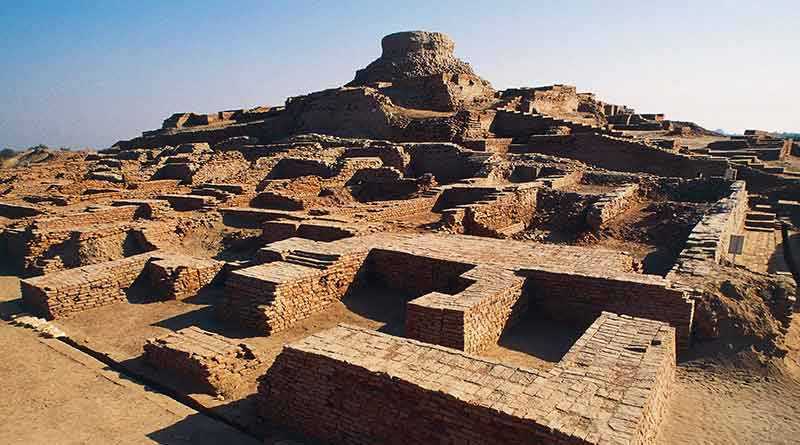
In this monograph, which is the first of his papers to be published in India, Dr. Semenenko shows that Rigvedic hymns mentioning forts being besieged or stormed do not occur in the oldest layers of the Rigveda. The oldest mentions of forts occur in a peaceful context. Dr. Semenenko also decisively refutes the AIT, according to which the earliest hymns should have described the destruction of forts. The author demonstrates that the description of fortresses in the Rigveda and the Atharvaveda reflect a unique chain of archaeological events in the history of South Asia — wherein a period when fortified settlements were besieged and burned down was followed by a period when they existed peacefully. This sequence of events corresponds to a transition from the Early Harappan period to that of Mature Harappa, and was never repeated again. With this insight, Dr. Semenenko has succeeded in establishing an absolute chronology for the Rigveda (which was hitherto not possible).
The translator dedicates his translation to the memory of his late lamented Russian teacher, Dr. Ganesh.V. Marathe. This translation was rendered possible only owing to Dr. Marathe's charity towards a schoolboy who could not have afforded to pay for the Russian lessons.
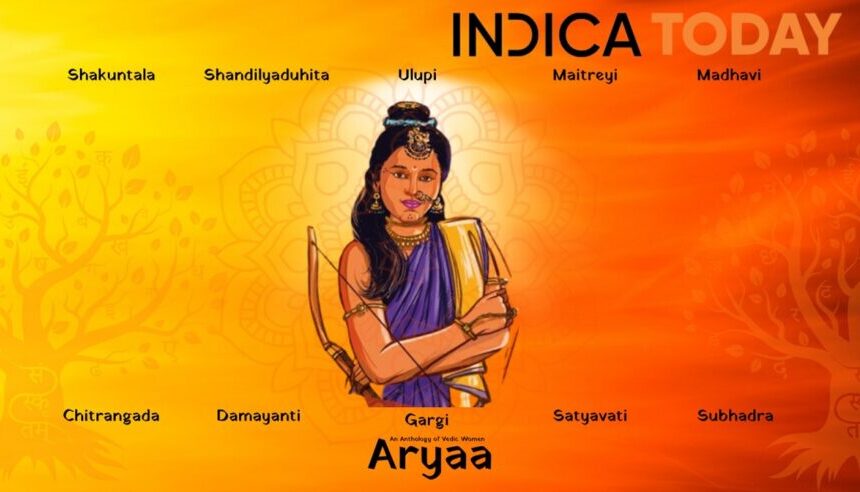
Aryaa - The Sanatana Women of Bharatvarsha

‘Aryaa’ – An Anthology of Vedic Women – Review

"Stories ranging from the Warrior princess Chitraganda who fights alongside Arjuna to the bold princess Ulupi who approaches Arjuna for the union of her own accord to Queen Subhadra who finds a different way of carrying out her dharma and supporting her husband than the conventional way one expects a wife to. Characters etched in the minds of popular imagination such as Satyavati, Shakuntala, and the duo Nala-Damayanti are also presented in a narrative that cannot fail to entertain and arouse interest. The most metaphysical and philosophical stories are undoubtedly those of Gargi, the Brahmavadini, and Maitreyi, the scholarly wife of the famed Yajnavalkya. These stories prove that while there were women steeped in the Shastric worldview, they were not purposely debarred from aspiring towards education and a spiritual path."
In this review of 'Aryaa - An Anthology of Vedic Women' Rohan Raghav Sharma discusses the need for such a book before delving into each of the ten stories told in the book. He gives detailed insights into each story along with his critique of the writing styles of the different writers.

https://twitter.com/propagandopolis/status/1660667509509431296?s=20

The Fate Of Muslims Under Soviet Rule : A Review

"Communism, as the logical outcome of materialism, cannot but be hostile to religion in all its aspects. Thus from the very beginning, the Communists aimed at the destruction of religious belief and worship in Soviet Russia." 
Halley Kalyan pens a review of “The Fate Of Muslims Under Soviet Rule” - a booklet about Soviet government rule in regions that had a significant population of practicing Muslims, by Erich W Bethman (1958); and highlights the shared antagonism towards religion (Hinduism in particular in the Indian context) between the Communist dogma and the Indian version of Secularism.

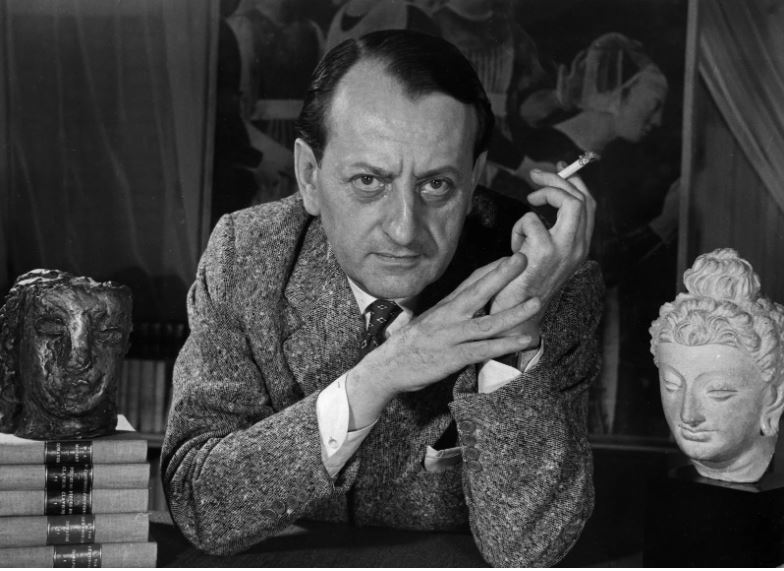
André Malraux

André Malraux on India and Bangladesh – Part 2

In the second installment of André Malraux's views on India and Bangladesh, Dileep Karanth translates an open letter written by André Malraux to the president of the USA, Richard Nixon. In the letter André Malraux questions the stand taken by the newly emerged superpower that the USA was, towards India, Pakistan, and Bangladesh.

André Malraux

André Malraux on India and Bangladesh – Part 1

This is a translation of two web pages about the French writer André Malraux, and his views on India and Bangladesh.
Dileep Karanth brings to light the love and fascination that a misunderstood frenchman, André Malraux, had for India - not only the politically defined territories of India but also the civilisation; as his words to the students in Dacca prove.
The article attempts to understand the man and his ideologies and beliefs before delving into his love for India.

Who Is A Hindu?

Hindu, Hinduism, Hindutva – Part 1

Who exactly is a ‘Hindu’ and what are ‘Hinduism’ and ‘Hindutva’? Does it mean the land (geography), ancestral roots (history), or a shared culture?
Dr. Pingali Gopal tackles this proverbial bull by the horns, systematically looking at attempts to define and distinguish ‘Hinduism’ and ‘Hindutva’ by Western thought, the Indian liberal elite, and practising Hindus.