
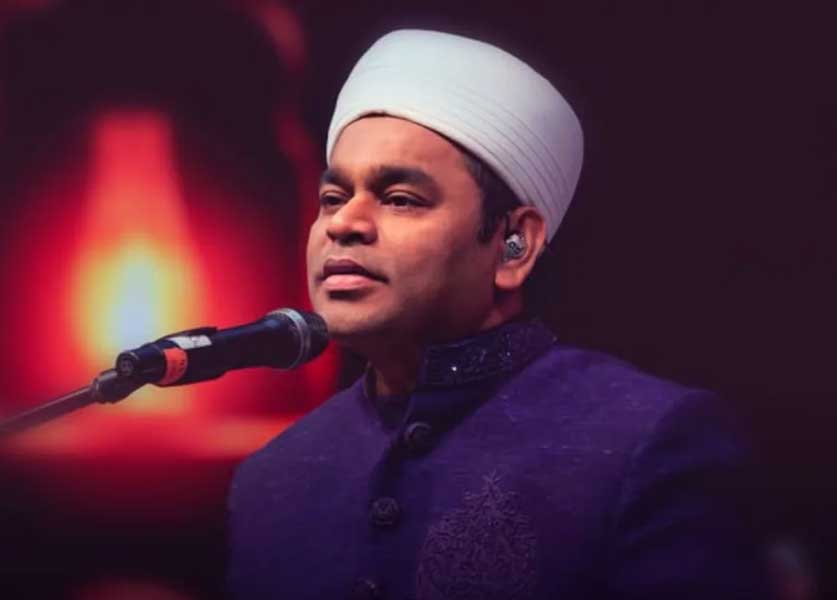
In 1992, as A R Rahman’s debut film as music director, Roja, played to packed theatres, a friend mentioned some audience members shouting ‘Jai Shri Ram’ during patriotic scenes. Later that year the Babri Masjid was demolished and communal riots broke out across the country killing thousands. Purportedly retaliatory terrorist bomb blasts killed hundreds more. In this fraught environment the three Khans (Aamir, Shahrukh, and Salman) rose to new heights of superstardom in Bollywood and Rahman to supremacy in Indian film music. Certainly, talent and effort drove them to the top of the heap, but it was on the shoulders of an open, trusting, and majority-Hindu audience that they rose to the top of the mountain. From these summits of success two of the Khans–Aamir and Shahrukh–and now Rahman looked down and accused those very Hindus of ‘intolerance’ and ‘communal prejudice.’
Having spent recent months researching and writing an essay-series about the often Hinduphobic and soft-fundamentalist agenda that ‘minority-progressive-celebrities’ (MPCs) pass off as ‘secularism,’ the Rahman interview felt all too familiar. My effort here will be to place Rahman’s comments in that larger context.
A Gaffe?
Notably, Rahman made the statement about ‘the communal thing’–that is, discrimination against him in the Hindi film industry for being a Muslim–unbidden and unprompted. It could be dismissed as a gaffe, but that would be surprising given the political astuteness with which Rahman parried other questions, all the while checking boxes important to MPC discourse.
To learn Hindi or ‘do one better’?
Consider, for instance, Rahman’s statement that it was difficult for him to learn Hindi because Tamil people are ‘so attached to Tamil.’ The mental dissonance he alludes to isn’t just about love for one’s own mother tongue–which every Indian possesses–but about Dravidian politics. In this brand of openly anti-Hindu politics, the primary objection to Hindi is that it is derived from the language of Hinduism’s sacred texts, Sanskrit.
That Rahman felt intensely conflicted even while aspiring to go nationwide using Hindi–and reaching Hindi-speakers–feels disrespectful in itself. What follows, however, is even more so. He says that he decided to ‘go one further’ and learn Urdu. Seemingly in explanation, he mentions that he was learning Arabic at the time and that Urdu’s proximity to it was an attraction.
A Muslim learning the language of the Quran is fully understandable. Even so, if studying the non-Indian Arabic didn’t disturb his attachment to Tamil, why should Hindi? If Rahman respects all religions–as he says he does–then why hold proximity to Sanskrit against Hindi? Especially when majority-Hindu India didn’t hold proximity to Arabic against Urdu, which Rahman himself describes as the ‘mother of Hindi music in the 60s and 70s?’
Even those who didn’t understand Urdu–like my Andhra uncles who amusedly said they couldn’t make out half the words–didn’t reject the songs on the grounds of Urdu’s association with Islam. Rahman, however, hadn’t a single appreciative word to say about Hindi in the interview. But he did mention becoming interested in Punjabi because of Nusrat Fateh Ali’s songs–presumably Ali’s forte, Sufi music. So, Sufism made Punjabi acceptable, but Hindi remained beyond the pale?
The interviewer then goads Rahman to talk about the ‘discrimination against the Tamil community’ within Bollywood. It is a fact that regional chauvinisms coexist with overall assimilation in every Indian state including Tamil Nadu. But rather than defend the industry and society, Rahman says ‘God probably concealed all this stuff’ from him before admitting he never ‘felt any of those.’ Once again, Dravidian parties were given no cause for complaint.
Interestingly, the Tamil Nadu government recently disregarded two High Court rulings (given by both a Single-Judge and then a Division Bench) to allow the ancient Hindu ritual of lighting a lamp on a hilltop because a Muslim dargah is also located on the hill.
So, was Rahman being careful to signal within this Dravidian-Islamic alignment?
Dodging the Pakistan bait
Rahman’s diplomatic side was again on display when he explained away not having collaborated with Pakistani singer Atif Aslam saying: ‘Not yet, with what’s happening politically.’ The interviewer calls it a ‘shame’ and mouths cliches about ‘music and art’ being ‘borderless.’ (It would have been interesting to hear these two discuss the cultural boycotts of Israel and Russia in a similar vein, but that is an aside.)
Rahman’s response: Anyway, let’s talk about it later.’
What might Rahman want to share off-air? That India will not accept cultural exports alongside exports of jihadi terrorism? That Pakistan makes financial, influence, and propaganda gains through cultural collaborations with no comparable benefit for India? If this discussion were on air, would it have angered Indians or Pakistanis?
We won’t know because Rahman shrewdly nipped the topic in the bud.
Chaava being ‘divisive’
There is a parallel between Rahman calling Chaava ‘divisive’ and Naseeruddin Shah defending A Wednesday at the time of its release and later calling it Islamophobic. It appears that Rahman accepted Chaava with knowledge of the script as he recalls asking the makers why they wanted him and their responding ‘we need only you for this.’ The interviewer presses Rahman, calling the film divisive; Rahman concurs, saying it ‘cashed [in] on divisiveness’ but adds that the film was about ‘bravery.’ The interviewer persists saying the movie had ‘problematic imagery.’ Rahman’s response is evasive. He says he was ‘honored to have scored’ a film that is ‘the pulse and soul of every Maratha–presumably referring to the veneration of Shivaji and Shambhaji.
This emphasis on Maratha pride, while real and warranted, is also the site of an Indian Opposition political project: a Maratha-Muslim combination, that is, using Maratha identity to prevent a ‘Hindu vote’ consolidation in favor of the Bharatiya Janata Party (BJP). But the two Maratha heroes are also revered as Hindu bulwarks against the Mughal ruler Aurangzeb’s zealotry, and that is what the interviewer is getting at.
The interviewer doubles down: he says scenes showing Islamic slogans shouted while atrocities are committed were ‘problematic.’ Rahman responds: ‘That’s such a cliche, no?’ And adds that he has ‘great respect for people’ because ‘they’re not that foolish’ to be ‘influenced by false information,’ and so he has ‘great faith in humanity.’
What Rahman says next is genuinely heartwarming: that people don’t wake up wanting to hate because hate is ‘like acid in your heart–it’s going to destroy your heart’ and that ‘people internally have a heart, a conscience, they have love, they have compassion.’ And when he says ‘the heart is a divine place, a shrine of God–whichever God you think…the real truth is in the heart,’ any Indian would get goosebumps–recognizing it as the spirit of India uttered aloud. Then why constrict such generosity of spirit by dismissing the Hindu view of history as ‘false information?’
Even those trying to blunt criticism of Aurangzeb do so claiming that his use of Islam was political, not religious. This view is contested, but heightened bigotry during his rule is largely accepted. So, by dismissing it as ‘false information,’ Rahaman, in a sense, defends Aurangzeb. As I have described in detail elsewhere, defense of Aurangzeb was the theme of the Muslim League, British divide-and-rule advocates, Indian Leftists, and contemporary Islamic fundamentalists in India and Pakistan. Possessing the generosity of spirit that Rahman does, what makes him wishy-washy on this issue?
What prevents him from saying: ‘my Hindu fellow-citizens feel my religion was misused to commit such atrocities and they have a right to express it?’ What prevents him from saying: ‘Hindus were hurt by the objectionable depiction of Lord Ram and the one-sided depiction of the Bombay Riots of 1992 in Slumdog Millionaire, so if you and I can celebrate that film without qualification, how can we object to Chaava?’ And what prevents him from saying: ‘When we expect Hindus to believe that Akbar didn’t convert his wife, Harkkabai (mistakenly called ‘Jodha’), to Mariam-uz-Zamaani, or call him “the Great” even though he massacred over 30,000 noncombatant Hindus at Chittoragarh, then why can’t we be open to Aurangzeb having committed atrocities?’ Whom would these statements hurt other than extremist Muslims in India and Pakistan?
But Rahman remained diplomatic, or evasive.
The ‘communal thing’
The irony of a man called upon to score Chaava and Ramayan claiming he had lost work due to Hindu bias is too absurd to warrant further examination. That Hindus did not object to Rahman scoring either–at least until now–is a refutation all by itself.
‘Hate-speech’
Malayalam music composer Kailas Menon writes that ‘reducing [Rehman’s] lived experience to a “victim card”’ –amongst other things–was ‘hate speech presented as opinion.’ He adds: ‘Freedom of speech applies to Rahman as much as it applies to his critics.’
Menon holds no authority to decide what constitutes ‘hate speech’ or the terms in which Rahman is addressed. Trolling is usually vile and indefensible, but such attacks are directed at people of all communities. Menon expressing his opinion is fair but the tone of privilege in it is striking–all the more so because Rahman’s family has amplified Menon.
While genuine ‘hate speech’ has legal parameters and entails punishments, other criticism–even harsh criticism–of Rehman isn’t an impingement of his right to speech. And freedom of speech applies to Rahman’s critics as much as it applies to Rahman.
When Menon says Rehman ‘represented the country with dignity,’ he fails to add that the citizens allowed him to do so–they honored him with the expectation that he would honor their faith in him. The Hindus amongst them likely didn’t expect to be besmirched as a people on the basis of his so-called ‘lived experience’ of having heard ‘Chinese whispers’ about a ‘communal thing’ and concluding it was the only reason he lost work to others.
A people’s trust and affection are not rights, but privileges accorded to one they think of as their own. If Rahman believes otherwise–that his adoration in India is solely due to his genius–then he is not as egoless as he claims to be. And his defenders, who speak of him as an icon beyond reproach, are free to do so but not to demand that Hindus quietly accept his aspersions.
Power-shifts
Rahman’s use of ‘power-shift’ seems almost Freudian. The ‘people who are not creative’ and might be ‘communal,’ who Rahman says have ‘the power to decide things’ in Indian culture now might be one of the following: corporate executives, political forces, and, of course, the audience.
The suggestion that corporate executives are pursuing a communal agenda rather than a commercial one rings hollow, especially as money churning audience-pleasers like Chaava and Dhurandar are still the exception and not the norm. As for political forces, Rahman’s ability to skillfully negotiate that landscape has already been discussed. The one category that then remains is the audience.
The real shift that Rahman probably alludes to is a time when culture could be controlled at the supply end regardless of the demand. ‘Non-communal’ elites could always turn off the tap of what they decided was unacceptable. That some industry circles reacted to Dhurandar’s success with near outrage reveals the depth of their frustration at this power-shift. But this shift would hardly cause despair in the ordinary citizen, whose clout in articulating sentiment and at the box office has only increased. And this audience is made up of citizens who won’t be gaslit for their political choices.
Conclusion
In a clarification video, Rahman spoke of India being his inspiration, his pride at representing India, and events he performed at with the Prime Minister in attendance. One sincerely wishes he would have expressed such sentiments in the interview itself–that he had expressed a genuinely expansive vision of humanity and India rather than a politically-calibrated one.
Finally, controversial statements by privileged Indian MPCs usually play out in a predictable pattern: a victim-card statement; public outrage; claims of bullying and trolling; a ‘clarification’ that sympathizers claim is forced–and victimhood twice over. The international media then claims ‘proof’ of Hindu bigotry; and foreign governments and pressure groups misuse such media coverage for strategic leverage. All based on what: ‘Chinese whispers?’
Leave a Reply