
(Note: My process of writing articles begins with a research deep-dive that reveals the themes that run through an issue; I then set out to write a series of articles describing those main themes. The smaller but equally interesting threads that emerge often get left out. But these smaller threads assume greater significance when viewed against the tapestry of larger narratives running through society as a whole. At such times, the subject of the research itself–in this case, Naseeruddin Shah’s public statements–becomes a mere framing device to illuminate aspects of that larger narrative. This article is one such. This explanation of sorts felt worth including as writing a series of essays on one subject prompts friends and readers to ask if one is ‘going after’ a person, party, or ideology. That is not my intention. However, given Shah’s penchant for making tasteless and insensitive statements about fellow film-industry people or Indian society as a whole, I make no apology for my acerbic tone.)
Celebrities and activists tell us that the Indian press, cinema, ‘civil society,’ and Indian society in general are in a crisis. Of course, Naseeruddin Shah has jumped onto this bandwagon. With so-called global rankings laughably ranking freedom in India below Pakistan and Afghanistan’s, and domestic actors (pun intended) echoing them, a sense of moral emergency is in the air, or more truthfully, on some web platforms and legacy media. The suggestion–implied or expressed–is that the incumbent Bharatiya Janata Party (BJP) government has transgressed redlines on freedoms that earlier governments had held sacrosanct; and, in so doing, has damaged the fabric of Indian democracy itself. These claims, however, don’t really add up.
The BJP can defend itself, but, the hypocrisy of celebrities and ‘civil society’ sorts who invoke these freedoms for their own ends must be called out in the interest of these very freedoms. Narrow political or community-based agendas passed off as moral arguments create more social friction rather than avert it. As has been done in the rest of this series of essays, Naseeruddin Shah’s comments–while largely vacuous and unimportant in themselves–are used to discuss the larger narrative of which they are a part.
Shah’s Anguish Over Non-Governmental Organizations (NGOs)
Shah appeared in a public-service-announcement (PSA) for Amnesty International in 2019, which projected NGOs as preservers of the rights enshrined in the Constitution of India. NGOs, it also said, tried to prevent the ‘destruction of the poor’s homes, lands, and livelihoods.’ The Constitution, of course, mandated legislative, executive, and judicial organs with such tasks and made no mention of NGOs. But this substitution isn’t accidental and goes to the heart of what is problematic about this worldview.
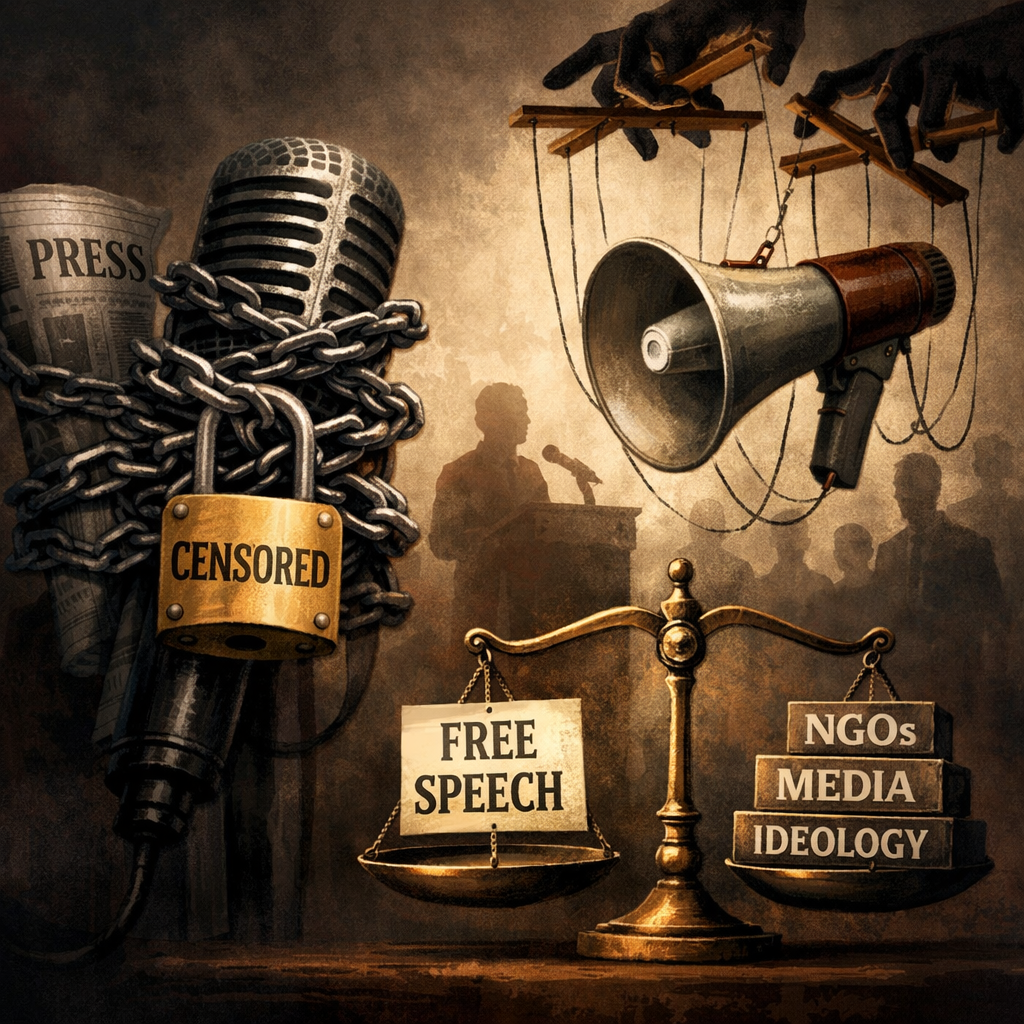
‘Civil society,’ by all means, has a role to play, but democracy works primarily through its elected bodies. NGOs, even if some of them do sincere and important work, are unelected, opaque, and potentially carry security risks for a country. These risks may manifest in multiple ways: by becoming channels of foreign influence through funding and international pressure; by providing cover for anti-State activities; and by resisting regulation and accumulating extra-Constitutional power. All NGOs are certainly not guilty of such activities but enough are to warrant governmental scrutiny and action.
Big Western NGOs with deep pockets taking control of policy in entire sectors or nations themselves is a worldwide concern, and the lattice-work of local and global activists bringing international pressure upon national governments–by lobbying with foreign governments or driving down ‘global ratings,’ to mention just two tactics–has become a serious concern in the global South. Just recently, the World Bank was forced to make changes to its World Governance Indicators (WGI) system after concerted global South action protesting the inherent bias in their methods. This example, amongst others, shows why NGOs (along with academics, think-tanks, and others) are seen to be part of a system of mutual-endorsement and influence-peddling that often pushes transnational and unclear agendas.
Observe, for instance, that Shah’s PSA for Amnesty India aired months before the 2019 General Elections in India: that is to say, it was soft campaigning against the BJP. While an NGO certainly has a right to be political, the citizen has an equal right to satisfy themselves about an NGO’s true ideological goals, funding, and foreign influences.
This is also true for a celebrity, like Shah, endorsing an NGO: a citizen has a right to know or guess at the celebrity’s biases and ideology before accepting a message as a moral truth. In the spirit of such questioning, let us examine the impression that the Modi government’s actions against NGOs are a new and novel threat to the Constitution.
The enactment of laws against foreign-funding in India dates back to 1976, and a stricter law was passed in 2010–both by Congress governments. Clearly then, serious concerns about NGOs predate the Modi government. Former Prime Minister Manmohan Singh had said: ‘There are NGOs, often funded from the US and the Scandinavian countries, which are not fully appreciative of the development challenges that our country faces.’ Also, his government canceled the licences of three NGOs involved in protests over the Kundakulum nuclear power project.
A leaked document from India’s Intelligence Bureau (IB) in 2014 (after Prime Minister Narendra Modi came to power) is reported to have estimated a 2-3% negative impact on India’s GDP due to NGO activities. Predictably, the report sparked an outcry about suppression of dissent from NGOs before any action had been initiated. However, the actions and thinking of successive governments shows the potential (and possibly real) harm to India from poorly-regulated NGOs. Issues such as the ‘disproportionate number of NGOs in India and their lack of transparency and accountability’ and ‘allegations of corruption against NGOs’ are known and serious concerns even for staunch supporters of this sector. This contextualization is essential, and it cannot be brushed aside merely because a grandstanding celebrity associates with a high-profile NGO.
That NGOs working for citizen’s issues might need protection from governmental pressure is a reasonable expectation. However, it is also reasonable to impose regulations that ensure that NGOs do not go against national interest–as defined by an elected government and subject to the Indian judicial process–and that they do not represent transnational ideological or geopolitical agendas that undermine the Indian State. Further, it is important to ensure that a nexus of NGOs, media houses, political interests, and business interests does not undermine either an elected government’s functioning or an ordinary citizen’s rights.
Currently, the organizational heft of NGOs and the connections of their top-tier workers gives them access to political backing, legal services, press coverage, alternative employment opportunities, and even international support. Therefore, agenda-driven nexus-systems involving NGOs are potentially in a position to manufacture issues and events for propaganda purposes or to elicit international interference. In this, they can rely upon their own ecosystem for media coverage, legal aid, international pressure, domestic political pressure, and so on. In this way, they can exert an inordinate amount of pressure upon an elected government or, worse still, against specific social groups or even individuals. These manufactured events may be passed off as a ‘protection of free-speech issue,’ for instance; but in reality they do nothing for the ordinary citizen’s free speech, as the ordinary citizen deals with the suppression of their speech by themselves and at their own expense, not to mention peril.
Does that mean that NGO activity must be curtailed? No. But they must be well-regulated. And given the possibility of misuse of NGOs, the onus must be on the NGOs to convince the elected government, judiciary, and, more importantly, the ordinary citizen that they are compliant with national regulations and aligned with national interests. Simply put, NGOs must practice the transparency they preach in order to receive genuine public support against governmental overreach. The same applies to the other supposed ‘victim’ of the BJP government according to our ‘conscientious celebrities’ and their allies: the media.
Shah’s Distress About the Media
Shah’s PSA also talks about supposed curtailment of media freedom by the BJP government. Media freedom is an important issue in any democracy, but to suggest that disturbances in this sphere are new or exclusive to one political party is entirely false. Controversies about media ownership emerged repeatedly during other parties’ rule as well; and, without going into the merits of these cases, a clear pattern runs through them: lack of transparency in media holdings, operations, and finances. This is not an attempt to blame the victim but merely to point out that in order for the media to claim the moral high-ground it must first occupy it.
Consider this: in the early 2000s, the Congress-led government in the (then) combined Andhra Pradesh (and later the YSRCP government in post-bifurcation Andhra Pradesh) took on the Eenadu group–which had national presence. This did not set off a flurry of international ‘civil society’ complaints about media freedom, though it did trigger some domestic journalists and news organizations.
The case of New Delhi Television (NDTV) is even more striking. The company saw wild expansion in the early 2000s, which coincided with the Congress-led United Progressive Alliance’s (UPA) rule. NDTV entered into strange collaborations like a channel showing just French cinema and a lifestyle channel with Kingfisher Airlines. The viability of such channels was hard to imagine, let alone see play out. The group’s flagship channel NDTV 24X7 did lead English-news viewership for quite some time, but Indian-language news channels clearly dominated the space and English news constituted just a small percentage of overall viewership. There were murmurings about the management’s proximity to the Congress leadership and about mismanagement, though nothing was publicly revealed at the time. But the fact that NDTV was under severe financial strain well before the BJP came to power is not in question.
It is now alleged that NDTV’s founders were forced to sell the network to the Adani Group, which is perceived to be close to PM Modi. Two plausible scenarios present themselves in a case like this: one, that the incumbent government launched nuisance investigations to harass a transparently-run but hostile media organization; two, the incumbent government launched investigations into a hostile media company that had unclear funding sources (including possible off-shore funding), was possibly mismanaged, and was definitely cash-strapped.
If the latter is the case, then NDTV cannot shout ‘press freedom’ for being investigated. The only situation that it can do so is if it is able to provide clear proof of governmental pressure on behalf of the Adani Group. In the absence of such proof–drawing from one of the channel’s many boastfully-titled shows–The Nation Wants to Know who financed NDTV and kept it afloat for so long, and to what end?
Just as NGOs are suspect when they equate government action against them to challenges to the citizen’s freedoms, media organizations must be viewed critically as well. The Congress government’s action against the Eenadu group was justified by the governments at the Center and the State on the grounds that corporate wrongdoing cannot be excused in the name of press freedom. The same would hold true for NDTV as well, unless being anti-Modi comes with corporate-governance and foreign-exchange rule exemptions.
At the risk of belabouring the point, it is worth pointing out that early in the NDTV 24X7 launch event (perhaps in 1998) Prannoy Roy declared that ‘confidentiality clauses’ prevented detailed discussion of their finances. The irony of the transparency-preaching NDTV founders not being able to reveal who financed their company went unremarked upon at the time. NDTV would later run Right to Information (RTI) marathons hauling up minor officials in the name of transparency–drumming up favorable press for the RTI legislation–when it itself hid behind confidentiality clauses.
Similarly, early in the Modi years, Hindustan Times’s editor, Bobby Ghosh’s departure was reported as the result of Government of India (GoI) pressure. A government forcing out an editor is certainly news, but a greater news-story gets overlooked here. Ghosh’s departure was speculated to have been forced by the management to protect its commercial interests, which are heavily tied to government patronage.
Surely then, the real question is this: why is the ‘free press’ entirely dependent on GoI participation at their conclaves, government ad revenue, and government indulgence in general? And if it is, then shouldn’t the pretence of being independent be toned down as well? Recent experiences in international media, such as Jeff Bezos’s interference at The Washington Post and comedian Jimmy Kimmel’s temporary cancellation at ABC, have made apparent the band of commercial concerns that the ‘free press’ is free within.
Media financing, ownership, and influence are intimately connected with press freedom and must be discussed openly in the interest of having a free press. This applies equally to Indian media funded by foreign sources, Indian media funded by Indian high-networth individuals, and to foreign media operating in India. And in the case of Indian networks like News18 and NDTV, which struggled financially and needed buyouts, the attempt to pass off one buyout as routine and another as political must be looked at with skepticism unless clear proof of undue pressure is produced.
The other insinuation, that exerting pressure on the media is unique to this government, also doesn’t hold water. Media-owner Kalli Purie’s recent statement about pressure from a presumably Congress government and the Indian Express’s targeting during the Emergency and the Bofors scandal gives the lie to such assertions.
The BJP’s actions are certainly not justified by the Congress’s precedents, and I have no intention of making the BJPgovernment’s case. However, I do object to ‘publically-minded’ celebrities passing off political statements as moral ones. Will these celebrities commit to standing for the cause rather than for a political party or coalition? The Eenadu case, reactions to the arrest of Republic Media Network’s editor-in-chief Arnab Goswami, and recent claims by the Punjab Kesari of being targeted by the Aam Aadmi Party (AAP) government in Punjab demonstrate that they will not.
So, unless Shah sleep-walked through the UPA years and is now criminally ignorant about press freedom issues around the world, he cannot in good conscience give the impression that the state of media freedom in India is new, unique, or solved simply by voting for another party.
Freedom of Speech in General
That freedom of speech in India is being tested is not in question. Comedians, podcasters, journalists, and ordinary people increasingly find themselves in legal trouble for expressing their views. But if the concern for such freedoms expressed by NGOs, celebrities, or the political parties they promote were genuine, then it is baffling that they remained silent when potentially restrictive laws in the Indian Penal Code (IPC) were retained in the law that replaced it, the Bharatiya Nyaya Sanhita (BNS).
The bafflement diminishes when one sees that there is little outrage expressed by this very set of ‘conscience keepers’ when people on the other side of the ideological divide are targeted. For instance, one doesn’t recall Shah or his ilk speaking out when policemen from Congress-ruled Karnataka arrived in Noida to serve a ‘notice to appear’ on podcaster Ajeet Bharati, in a brazen attempt to intimidate him. There was no call to vote against the ruling Trinamool Congress (TMC) when a professor was arrested and attacked in West Bengal merely for forwarding a cartoon satirizing the Chief Minister. The TMC’s designation as a ‘secular’ party presumably placed it above all freedom-of-speech concerns. The protests and violence that followed the Nupur Sharma controversy, where ‘sar tan se juda’ chants were raised, didn’t attract a Shah outburst. Rather, he called the BJP suspending Sharma ‘too little, too late’ and challenged her to show even one recording of a ‘Muslim derogating (sic) the Lord Ram or the Lord Krishna.’ Perhaps he’ll accept this video clip of Akbaruddin Owaisi mocking and insulting Hindu gods? Yet Shah is accepted in ‘polite society’ to be speaking for free-speech.
The recent deferment or cancellation of a literary event in West Bengal because Islamic conservatives [specifically, the Jamiat Ulema-e-Hind, a Deobandi organization] objected to the presence of Javed Akhtar, an atheist, is even more enlightening. Shah wrote a piece about it, where he criticized the uncivilized language used against Akhtar, wondered if jealousy (‘the green-eyed monster’) was a factor in keeping Akhtar out, questioned why religious faith was required to contribute to Urdu, and so on. But before one hoists Shah on their shoulders for standing up for free speech and calling out illiberality in all communities, take a moment to acknowledge the elephant in the room: what does Shah not mention?
The politics behind the cancellation. The organizer of the event, the West Bengal Urdu Academy is a state government organization with a ruling Trinamool Congress (TMC) MP as vice-chairman and Chief Minister Mamta Banerjee as Chairperson. What doesn’t figure anywhere in Shah’s criticism is that the TMC is accused by the BJP and many others of pandering to Muslim fundamentalist forces.
Leftist activist Shabnam Hashmi, however, doesn’t hold back. She wrote: ‘”This is the beginning. I have been shouting from the rooftop, telling my fellow senior activists and the young ones to stop legitimising platforms run by the Muslim right. I have been systematically pushed to a corner within the Delhi civil society because I refused to share platforms with Muslim right-wing orgs while a large number of senior activists are fooling themselves in the name of fighting against majoritarian politics. Struggle for democracy, equality, dignity of minorities- Muslims, Christians, Jains, Sikhs can be fought only within the framework of the Constitution.”’ She tagged Akhtar and added: ‘”If you are open to it, I will organise the program in Kolkata. Dekhti hoon kiski himmat hai jo rok de (Let’s see who dares to stop it).”’ Neither Shah nor Akhtar has taken notice of or responded to Hashmi’s comments. Why not?
Would either Shah or Akhtar have hesitated to politicize this incident if a Hindu group had instigated the cancellation or if it had happened in a BJP state? But so tied is the ‘minority-progressive celebrity’ (MPC) to the vote-bank politics of ‘secular parties,’ which involves pandering to minority fundamentalists, that they will not criticize them directly. This silence on the underlying politics isn’t remotely accidental.
It isn’t new either. Salman Rushdie’s visit and then presence via videolink at the Jaipur Literary Festival were called off in 2012 due to Islamist protests [spearheaded by a Deobandi organization then as well]. Four authors at the festival who read from The Satanic Verses in protest were then forced to flee Jaipur for fear of arrest. Both the Central and State governments at the time were ruled by the Congress party. The usually outspoken Akhtar was evasive in his response and appeared to blame the authors for the form their protest had taken. Yet freedom of speech did not seem imperiled to Shah or Akhtar at this time. Or did they just feel that siding with the political parties they favored was more important than free speech itself?
It appears that Shah is now preparing to perform a theatrical piece based on Salman Rushdie’s near-fatal stabbing in 2022. It will be interesting to see if Shah remains true to what actually occurred or attempts to turn this instance of Islamic-fundamentalist violence into a harangue against the Hindu-Right! Perhaps, now encouraged by Salman Rushdie’s concerns about ‘Hindu nationalism,’ they can together blame the attack on Rushdie on the Rashtriya Swayamsevak Sangh (RSS)!
Ultimately, the issue of freedom of speech and expression isn’t about approving of particular people, their activities, or their ideologies–it is about treating certain freedoms as being above political divides. It is abundantly clear from the instances above that people like Shah don’t aspire to these standards. One could easily dismiss their statements as outbursts of old men embittered about their diminishing influence. But that is simplistic: it is important to keep in mind that celebrities like Shah are people with axes to grind who pass themselves off as ‘principled commentators.’
Anguish about the State of Society As A Whole
‘[T]he insecurities of men are increasing and that is why there is a push for hyper-masculinity,’ Shah recently stated. ‘Hyper-masculinity’ is, of course, a dogwhistle for the political right–one guesses the Hindu-right in this case. But even if Shah wasn’t referring to politics at all, can he really be serious? Does he recall the films of the 1970s, 80s, and 90s when he was most active?
Back then, scenes of rape were inserted in films supposedly for ‘tittilation’ and discussed as such in film magazines; suicide was shown as an ‘honorable way out’ for victims of rape; alternatively, victims married the rapist or married a ‘savior’ male. The end of every dramatic argument–especially if it involved a woman–was a ringing slap across the face; men committed bigamy so a woman’s ‘life wouldn’t be ruined’; and so on and on. If Shah genuinely believes that patriarchy, male insecurity, and toxicity in films and society is peaking now rather than back then, he should seriously be concerned for the state of his judgement, if not memory.
Conclusion
But assuming that Shah knows his statement is absurd, then he is being dishonest and manipulatiive.The true reason then for his statement would be to create an impression of a moral collapse and to claim that Hindu assertion (in the form of a BJP government and agenda) is both a cause and consequence of it. That is better called out for that it really is: an attempt to morally-shame the majority for their political choices. The likes of Shah should be wary of calling ‘wolf’ in the name of freedom all too often, for the people of today are increasingly wary of hypocrisy and ever on the look-out for wolves in sheep’s clothing.
Leave a Reply