
In the Baburnama, Babur’s own memoirs, we find an approach made by an envoy of Rana Sanga offering joint action against Ibrahim Lodi, and later, an allegation that Rana Sanga had violated that. It has been debated for more than 100 years and continues to be debated to this day, historians trying to come up with a better understanding of what that passage has told them.
This article isn’t trying to resolve it either. It attempts, on the basis of the available evidence, to determine what is known with certainty, what is less clear, and what cannot be confidently concluded, based on each of the two possibilities, namely, that the individual is or is not a traitor.
The following is based on four questions which are not interchangeable: Was there any communication between Rana Sanga and Babur? If it did, was it an invitation to attack Ibrahim Lodi? What was the motivation for both sides in doing so? Does any of this make Rana Sanga a “traitor”? Much of the modern debate reduces these four questions to one and that’s where it goes wrong.
A Weakening Sultanate
Roughly five hundred years after Muhammad Ghori defeated Prithviraj Chauhan in 1192, the Delhi Sultanate had passed through five dynasties. The last, the Lodi dynasty, ended with Ibrahim Lodi, who took the throne in 1517 on his father Sikandar Lodi’s death and ruled about nine years, until Mughal forces overran it in 1526.
Ibrahim Lodi inherited his father’s sultanate which was on the verge of collapse: governors who had fought under him had proven less reliable under him, and he was extremely suspicious of much of the nobility, jailing relatives of those he suspected of rebellion and replacing trusted commanders with those he felt he could rely on, a rule of suspicion rather than consolidation.
The Rise of Rana Sanga
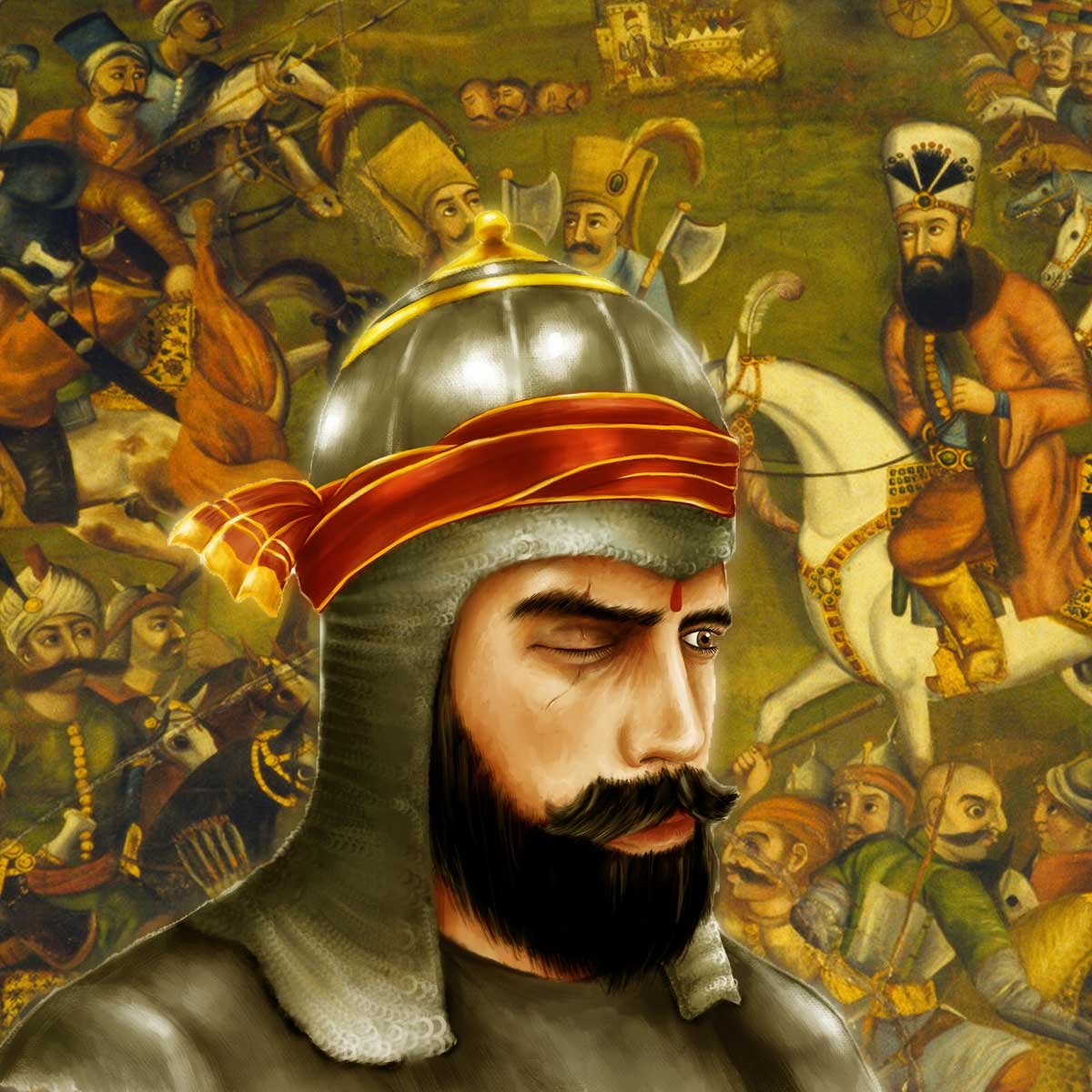
South-west of the sultanate lay Mewar. Rana Sanga’s father, Rana Raimal, died in 1509 after a bitter succession dispute among his sons, in the course of which Sanga is said to have lost the sight of one eye; he was crowned Maharana of Mewar on 24 May 1509. Over the next decade he built one of the era’s most formidable military reputations, defeating Malwa, extending Mewar’s reach into northern Gujarat, and fighting Ibrahim Lodi’s forces to a standstill.
Mewar’s neighbors were Muslim sultanates, such as Lodi, Malwa and Gujarat, as well as other regional powers such as the Rajput, known for centuries for their rivalries and changing alliances. It’s accurate to say that Mewar was a Hindu kingdom surrounded by Islamic kingdoms, but this fails to convey the full picture, as Mewar and the neighboring states were influenced by dynastic ambition, territorial rivalry, and weddings that were sometimes arranged on religious grounds.
Sanga had fought three major battles against Ibrahim Lodi’s army at Khatoli in 1517, Dholpur in 1519 and at Ranthambore in 1521 during which he was wounded in his arm and leg for which he is most remembered. There are eighteen battles attributed to him in his career and more than eighty wounds.
That reputation and his willingness to take the lead despite injuries drove Rajputana’s rival houses to join him in a larger coalition than they had formed in generations. It is a sort of exaggeration to say that “all the Rajputs were united” because several houses remained outside of it, and the coalition that fought at Khanwa in 1527 was a coalition of convenience in which each house was essentially under the control of its chief and not in any sense a political union. By the early 1520s Mewar’s border had extended northward towards the Agra region, but not to Agra, and Delhi was within reach, and perhaps only a generation out of reach, for the first time in many years.
Babur’s Long Road to India
Babur was born in the Fergana valley in 1483 and ruled over it as a child; he twice conquered and lost Samarkand until in 1501 he was expelled from Central Asia by the Uzbek warlord Muhammad Shaybani Khan. In 1504 he established a base at Kabul and during the following decade made several unsuccessful attempts to win back Samarkand. He failed in that endeavor and after that, his desire went towards Hindustan, as he writes in Baburnama that he had long thought about it and that there was something attractive about not being within the reach of his rivals.
Sikandar Lodi died in 1517, and Babur got his chance when the less experienced Ibrahim Lodi ascended to the throne. He launched four or five incursions into the Punjab, capturing Bhira, then Sialkot, and finally in 1525-26, Lahore, and on 21 April 1526, he was successful in his invasion of the Delhi region, where Ibrahim Lodi was defeated at Panipat.
The reasons why Babur wanted to establish a foothold in Hindustan were also independent of Rana Sanga. While it is important and is smaller than it seems, at least it demonstrated that there was no need to invite Sanga in order to explain Babur’s invasion, but it does not mean that there was no such invitation. All those are questions in themselves and the first can’t resolve the second.
The Baburnama and the Alleged Proposal
The main source on which the story of Babur “inviting” Sanga is based is Babur’s memoirs. In it Babur mentions that an envoy from Rana Sanga had come with an offer to take action in tandem to Ibrahim Lodi: in general, if Babur would go on Delhi from north side and Rana Sanga would go on Agra, they would divide the land between them. Babur subsequently records that when he conquered Delhi, Sanga took no action on Agra, and claims that Sanga had broken faith.
It is important to note this passage for what it says rather than for what it does not say; it is important to note this passage for what it means, and not just because Babur had a personal interest in it. The Baburnama remains a primary source for the historian in the form of a memoir of a ruler, and in this respect, it is remarkably frank in its account of what it says really happened. In the end, however, it was a man’s story in which nothing, but his word remains of a diplomatic encounter gone wrong: delivered by an ambassador, recorded merely for the purposes of the party that was angry about it. It is not possible for the Baburnama to reconstruct what was Sanga’s real intention as opposed to what he believed or claimed to believe. That is the interpretive issue that fuels this debate and one that serious historians still disagree on.
Other Invitations to Babur
Two more attacks from within India are mentioned in Babur’s memoirs. The governor of Punjab, Daulat Khan Lodi, asked Babur to attack Ibrahim Lodi, who had expected him to retreat carrying off loot and leave Punjab and Delhi undefended. An uncle of Ibrahim Lodi, Alam Khan Lodi also approached Babur with his claim to the throne. Daulat Khan’s invitation is supported by Mughal sources and also in Rajputs’ as compared to the one used by Sanga. Such was Babur’s strategy that he conquered them first and then turned on Daulat Khan.
These other invitations do not negate the occurrence of Sanga’s. It demonstrates that Babur’s act of intrusion in North India was not the result of any single actor’s invitation even if it was Sanga. He had his own motives, other Indian allies ready to work with him, and readiness to use and drop each one that is useful.
The Historiographical Debate
Historians who have examined this episode fall broadly into three positions.
Interpretation A: Babur’s account substantially reflects what happened. On this interpretation, Sanga did communicate with Babur, he hoped that he would weaken or remove Ibrahim Lodi and he and Babur had a tacit or explicit understanding, which Sanga failed to keep — perhaps because he changed his mind or he misjudged Babur’s intentions or he was overruled by his court. Satish Chandra makes a case for Sanga hoping for a long and tiring Babur–Lodi tussle which would give Mewar the chance to build strength in the void, without getting himself locked into the Babur–Lodi conflict.
Interpretation B: Babur’s account should be treated with caution. G.N. Sharma et al. doubt the veracity of Babur’s narration. It is not clear that Sanga needed the assistance of Babur; a fractured partnership does not mesh well with his twice-battling Babur instead of mending relations. A sense of betrayal might have been useful to Babur as a political move; once Delhi was conquered and his soldiers wanted to return home, he had a legitimate grievance against a strong rival and an excuse to continue campaigning.
Interpretation C: Babur may have sought Sanga’s cooperation, not the reverse. Based on the tradition of the Rajputs, Rima Hooja makes the assertion that Babur was the one who offered an alliance against the Lodi sultanate, and Sanga’s own ministers used to oppose it, which is why the Mewars were not included in Babur’s army when he fought Ibrahim Lodi at Panipat. It is a coherent and historical alternative but, it has been based on traditions which were compiled long after the events it describes and of which there is no contemporary document to stand against Babur’s testimony. It is a real, evidence-based counter-reading, NOT an accepted fact which replaces the Baburnama.
Bayana and Khanwa
By late 1526, Sanga had emerged as Babur’s most serious remaining opponent in North India. In early 1527 his forces besieged and took the fortress of Bayana, defeating a Mughal relief force under Mir Abdul Aziz. The defeat badly damaged morale in Babur’s camp, already strained by heat, homesickness, and over a year of campaigning; several senior commanders wanted to withdraw altogether.
Following the convention of the time — one that had already cost him dearly, since Ibrahim Lodi had escaped before — Sanga did not pursue Babur’s retreating forces, giving him roughly a month to regroup. Babur used the time deliberately, declaring the battle a jihad and casting a war of conquest as a religious obligation, hoping to steady his demoralised troops and draw Muslim contingents from Sanga’s coalition. To make the declaration credible from a ruler not known for piety, he publicly renounced wine, destroyed his liquor stores, and abolished a tax on Muslims — measures aimed at troop morale rather than at Sanga’s forces directly.
The armies met near Khanwa, west of Agra, on 17 March 1527. Sanga’s coalition — Rajput contingents from Mewar, Amber and Marwar, alongside Afghan allies including Mahmud Lodi and Hasan Khan Mewati — significantly outnumbered Babur’s force, though precise figures vary too widely across sources to state with confidence. Babur’s decisive advantage lay in his field artillery and matchlock infantry, deployed behind a fortified line of wagons, the same arrangement that worked at Panipat the year before. Repeated Rajput cavalry charges failed to break the line, and Sanga’s war elephants, panicked by cannon fire, added to the disorder in his own ranks. The coalition was fragile too in another sense: each contingent answered chiefly to its own chief, and the fall of a leader tended to prompt withdrawal rather than a rally under new command.
Sanga himself was struck by an arrow and fell unconscious; he was carried from the field by Prithviraj Kachhwaha of Amber and other nobles. According to a tradition recorded by Rima Hooja, the nobleman Ajja Jhala, who resembled Sanga and wore his insignia, held the field in his place and was killed in the fighting that followed. Without its king visibly present, the coalition broke, and Khanwa was lost.
The Final Defiance
Carried unconscious from the field, Sanga is said to have first believed his side had won. On learning otherwise, and that Babur was advancing towards Chanderi, he reportedly declared he would not return to Chittor until he had faced Babur again. His commanders, mindful that Mewar needed time to recover, urged restraint; by most accounts, Sanga refused it. He died on 30 January 1528, roughly ten months after Khanwa, at Kalpi. Some later accounts attribute his death to poisoning by his own circle, fearing a renewed campaign; the claim is not established by contemporary evidence and is best treated as a persistent but contested tradition.
Conclusion
The label “traitor” does not sit easily on Rana Sanga. If it belongs to anyone, it belongs to those who, faced with a divisive claim, choose to support it or stay silent rather than examine it. Babur’s memoir is important evidence and cannot simply be set aside. It records what its author presents as a proposal from Rana Sanga and remains the fullest surviving account of the exchange. But its purpose, precise content, and reliability on this point remain genuinely disputed, and no independent contemporary source confirms Sanga’s side of the story. Babur, meanwhile, had entered India for reasons that had nothing to do with Sanga, and had already received invitations from Daulat Khan Lodi and Alam Khan Lodi before any communication with Sanga is recorded. Whatever passed between Mewar and Kabul, it was not the sole, or even necessary, cause of the Mughal invasion.
What is not in dispute is what came after. Rana Sanga became one of Babur’s principal opponents, assembled the largest Rajput coalition of the age, defeated a Mughal force at Bayana, and fought Babur to a costly standstill at Khanwa before artillery and a fractured command decided the battle against him. He paid for that resistance first with an arrow to the head, and ten months later, with his life.
Sources and Further Reading
Primary sources
Babur. The Baburnama: Memoirs of Babur, Prince and Emperor. Translated by Wheeler M. Thackston (see also Annette S. Beveridge’s earlier translation).
Dughlat, Mirza Haidar. Tarikh-i-Rashidi.
Secondary scholarship
Hooja, Rima. A History of Rajasthan. Rupa & Co., 2006.
Sharma, G.N. Mewar and the Mughal Emperors (1526–1707 A.D.). S.L. Agarwala, 1954.
Chandra, Satish. Cited on a prolonged Babur–Lodi conflict rather than a firm alliance.
Smithsonian Institution (Asian art collections). On Babur’s renunciation of wine before Khanwa.
Journalistic coverage of the 2025 controversy (context, not historical authority)
Times of India, “Rana Sanga vs Babur: 5 reasons why Mughals didn’t need any invitation to invade India,” 2021.
India Today, “Did Rajput king Rana Sanga invite Babur to invade India, sow seeds of Mughal rule?,” 2025.
LokMarg, “Rana Sanga Didn’t Need Babur To Defeat Lodi; He Had Done It Twice On His Own,” 2025.
Leave a Reply