
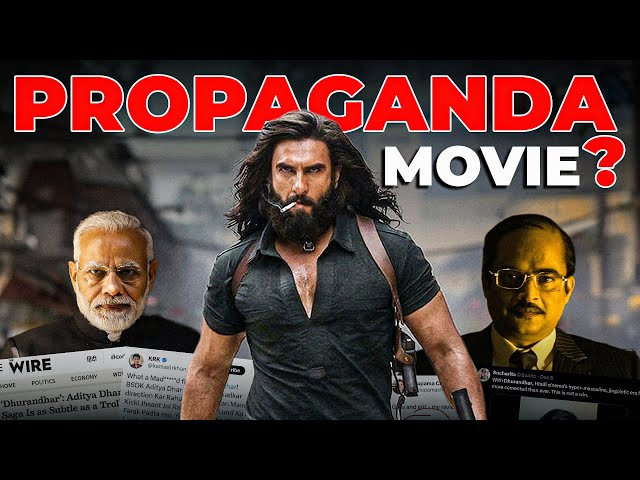
Part 1: Bollywood Isn’t Propaganda?
By setting Dhurandhar in Pakistan Aditya Dhar put into practice a credo he popularized: ‘ghar mein ghus ke maarenge.’ Taking his story behind enemy lines, into the lives of the Pakistani establishment and underworld, Dhar plunges the audience into a hitherto unknown space–a space where the usual Bollywood genre conventions no longer hold. The result: two cinematically-brilliant films where India isn’t victim-blamed and excuses aren’t made for the bigotry and supremacism that drive Pakistan’s proxy-war against India. Sections of the Indian film industry and commentariat–not just Pakistan’s–accused Dhurandhar (used hereon to refer to both films in the franchise) of being Islamophobic, Hindu-nationalistic, and propagandist.
‘Propaganda’ or ‘counterpropaganda’?
Many critics were enraged at Dhurandhar’s portrayal of the incumbent Bharatiya Janata Party (BJP) government and its Pakistan policy, but that doesn’t explain all the venom directed at it. We will look at the government angle in detail, but let us first ask what messages and values Dhurandhar’s story contains that some found so problematic?
Dhurandhar holds that: a.) Pakistan is an enemy state that fuels terrorism in India; b.) Pakistan weaponizes Islamic fundamentalism domestically and to target India; c.) the Pakistani establishment believes in the Two-Nation Theory and fantasizes about ‘Ghazwa-e-Hind’; d.) Pakistan treats its ethnic and religious minorities appallingly; e.) Pakistan uses its domestic and Indian underworlds to facilitate terrorism and more in India; and f.) Pakistan exploits Indian peace overtures to expand its proxy war and influence in India.
Given that ample nonpartisan evidence exists confirming all these as facts, the real question is this: why should any Indian–majority, minority, Right-leaning, or Left–find this messaging objectionable? Pakistan may call it propaganda, but why should Indians?
Yet the reactions of Bollywood, its media ecosystem, and Opposition-leaning commentariat almost imply that not being exculpatory of Pakistan (especially for its use of Islamic fundamentalism) and not making peace overtures to Pakistan–as previous governments had done repeatedly–are somehow signs of Islamophobia, hostility towards Indian Muslims, and Hindu-chauvanism. These, the critics declare, are Dhurandhar’s problematic values, which make it propaganda.
Now, any narrative that stands for certain values may reasonably be termed propaganda. But by that yardstick the critics’ reactions are also value judgements and therefore, by definition, propagandistic. So, it isn’t Dhurandhar being propagandist per se that’s problematic but that its values are at odds with the Bollywood’s default propaganda position. But what is Bollywood’s default propaganda position?
Bollywood Propaganda
Bollywood has normalized, internalized, and commercialized the ideological dogma of India’s post-Independence political elite. This elite’s pre-Independence approach on Pakistan resulted in the Partition but the elite persisted with a watered-down version of the same approach post-Independence. This ruling elite was also enamoured of socialism, and so Bollywood eagerly became a socialist propaganda machine and remained one right until the ideology bankrupted India in the late 1980s. In the 1990s, Bollywood made a u-turn capitalism ward hot on the government’s tail. But socially Bollywood’s loyalties remained where they were. In significant part this was because the social agenda had become structural: the artists, markets catered to, and the messaging were too closely tied to political interests to change. So, Bollywood’s ideology remained a spurious mix of Nehruvian thinking and the Congress and Left’s realpolitik passed off as ‘liberalism’ and ‘secularism.’ These political forces believed Hinduism to be a nuisance best suppressed and adopted ‘appeasement’ policies towards the minorities (a continuation of the elites’ pre-Independence approach), so this became Bollywood’s default agenda. It went largely unchallenged until well after 2014.
To conceal its Hinduphobic slant, the agenda was couched in the language of reform. Hindus’ eagerness to change with the times also made them particularly vulnerable to this framing. And so, the ‘reform agenda’ template, which mirrored the political messaging of the time, came into being. It had three elements: portraying Hinduism and Hindu society in poor light; depicting adoption of Western ideologies as ‘progress’; and showing Indian minorities in an unfailingly good light–tacitly or explicitly contrasting them with the ‘regressive’ Hindu. Each element promoted a value and also contained unspoken redlines not to be crossed.
Dhurandhar tramples all three elements underfoot and kicks through the industry’s lines in the sand. The film has no Indian or Hindu self-flagellation; no Western ideologies to turn to for direction or affirmation; and it uninhibitedly depicts Islamic fundamentalism being weaponized against India. It is no surprise then that Bollywood’s ideological minders were up in arms: their longstanding codes of silence were being scattered to the winds.
Bollywood: useful idiots, profiteers, or both?
Since its founding, Pakistan has thrived on animosity towards India; but so deep does Bollywood’s structural ideology run that it extends the ‘good minority’ convention to Pakistan! Other disturbing Bollywood trends–like stars shouting ‘Islamophobia’ if Aurangzeb or Alauddin Khiliji are depicted negatively or if the Mughal era is not accepted as a ‘golden age’ for all– contain disturbing echoes of Muslim League rhetoric. Yet Pakistan-sensitivity in Bollywood culture has been normalized.
More unsettling is the tendency amongst mainstream films–like the YashRaj spyverse–to show the Pakistan establishment in good light. They often contain plotlines where Pakistan’s Inter-Services Intelligence (ISI) is wrongly blamed for anti-India actions of non-state actors and the like. Indians and Pakistanis are also shown to be one people kept apart by official cynicism on both sides equally.
Now consider Pakistan’s official strategy. First, it denies involvement in terrorism–despite India presenting overwhelming evidence–and blames it on non-state actors. Second, Pakistan wants talks regardless of terror events in India–indirectly requiring India to accept the ‘non-state actor’ explanation. Third, Pakistan’s civilian governments seek Indian concessions ostensibly to strengthen them against their own hawkish army, but these concessions are inevitably sought in bad faith. Fourth, Pakistan uses Indian restraint during periods of dialogue to build its influence and its terror and secessionist networks in India. Fifth, talks allow Pakistan to bargain for more than they can ever get militarily. Sixth, Pakistan evokes historical, cultural, and people ties to weaken Indian resolve. Now consider: does Bollywood impede or promote this agenda?
Former Foreign Secretary Shyam Saran, who is no BJP-supporter, states the following even as he recommends greater people-level interaction: ‘Pakistan also uses our shared language and culture to arouse sentimentality. This mawkishness camouflages its mostly unsentimental aims as a state with hostile intent. Indian civil society and political leaders fall prey to this tactic, having no clue about the ulterior intent. Our bonds of language and culture are very real and should be used to advance links but they must not influence the calculus of interstate relations.’
‘The calculus’ of Indian policy for over a decade now has been that terror and talks cannot go together, and that India will respond to terror with strong military action. A question that logically follows is: with the exception of Dhurandhar, why is Bollywood’s messaging in lock-step with Pakistan’s strategic calculus and not India’s?
Bollywood’s Geopolitical Melodrama
In significant part, Saran’s comment and the structural embedding of the ‘reform agenda’ explain Bollywood’s ideological slant. But two additional factors play an important part: one, the belief that anti-Pakistan content alienates Indian Muslims (a perception encouraged by so-called secular parties and media); and two, the lure of Pakistani-diaspora and Persian-Gulf audiences–incidentally, Dhurandhar was banned in Pakistan and the Gulf. It is this toxic mix of commercial calculations and political cynicism–not idealism–that determines Bollywood’s political agenda.
But how do films with messaging at odds with Indian public sentiment find mainstream success? Many reasons may be at play but relevant to our discussion are the following: one, non-Indian audiences provide a commercial buffer; two, lacking an alternative, Indian audiences take the entertainment despite the messaging; three, the conditioning of the ‘reform agenda’ allows Bollywood content to pass for neutral; and finally, Bollywood uses cloying melodrama and banalities to pass its agenda off as ‘humanism.’ So just as reform language is used to pass Hinduphobia off for ‘reform,’ melodrama is used to pass a Pakistan-friendly agenda off for being ‘humane.’
Ensconced in this environment, Indian stars presume to lecture Indians about art transcending borders even as Pakistani actors hosted, fawned upon, and enriched by Indians–like Fawad Khan and Mahira Khan–openly criticize India and support their own government. Cricket stars sometimes indulge in similar self-abasement. A telling illustration of this is Harbhajan Singh sentimentally declaring Indians and Pakistanis to be one people and Shoaib Akhtar countering it with the Two-Nation Theory. Elsewhere, Akhtar speaks of Pakistan conquering Kashmir and Ghazwa-e-Hind. The total failure of the reform-agenda rationale of ‘winning Pakistanis hearts’ requires no further demonstration.
Dhurandhar and geopolitics
All art has a context and Dhurandhar’s is Independent-India’s national-security history. A well-founded view of this history holds that Indian governments have often squandered the Indian military and intelligence’s gains. Even Indira Gandhi, who severed Bangladesh from Pakistan and held 93,000 Pakistani prisoners of war, let Pakistan off lightly in the hope of boosting Zulfikar Ali Bhutto’s popularity vis-a-vis his own army’s. Bhutto’s private assurances were predictably insincere just as similar assurances are today. Even the newly-liberated Bangladesh turned hostile within just five years, and India did not gain in goodwill or security. In the 1990s, Prime Minister I.K. Gujaral’s bombastic peace ‘doctrine’ set Indian intelligence several years back as he halted the Research & Analysis Wing’s (RAW) hostile operations without reciprocation from Pakistan.
The Vajpayee government’s humiliating exchange of terrorists for the IC 184 hostages (in 1999)–Dhurandhar’s opening sequence–is a scene from another bizarre act in India’s strategic history. The hijacking happened months after PM Vajpayee’s Lahore peace overtures were sabotaged by Pakistani army’s infiltration into Indian territory and the resultant Kargil War. The Vajpayee government then virtually rewarded Pakistan for Kargil and the hijacking with the Agra Summit in 2001. The impression of Indian desperation for peace was further solidified by the Manmohan Singh government’s failure to respond militarily to the 26/11 Mumbai terror attacks (2008). In 2009, Singh allowed a mention of Balochistan in a joint-declaration–hinting at Indian instigation–and committed to a “Composite Dialogue process” not linked to “[a]ction on terror.”’
That this approach was adopted despite its security implications in the aftermath of the 26/11 attacks is mind-boggling. The media group Times of India even launched the ‘Aman Ki Asha’ propaganda campaign in collaboration with Pakistan’s The Jang in support of such initiatives. India, it seemed, was incapable of learning from the repeated failures of the Shimla Agreement approach of imagining there was an ‘opportunity to exploit the possibility for an internal transformation of Pakistan’s body politic’ by avoiding the ‘weakening [of] the […] civilian leadership in Pakistan.’ That this wishful thinking had become India’s security doctrine is perhaps not surprising considering that the Indian elite had not even taken lessons from the Partition. Less discussed is the likelihood that this approach suited the elites’ domestic politics as well.
Narendra Modi’s ascent marked a radical shift away from this old approach. Initially, he took tentative steps towards talks, but following Pakistani terror attacks he didn’t hesitate to respond with airstrikes or cross border special-forces operations. Other rumored measures–though officially denied–include exploiting internecine fighting amongst terror and underworld networks to target Pakistan-sponsored terrorists. Those carrying out these attacks came to be called ‘unknown gunmen.’
The world of the ‘unknown gunmen’ is rich with detail. They gained particular notoriety through tendentious Western-government leaks, Western-media propaganda, and the eager ‘corroboration’ of dubious ‘retired Indian officials.’ Pakistan, Canada, and the Biden administration in the United States led the charge with these allegations. The veracity of these efforts can be gauged from the Canadian authorities’ recent admission to finding no India link to killings there; the case in the US reading more like poorly-plotted fiction; and Pakistan having neither evidence nor a moral leg to stand on. Plausibly, the purpose of this exercise was to ease pressure on politically-influential anti-India extremist groups in the West by bringing international and domestic pressure upon the Government of India. The move backfired. Speculation about ‘unknown gunmen’ killing India’s enemies only bolstered the government’s image in India.
But through this high-decible process, the workings of Pakistani terror networks and Indian counterterror measures entered the popular imagination. An entire mass of facts, think-tank reports, geopolitical analysis, investigative journalism, podcasts, newsreporting, educated guesses, and conspiracy theories suddenly came to light. Suddenly, this shadowy world attained color and form.
This world has its own mythos: ’myth’ not implying fictionality but recurring characters, important incidents, values, and a set of rules by which it functions. Dhurandhar is firmly-set in this particular world of facts, analysis, educated guesses, fiction, conspiracy theories, and an informed strategic view of the Indo-Pak conflict. This view definitely breaks with the strategic view of the past and the politics of the Indian elites who pursued it. By implication then, it breaks with the Bollywood propaganda that promoted the old view–and this explains the volume and tone of criticism. It is only with this contextual understanding that Dhurandhar can be accurately analyzed.
Part 2 : Dhurandhar as counter-propaganda
Dhurandhar is remarkably well-made. Much has been said–and remains to be said–in praise of its craft, but the focus of this essay must stay with the story’s themes and message in relation to opposing narratives. In other words: Dhurandhar as counterpropaganda.
Behind the barrage of scattershot value judgments that Bollywood’s critics fired off at Dhurandhar–jingoism, propaganda, chauvinism, and what not–is a palpable and seething disbelief that a filmmaker dared to disregard Bollywood’s ‘reform agenda’ conventions. Dhurandhar’s subsequent blockbuster success likely confirmed the extent of the threat it poses to Bollywood’s agenda. Let us now examine Dhurandhar’s transgressions of convention by turn.
Transgressing ‘Reform Agenda’ Convention 1
The first convention of the ‘reform agenda’ demands Hindu or (Hindu-dominated) Indian defensiveness or self-flagellation. Dhar’s dismissal of it has major storytelling implications. There is no ‘your own bigotry is equally bad or created this situation’ aspect that the ‘reform agenda’ mandates. Dhurandhar takes a direct and unapologetic position: Pakistan weaponizes terror and Islamic fundamentalism against India–period.
On religion, the film’s choices are subtler: the protagonist is Sikh and references to Hinduism are largely limited to expressions of contempt by Pakistani extremists. But Dhar also doesn’t hold back in depicting Islamic fundamentalism fuelling Pakistan’s hatred. Here, Dhar’s decision to set the story in Pakistan turns the formula on its head: there are no bigoted Hindu characters to partake of the blame for terrorism in India–and with that one change, the Bollywood template struggles to find its feet.
The depiction of the Indian establishment as one that is only responding to Pakistani malevolence is also in defiance of the ‘faults on both sides’ subconvention. This specific aspect pushed some commentators over the edge: the criticism being that Dhurandhar is pro-Bharatiya Janata Party (BJP).
That Dhar supports the BJP-government’s national security policy is no secret: his last two films were Uri and Article 370. He has stated in the past that he cannot ‘negate’ the fact that these aggressive decisions were taken by the Modi government. He has also said that his ‘intent’ in making a film is never propagandistic but well-intentioned storytelling and that the audience can distinguish between the two. He also called out the propaganda intent of those attacking the film. A debate about intentions is ultimately unresolvable, but Dhar’s frustration with critics may well be due to their inability or unwillingness to acknowledge the sophistication of his storytelling.
As described earlier, the corpus of literature on Pakistani Inter-Services Intelligence (ISI) activities and India’s Research & Analysis Wing’s (RAW) countermeasures throw up recurring characters, global forces, events, values, and even speculations. In storytelling terms these would be called ‘archetypes.’ Archetypes contain the weight of history, emotional resonances, contemporary stakes, and values. By setting Dhurandhar within this larger mythos (once again, ‘myth’ not implying fictionality) Dhar taps into the power of these archetypes. He is now able to reach deep to access emotions and meanings associated with archetypes (iconic personalities, historical events, settings, values, and so on) and also go broad to gather contemporary geopolitical events into its ambit. Suddenly, Dhurandhar’s conflicts are suffused with emotional, contextual, and historical charges far greater than a mere espionage story.
For instance, in creating an ‘Ajay Sanyal’ Dhar doesn’t merely use a likeness of Ajit Doval but invokes all of Doval’s lore: his career, reputation, approach to counterterrorism, and role in current events. That is to say: Dhar engages the ‘Doval’ archetype to reinforce his story. The same is true of Modi. Archetypes are engaged even amongst the antagonists: Asif Ali Zardari and Nawaz Sharif amongst politicians, but also Major Iqbal (Iliyas Kashmiri), Rehman Dakait, Dawood Ibrahim, and others amongst gangsters and terrorists. Landmark events like Demonetization, 26/11, and IC 814 are also played off for deeper emotional pay-offs. That Dhar writes with a self-assured hand is especially evident in the way he trusts the audience to provide context (or ‘exposition’) for his story and reach into potent, long-held memories both individually and collectively.
Dhar also draws from the Tarantino playbook to express popular sentiment: showing long-absconding terrorists brought to justice–some of it factual, some of it fiction, some speculation, and some of it counterfactual. This mix serves as a powerful and public cathartic release for an audience grown weary of films that glorify gangsters and tiptoe around Pakistani sensibilities.
This is the real story-rationale for using contemporary political figures and antagonists in Dhurandhar: their archetypal power. That Dhar supports this government’s policy was never in question–unlike regular Hindi films where propaganda is sneaked in–but Dhurandhar resonated with audiences in ways typical Bollywood films or mere propaganda cannot simply because it gave voice to public sentiment.
And if the film portrays earlier Opposition and BJP governments in less-than-flattering light, it reflects Dhar’s belief that they pursued an ineffective and cynical security policy. If Bollywood attempting to pass off an agenda as desirable and moral isn’t propaganda then neither is Dhurandhar. The debate should stop there, but Dhar himself refuses to be onesided in his fiction: in a key revelation of the film, he grants earlier dispensations the credit of having planted a powerful mole in Pakistan.
So given the propagandist intent of the Bollywood ecosystem and Dhurandhar’s use of archetypes, the ‘propaganda’ accusation can either be seen as a diversion to conceal Bollywood’s own agenda or an attempt to silence a valid alternative view. But Dhar’s creation is bigger than the average Bollywood critic’s inanities: Dhurandhar is a film actively in conversation with history, current events, geopolitical strategy, public perception, and the existing propaganda paradigm–it is at once both great cinema and a cinematic event. It represents suppressed popular Indian sentiment bursting through cultural gatekeepers to expression.
Transgressing ‘Reform Agenda’ Convention 2
While Bollywood has often depicted the West in poor light, its embrace of Western ideologies like Marxism and contemporary Leftism is near total. This is in keeping with the ‘reform agenda’ convention of looking Westward for ideological affirmation, but it was also reinforced by a fear that turning to Indian thought might revive Hinduism. The Indian elites’ ideological subservience to the West was much in evidence recently when a few countries accused India of ‘transnational repression’ and mounted an international pressure campaign to make India defensive.
Some political and journalistic sections within India promptly scolded Indians for not being outraged at their own government. As mentioned earlier, these accusations largely fell apart even as Indian public sentiment remained in favor of India taking aggressive action against national threats.
The Indian citizenry’s aversion to the West dictating terms on national security isn’t new or unique to the current government. Indira Gandhi’s defiance of the Nixon administration during the 1971 Indo-Pak War, her decision to carry out nuclear tests in 1974, and the Vajpayee government carrying out the Pokhran nuclear tests in 1998 were equally popular with Indian citizens. That some in the elite are not on the same page reflects the level of their alienation from public sentiment.
Apart from the media though, the film industry refrained from telling stories about Indo-Pak wars until the late 1990s, even then sporadically. In recent years, Bollywood’s messaging has remained indirect. It makes vague ‘woke’ noises in its run-of-the-mill films, wears an entirely Western ideological lens when dealing with ‘serious subjects,’ and appears willing to toe the Pakistani official line in its so-called spy thrillers. Dhurandhar is free of any such inferiority complexes or confusion about its loyalties.
The Indian in Dhurandhar is patient, strategic, and self-assured. This isn’t the Indian of the ‘reform agenda,’ who was to be identified with their faults and ‘reformed’ in order to be acceptable to the West. This is disturbing to ‘reform agenda’ proponents because a self-assured Indian is not easily pliable and was never its desired outcome.
Transgressing ‘Reform Agenda’ Convention 3
While Dhar remains true to the convention of not showing Indian minorities in a negative light, setting the story in Pakistan allows him to brush aside Bollywood’s unspoken tendency to treat Islam, Indian Muslims, and Pakistan as one. The primary harm of the ‘reform agenda’ is that it provided space and cover to minority fundamentalists by preventing portrayal or discussion of negative minority-community trends, but its other major harm is in extending this injunction to include Pakistan. Dhar acknowledges no such injunction.
He doesn’t go over-the-top on the other side either, showing his seriousness as a storyteller. He is confident enough to give his Pakistani characters compelling humanizing dimensions. What he doesn’t do however–as juvenile and predictable Bollywood melodramas do–is treat these dimensions as being automatically redemptive. Dhar understands that archetypal villains–like those in Indian mythology–have good qualities that ultimately don’t detract from the evil they do.
Dhurandhar’s protagonist shares this clarity of thought: he understands that fleeting expressions of human qualities don’t wipe clean the terrible harm that criminality, blood-lust, and bigotry inflict. Some critics actually found fault with Dhar precisely for not taking the sappy route, but Dhar’s faith in a larger principle of justice doesn’t waver and becomes one of the film’s biggest strengths.
Conclusion
What does it say about Dhar that his unsparing depiction of Pakistani malevolence in Dhurandhar doesn’t inhibit him from displaying his–and India’s–affection for Islamic culture? The film draws generously from Pakistani and Middle-Eastern music, showcases the dress of the region, and depicts cultural refinement in parts. In so doing, Dhar disproves the assumption that anti-Pakistan equals Islamophobia or cultural hatred. He shows–rather than tells–that an affection and regard for Islamic culture can coexist with patriotism. Arguably, Dhar presents a new model of cultural ‘secularism’: one free of an ineffective and dishonest ideology and replaced with a more honest, patriotic, and reciprocally-appreciative identity.
The film’s success suggests that Indian audiences, regardless of community, embraced it enthusiastically. Also, at the time of writing, Dhurandhar: The Revenge crashed Netflix in Pakistan as soon as it dropped; Dhurandhar has also become the highest grossing Hindi movie franchise despite being banned in the Gulf and Pakistan. Now it is really for Bollywood to answer why it chose to feign ignorance about India’s strategic interests and grovelled in order to reach Pakistani audiences when India’s soft-power could have been exercised with stories like Dhurandhar.
What Dhurandhar ultimately exposes is the cynicism of Bollywood and its adjacent media ecosystem. It reveals how propaganda templates like the ‘reform agenda’ were used to influence and silence public sentiment. So, the big story is not whether Dhurandhar is propaganda–because it represents its values openly and without subterfuge–but that in transgressing and challenging Bollywood’s entrenched propaganda, it makes the ‘reform agenda’ visible. And that makes Dhurandhar counterpropaganda.
Leave a Reply