
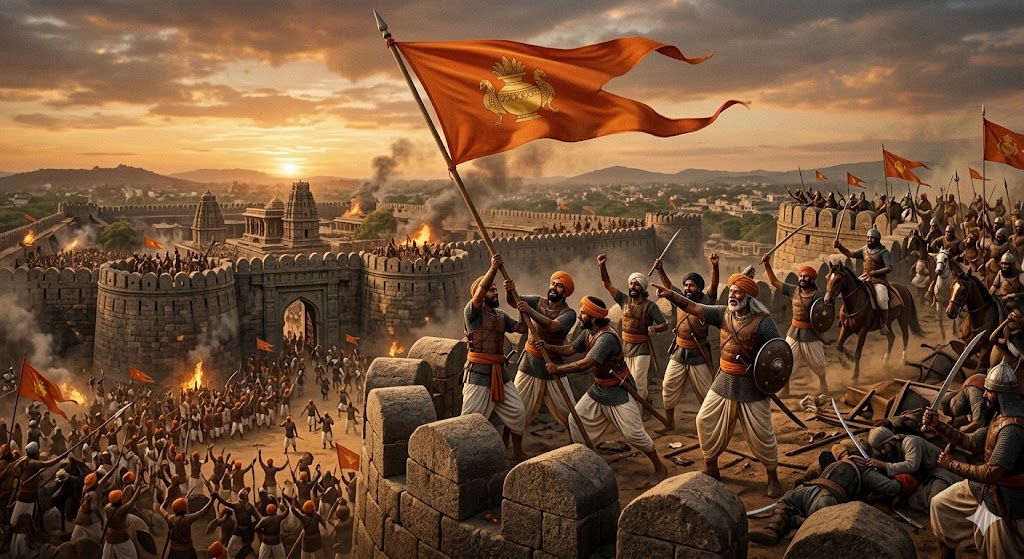
The fall of the Kakatiyas and destruction of Orugallu was a turning point for the Telugu lands. Once Rudrama Devi and Prataparudra’s fortresses had fallen, the Tughlaq army swept southward, dismantling one stronghold after another, Kondavidu, Kolanaveedu, Kondapalli, Nidadavolu, Rajahmundry, and Nellore. The invasion didn’t stop at the Krishna-Godavari belt, it surged all the way down to Madurai, toppling the Hoysalas and Pandyas.
For centuries, the South had been relatively shielded from the devastation that had already scarred the North. But now, the Delhi Sultanate’s expansion brought the same cycle of destruction, temples desecrated, wealth stripped. Heavy taxes were imposed on peasants, crushing agrarian life, forced conversions and religious persecution and looting of riches, leaving towns impoverished.
It was during such dark times that one of the greatest revolts against the Muslim rule would emerge in Telugu land. The Kakatiyas had come up with a system of Nayakas, by which any one could rise to the position of a leader, solely on the dint of their ability, than their caste. This was revolutionary for its time, men from Shudra peasant communities could rise through sheer hard work, courage, and loyalty.
The Nayakas were not mere retainers, they controlled their own territories, managed resources, and fought as independent commanders during campaigns. By Prataparudra’s reign, there were 75 Nayakas serving him, each a pillar of resistance in the military structure. Their rise represented both a social upheaval and a military innovation, a decentralized but fiercely loyal cadre of leaders who could rally local communities against external threats.
This system laid the foundation for later regional revolts against Delhi Sultanate rule, as the Nayakas embodied resilience and autonomy. They became the backbone of Telugu resistance, transforming despair into defiance.
After the fall of Kakatiyas, the Nayakas who had once been the backbone of Kakatiya resistance were scattered. Some tried to carve out their own territories, others were subdued by the invading armies. Many were captured, forcibly converted to Islam, and sent back as governors under the Delhi Sultanate’s expanding rule.
One of the most striking examples is Malik Maqbul, the Governor of Warangal. He was originally Gona Ganappa, a Hindu commander under the Kakatiyas. After the fall of Orugallu, he was converted and reinstalled as a Sultanate governor. His transformation embodies the tragic paradox of the time, warriors who had fought to defend their land now compelled to serve the very power that had subdued them.
It was during such dark and despairing times, two men would come to bring together the Nayakas on a common platform against the Muslim rulers, Bendapudi Annayya Mantri and Kolanu Rudradeva who had served as ministers under Prataparudra. They began reaching out to the dispersed Nayakas, reminding them of their duty to safeguard Dharma and to resist the foreign invaders. Their appeal was not just political but deeply moral, framing resistance as a sacred obligation.
However such a movement needed more than inspiration. It required a leader who could unite them all, someone with the charisma, military skill, and legitimacy to bind the Nayakas into a common front. Annayya Mantri and Rudradeva were the strategists, the organizers, the voices of conscience, but they were searching for a figure who could embody the revolt itself.
Out of the despair, Musunuri Prolayanayaka of Vengi emerged, a formidable warrior, son of Pochinayaka, with three brothers Devanayaka, Kammanayaka, and Rajanayaka. His lineage itself was steeped in valour, but what set him apart was his wise leadership and organizational ability.
Prolayanayaka’s adopted son, Musunuri Kapayanayaka , the son of Rajanayaka, would later become another towering figure of the resistance, carrying forward his foster father’s vision. Together, they embodied both continuity and renewal—Prolayanayaka as the unifier, Kapayanayaka as the executor of the struggle.
The Nayakas were divided, plagued by ego clashes and rivalries. Yet Prolayanayaka managed to bring them together, persuading them to set aside petty differences for the larger cause of liberating Telugu land from the Muslim invaders. This was no small feat, it required charisma, diplomacy, and the ability to inspire trust across fractured loyalties.
Some of the prominent Nayakas who rallied under his banner included Addanki Vemareddy, Koppula Prolayanayaka, Recherla Singamanayaka, Manchikonda Ganapatinayaka, and Vundi Vengabhupathi. The Nayakas put aside their petty differences, focusing on the main objective of liberating Telugu land from the Muslim invaders.
The Vilasa grant is a crucial record that anchors Musunuri Prolayanayaka’s leadership in history. It states that he ruled from Rekapalle, at the edge of the Papikondalu hills, controlling the Sabari river valley between Papikondalu and Bhadrachalam. This location was strategic, dense forests, river routes, and natural fortifications made it an ideal base for organizing resistance.
He was assisted by the Konda Reddy tribals, who lived in the surrounding forests. Their knowledge of terrain, guerrilla tactics, and loyalty gave his movement both strength and resilience.
The Vilasa grant also vividly describes the devastation under Muslim rule in Telugu land,the destruction of temples, the oppression of peasants, and the atrocities inflicted on local communities. It’s both a historical record and a moral indictment, underscoring why the Nayakas rallied under Prolayanayaka’s banner.
Knowing that the Sultanate’s armies were too powerful to defeat in open battle, Prolayanayaka, along with Vema Reddy, turned to guerilla warfare. Using the thick forests of Papikondalu and the Sabari valley as their base, they harassed the invaders, cutting supply lines, striking forts, and driving them out of the coastal belt between Krishna and Godavari.
He also strengthened forests as sanctuaries and bases of resistance, rebuilt temples that had been desecrated. Restored agraharas to Brahmins, reviving the spiritual and scholarly centers, encouraged scholars and artists, ensuring that culture flourished alongside resistance.
As age caught up with him, Prolayanayaka stepped down and moved to Khammam, spending his final days there. He handed over power to his adopted son, Kapayanayaka, who carried forward the struggle with equal valor. Under Kapayanayaka’s leadership, the Nayakas systematically recaptured fort after fort, driving out the Muslim governors from Telugu land.
This is the moment where the Musunuri resistance ripples outward, igniting a wider southern revolt. Once Prolayanayaka and Kapayanayaka had shown that the invaders could be harassed, forts reclaimed, and Dharma restored, other rulers began to rise. Dwarasamudra, Kampili, and Araveedu threw out their Muslim governors, reclaiming their territories.
Vema Reddy assisted Kampili in its liberation, while Kapaya Nayaka and Vema Reddy together aided Somadeva of Araveedu, driving out the Sultanate’s hold over forts in the Krishna–Tungabhadra doab.
In the midst of this upheaval, two young men, Harihara and Bukka Raya, once serving under the ruler of Anegondi, seized the moment. They established their own kingdom at Hampi, which would grow into the mighty Vijayanagara Empire, a beacon of resistance and cultural renaissance for centuries to come.
By the mid‑14th century, Mohammad bin Tughlaq was beset with revolts in the North after becoming Sultan. Taking advantage of this turmoil, Jalaluddin Hassan established an independent kingdom in Madurai, forcing Tughlaq to march South with a massive army. Yet fate intervened, an epidemic struck his forces, compelling him to retreat. In his absence, he placed Malik Maqbul (formerly Gona Ganappa) in charge of Warangal.
It was then that Kapaya Nayaka, inheriting Prolayanayaka’s mantle, forged a crucial alliance with Veera Ballala III, the Hoysala ruler. Together with the Nayakas, they mounted a bold campaign to liberate Orugallu and in 1336, thirteen years after its fall, the Telugu forces routed the Tughlaq army. Malik Maqbul fled to Devagiri, and Orugallu was reclaimed, a symbolic and strategic victory that restored pride to the land.
After the liberation of Warangal, Kapaya Nayaka rose as the central figure of resistance. He was honored with titles such as Andhradesādīśwara , Lord of Andhra land and Andhrasuratrāṇa, Protector of the Andhra people. What made his leadership remarkable was his respect for the autonomy of fellow Nayakas. Rather than imposing centralized control, he gave them complete freedom, ensuring unity without stifling individuality. This allowed the coalition to remain strong and resilient.
Together, the Nayakas and allied kingdoms drove out the Muslim invaders across a vast stretch, from Srikakulam to Bidar, from Sirpur to Kanchi as fort after fort was reclaimed, governors expelled, and the land restored to Hindu rule. The combined effort of warriors, ministers, peasants, and tribal allies transformed despair into triumph.
In 1345, Hassan Gangu, a former servant who rose among the nobles, led a revolt against Mohammad bin Tughlaq. Assuming the regal name Alauddin Bahman Shah, he established the Bahmani kingdom in the Deccan, first at Devagiri and then shifting his capital to Gulbarga in 1347. His ambition was clear, to conquer the entire Deccan and South, re‑establishing a Muslim empire in the region.
Tragically, just as the Telugu land had been liberated under Kapaya Nayaka, ego clashes resurfaced among the Nayakas. Rivalries and plotting began to weaken the unity that had made their resistance so formidable. In this fragile moment, Kapaya Nayaka himself made a fateful misstep, he aided Bahman Shah when Tughlaq attacked his kingdom, unaware of Bahman Shah’s long‑term intentions to dominate the South.
This is where the Musunuri saga begins to unravel under the weight of betrayal and renewed imperial ambition. Recherla Singama Nayaka, harbouring a long‑standing grudge against Kapaya Nayaka, who had earlier prevented him from attacking Addanki, turned traitor. He joined hands with the Bahmanis, aiding Alauddin Bahman Shah in his campaigns.
Together, they attacked Orugallu twice, first in 1350, and again in 1351. Though Kapaya Nayaka put up a valiant resistance, the combined might of the Bahmani forces and Singama Nayaka’s treachery proved overwhelming. Kapaya was eventually defeated and forced to cede the forts of Bhuvanagiri and Kailasakota. The Bahmanis devastated the countryside, leaving a trail of destruction that echoed the earlier Tughlaq invasions.
After Alauddin Bahman Shah’s death at Gulbarga, his son Muhammad Shah ascended the Bahmani throne. Sensing an opportunity, Kapaya Nayaka sent his son Vinayaka Deva, in alliance with Bukka Raya II of Vijayanagara, to recapture the forts that had been ceded earlier.
At first, Vinayaka Deva achieved some success, reclaiming territory and striking at Bahmani positions. But fate turned cruel, he was captured by the Bahmanis and executed in a gruesome manner. This loss was a devastating personal blow to Kapaya Nayaka, shaking both his spirit and his cause.
Yet Kapaya did not relent. He rallied a huge army, once again in alliance with Bukka Raya, and launched a fresh campaign against the Bahmanis. But destiny struck twice, Bukka Raya’s untimely death robbed Kapaya of his strongest ally. Alone, he faced Muhammad Shah’s forces, who defeated him and captured Golconda and Warangal.
With no support from Vijayanagara, and the Recherla Nayakas siding with the Bahmanis, Kapaya fought a lone, desperate battle. Ultimately, he was forced to surrender vast riches in tribute, including the famed turquoise throne, a symbol of his authority and pride.
By the late 1360s, the strain of endless wars, betrayals, and personal loss had left him war‑weary. His treasury was exhausted, his spirit broken by the execution of his son Vinayaka Deva, and the treachery of fellow Nayakas. Sensing his weakened position, the Recherla Nayakas declared independence and revolted against him, striking at the very unity he had once forged.
In 1370, Kapaya Nayaka rode out one last time, leading his forces into battle at Bhimavaram. True to his warrior’s spirit, he fought with valor until the end, falling on the battlefield, a hero undone not by foreign invaders alone, but by betrayal from within.
It was a tragic end for the man who had united the scattered Nayakas under one banner. The man who had driven out the Muslim invaders from Telugu land, restored temples, agraharas, and cultural life and inspired southern kingdoms to rise in revolt, paving the way for Vijayanagara.
Yet his sacrifice did not go in vain. After his fall, many Nayakas migrated to Vijayanagara, where they became vital pillars of its army and governance, ensuring that the spirit of resistance lived on in a new empire. Kapaya’s legacy thus became part of the foundation of Vijayanagara’s greatness,his struggle remembered as the bridge between the Kakatiya past and the Vijayanagara future.
Sources
Primary Sources
- Vilasa Grant, c. 1330s.
- Epigraphia Indica, Volumes XX–XXII.
- South Indian Inscriptions, ASI Publications.
Regional Histories
- Kakatiya Charithra, Telugu scholarly texts.
- Andhra Pradesh District Gazetteers (Warangal, Khammam, Krishna, Godavari).
- Telangana State Archaeology Department Reports.
Modern Scholarship
- Sastri, K.A. Nilakanta. A History of South India. Oxford University Press.
- Stein, Burton. Vijayanagara. Cambridge University Press.
- Parabrahma Sastry, P.V. The Kakatiyas of Warangal.
- Rama Rao, M. History of Andhra Pradesh.
Leave a Reply