
“Noooo listen, Maru bought this. This was originally Maru’s.”
“Why do you call Meenu Maasi, Maru?” asked Shveta.
“Because she was a naughty child and our grandmother always called her Marjani, the one who deserves to die – as a way of warding off evil-eye from a beautiful child who always gets attention,” Mother placed the tea cups on the table, “and since I could not say Marjani, I started to call her Maru.”
“No favor Mom, Maru still sounds like you’re hoping she kicks the bucket.”
Mother laughed hard and playfully tapped her daughter’s forehead, “Children, world over make no sense.”
“Yes we do! And why don’t you just use her real name, Meena? Everyone she knows in California does.”
“She may be Meena in California, she’s still Maru in my house and my heart.”
“As you say Your Highness, please continue with the story. So, it was Meenu maasi’s – so what?”
“Maru bought it with her first salary at Gurjari, y‘know, the Gujrat emporium in Delhi. But I was the one to wear it for the first time. We had a school function, and it fit exactly the theme that our group of girls had decided, mustard and maroon.” Mother pounded her fist gently on the dining table.
Shveta focused on the way ceramic cups wobbled on the table surface every time her mother hit the board.
“Cool and different from the reds and greens and pinks that other girls were going to wear. We were diffffeeerrrntt.” Mother made a gesture as if she was dusting ‘ordinary’ off her shoulder.
“Yeah, but in the picture – when I look at it, all I see is mustard, maroon just seems very thin.”
“Well, it can seem that way since its block printing. And of course the print is stronger in places than others. It’s all hand done, you know. But Maru told me to leave the blouse material that came attached to the saree and make a maroon one.”
“Then, I can see how it must have made the maroon flowers on mustard background stand out, …” said Shveta and quickly switched the topic “but why does Maasi call a saree a Nuwari?”
Mother chuckled, “Coz she’s married into a Marathi family, and their sarees are called Nuwaris, since they’re nine yards long instead of five and a half yards that Punjabis wear.”
“…and it’s worn weirdly too…..” Shveta wrinkled her nose.
“Actually, quite elegant if you ask me.” Mother waved her hand in caution. “Learn to see the beauty in things you do not understand.”
Embarrassed a little, Shveta said, “Soo, you were saying…”
Mother continued, “I mean, after both Maru and I grew bored of it, we couldn’t bring ourselves to discard it. Too many memories were tied to it.” She paused, then added, “Besides, why waste a beautiful, sturdy fabric that’s also a work of art?”
A strong breeze flew in the window and the panels of the blind rattled restlessly. Mother rushed to close the window. “It might snow today.” She looked at Shveta in disbelief, “April in New Jersey, aarrrgggh.”
“Continue please….Mom.” Shveta took a sip of tea.
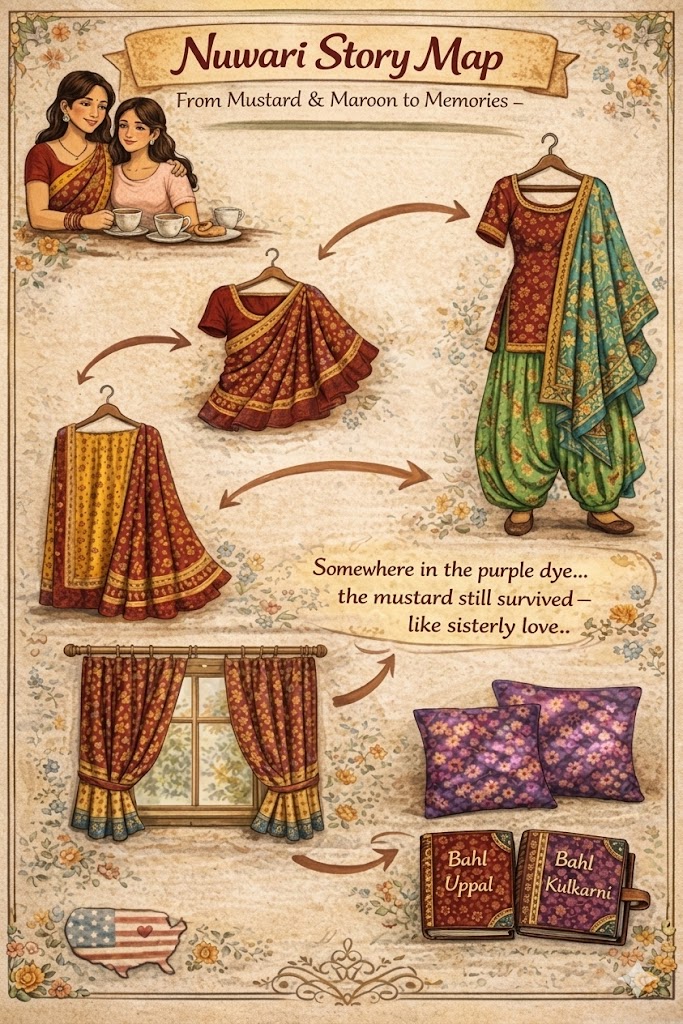
“Yes, we turned it into a half saree that we long admired from south-Indian movies, a long-gathered skirt and a bought a fancy dupatta to go with it.” Mother’s eyes widened and she looked straight into Shveta’s eyes, “but we still had enough material left to create a kameez’
“Because you had that extra material from the blouse still as a part of the saree?”
“Good catch. You’d be good at math my dear.” Mother tapped Shveta’s forearm before digging her spoon in the sugar bowl.
“So, that’s what you are wearing in your school farewell pictures?” Shveta tapped at the album in her hand, and lamented, “but in the pics your shoulder is covered with the pallu, so you can’t see the maroon blouse.”
“You noticed?” Ma’s eyebrows looked amused. Shveta rolled her eyes, because her mother had shared the photos with her so many times.
“Yes, Maru suggested we do something radical. We got bright green fabric and got it made into a Patiala-salwar to go with it. And Janak Maasi, my Maasi, bought us a dupatta with phulkari embroidery from Patiala in turquoise and green.”
“So, you looked like a color palette?”
“Say what you want, but our friends said we were ready to walk fashion ramps.” Mother took a sip from her cup and smacked her lips.
“The key here is they were ‘your’ friends.’ Mother grimaced. “So, what happened to the skirt of the half saree?”
“Well, we wore it with different dupattas, at different occasions. Both of us wore it in different company, so it lasted us through our college years,” Mother covered her face as her mouth widened a girlish giggle, “he, he, he, he….”
When mother looked she saw her daughter shaking her head, and extending her palm “Go on”, as if giving permission to continue.
“We turned the skirt into a curtain for our room upstairs, in Naani’s house.”
“A room?” Shveta extended her neck at her mother. “That’s an attic, Mom. Hardly a room.”
Mother placed her clenched her fists on the side of her waist.
“You may call it our play-palace. But do not use that ‘A’ word’”, then mother shook her head, “You kids have not known how to make the most of absence-of-things. We were pros at it.”
“Desperation?”
“Creativity!”
“Imaginative vocabulary.”
“Why not?” Mother smiled through her widened eyes, “Emoji generation won’t understand.”
“Uhhuh….are we at the end of the story, yet? I mean, obviously there’s more, for I am holding a part of that saree in my hands.”
“And there is one in your room too!”
“Wait, what?”
“Yeah, the curtain then became cushion covers, but only after we tie-dyed it”
“The purple ones?”
“Yup,” Mother grinned, “Surprised?
“Embarrassed.”
“It started as a saree,” Mother became nostalgic and her voice softened, “and became everything else we needed it to be. That’s the story of us, in fabric and color.” Then with a sunny-Delhi smile, Mother pointed at Shveta, “Oh, and the book cover for our family album that you’re holding—that’s what’s left of the kameez we made.”
“My God, what a saree of a story. You could have told me this in fifteen seconds.” Shveta tapped restlessly at her smartphone on the table and sighed.
“Actually,” Shveta corrected herself, “a nuwari of a story.”
“Family stories,” Mother added, smiling like a goddess, “must be enhanced with finely embroidered laces of memorable anecdotes.”
For few seconds mother was quiet, as if remembering, before she spoke again, “I kept the front side of the shirt and Maru got the back, she quilted it, added a trim of gold-gota, fabric painted our maiden and married names on the cover.”
Mother snapped her fingers, “And each of us got a book cover for our albums. Mine says Bahl and Uppal, hers says Bahl and Kulkarni. It feels like our life-story stitched and painted.”
“But you’ve got to admit, y’all were clingy and stingy,” Shveta said, setting her empty teacup back on its saucer.
“Kanjoos!” Shveta declared, a moment later. “You have to admit—kanjoos, kanjoos, kanjoos!”
“We like to say sarees taught us sustainability,” Mother said. “A creative way to recycle, in every household. Everything had many lives.” Mother pulled out a napkin from the holder and wiped off the drops of tea on the table. “In our family, nothing is ever discarded—just transformed.”
Shveta decided against mocking her mother. “That’s… sustainable.” She placed her hand over her mother’s and said softly, “I get it, Ma. Somewhere under the purple dye… the mustard still peeks.” She held her mother’s hand a little tighter. “Like sisterly love,” she added, quieter now, “woven into everything — even after you and Meenu Maasi built lives of your own.”
Instead of mirroring her daughter’s emotion, Mother narrowed her eyes in playful suspicion.
“Does this mean you’re done with listening to repetitions of this story,” she asked, “or do I still get the bragging rights about our wisdom… versus your reckless of a throw-away generation?” Mother made a funny face. “Oooh… let’s celebrate Earth Day — blah, blah, blah…” She stuck her tongue out at the fourteen-year-old.
“Oh, you are impossible, Mom.”
Shveta hugged her mother and headed to her room.
Leave a Reply