
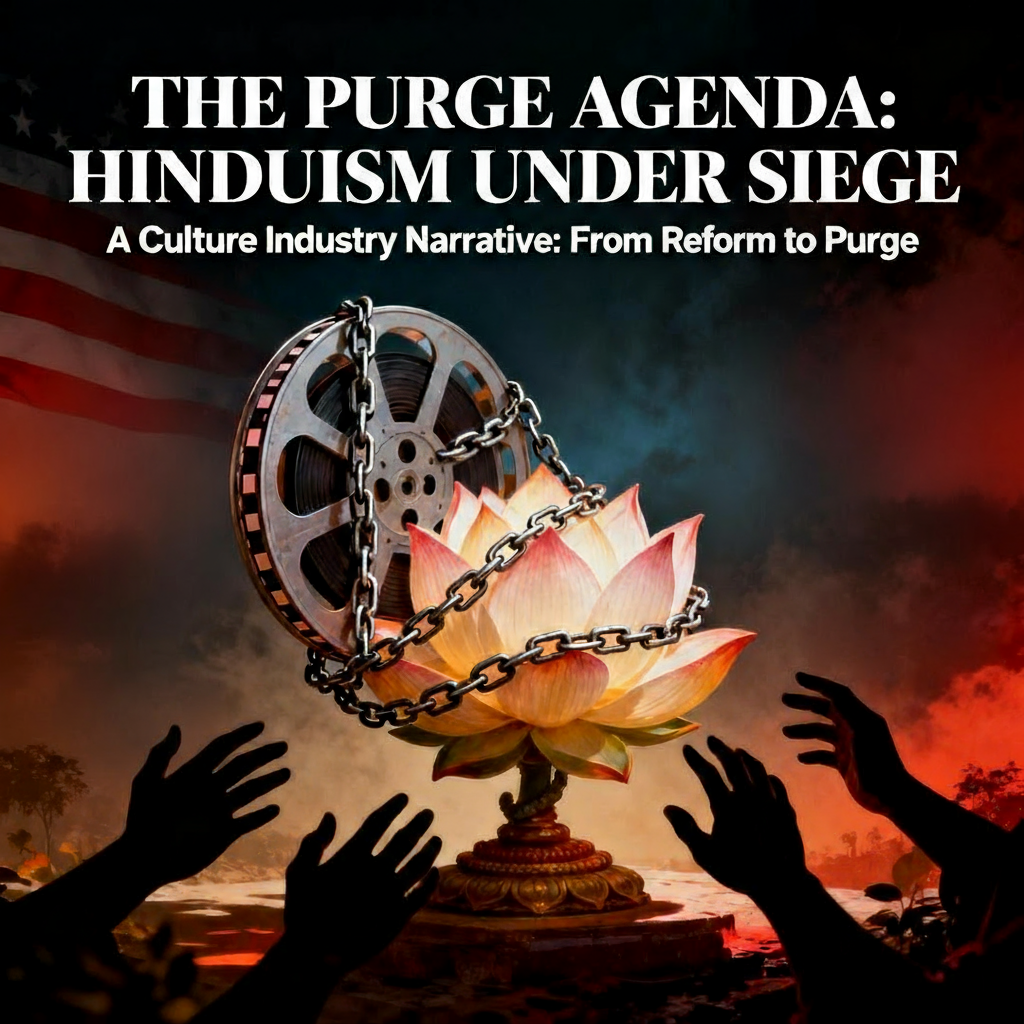
In post-Independence India Hinduism was subtly but surely undermined in the political and cultural spheres in the name of advancing the ‘reform agenda.’ The template was broadly this: ‘reform’ in cinema and society meant equating the Hindu religion and traditions with regressiveness, projecting Western ideologies as the only paths to progress, and portraying the minorities as unfailingly noble. This agenda’s functioning and its unsubstantiated colonial assumptions have been examined in Part 1 of this series.
The resultant conception set up Hinduism as being incompatible with ‘modern nationhood’ and, therefore, fit to be ‘purged.’ If that sounds extreme, keep in mind that Western ideologues like Communists and Fascists, hard-nosed secularists, and religious proselytisers nursed–and still nurse–the aspiration of purging a religion or all religions. Though they stopped short of expressing it openly, Nehruvian Secularism, Communism, and minority politics (often practiced by non-minority politicians) subtly shaped the ‘reform agenda’ in opposition to Hinduism. This weaponized form of undermining is better described in terms of its aim: the ‘purge agenda.’
As a matter of practice in the film industry, for example, it is seen that most successful film storytellers, like Salim-Javed, Mani Ratnam, and Rajamouli, are adept at community-wise messaging in their scripts. This inclination to manage constituencies is also why film-people believe they have a knack for politics. (It’s another matter that most industry-folk quickly find out that messaging is easy and dealing with everyday people and their issues is not.) Many of these storytellers use Hindu imagery and themes as well but bend them to the service of ‘secular’ or ideological themes. The fact that all these storytellers message respectfully to the minorities is not only a testament to the minorities’ box-office clout but to their ability to exert political and ideological influence over the culture-industry.
Through the years, the aggressive propagation of the ‘purge agenda’ by successive Nehruvian-Socialist governments in the name of ‘secularism’–also termed ‘appeasement’ with some justification–and ‘development’ lent this agenda an air of legitimacy and dominance over the culture industry. But this agenda can also be said to have been refined through reactions from specific constituencies (protests, boycotts), financial outcomes (losses or gains), governmental encouragement (funding, awards, censorship, bans, patronage, persecution), and the ideology of the intelligentsia and film artists (predominantly Leftist).
So ingrained and rigid was this template that by the time the politics of religion and caste came to a head in the 1990s, most in the culture industry openly aligned with political parties that wooed minorities and weaponized caste as a counter to Hindu consolidation. This alignment was now overt but certainly not new: the ‘modern progressive’ and the ‘noble minority’ were only doing in politics and society what they had so far done symbolically–teaming up against the ‘regressive,’ the traditional, the Hindu.
It is only at this time that Hindus first began to protest that their openness to reform and eagerness for progress had been exploited as weaknesses. Hindus had never protested that an artist (writer, actor, dialogue-writer, lyricist, director) or producer conveying these messages was themselves not a Hindu–in this they were secular in the true sense of the word. They also did not realize that ideologies like communism and ‘secularism’ aimed to supplant their heritage. Hinduism is not unique in facing such an onslaught as majority-communities everywhere (including Islam) face ‘secular’ pressures to some degree. However, in India, conservative Hindu politics having been long marginalized, the Hindu voice, which was sizable at the time of Independence, stood largely silenced. This created an environment highly-conducive to minority-progressive-celebrities (MPCs).
The internet revolution and the Bharatiya Janata Party (BJP) coming to power in 2014 created minor cracks in the culture-industry’s defenses, with books, television shows, news outlets, and even films with a Hindu-voice emerging. To this day, their clout in the mainstream of the culture industry is limited and they are treated as something of a genre–a commercially necessary evil. But even the partial lifting of these unspoken bans has sent the culture-industry’s denizens into a spiral of moral panic.
The Minority-Progressive-Celebrity’s Perch
In the heyday of the ‘purge agenda’ no tag was more celebrated than that of the MPC. The MPC was merely expected to promote the ‘purge template’ and make the odd disparaging remark about fundamentalist coreligionists. And while the ‘secular Hindu’ tied themselves up in knots showing appreciation for other religions, their histories (especially in India), embracing minority cultures (while heaping disdain upon their own), the MPC was spared the embarrassment of similar overtures towards Hinduism. In fact, MPCs would often compliment Hindus for being ‘secular,’ thereby placing a premium upon their adherence to the ‘purge agenda.’
The ‘Purge Agenda’ and the MPC
The ‘purge agenda’ in the hands of the MPC played out something like this: they criticized Hinduism (society, culture, attitudes) putting on their ‘progressive citizen’ hats (Negative for Hinduism); propagated ‘embracing modernity’ and moving away from the ‘shackles of tradition’ (Negative for Hinduism); portrayed the minority’s nobility (in the interests of minority-protection and national unity) and Hindu-majority Indian society as prone to prejudice (Negative for Hinduism). Still three strikes for Hinduism.
Doesn’t calling out fundamentalists in the MPC’s own community make up for any criticism of Hinduism: doesn’t it demonstrate the MPC’s even-handedness? Let us apply our ‘Positive-Negative’ value checks to other things the MPC does to find out.
One, the MPC underplays the danger posed by fundamentalist strands in their own community (Positive for one’s own community); two, equates the minority fundamentalist with any political party representing the majority-community’s issues (Positive for one’s own community); three, objects to any negative portrayal of minorities as ‘hate’ (Positive for one’s own community); four, underplays historical excesses or prejudice attributed to their own community (Positive for one’s own community); five, is evasive on social issues within their own community while being vocal on the majority’s issues in the name of ‘social critique’ (Positive for one’s own community); six, takes pride in minority contributions to Indian culture (Positive for one’s own community); seven, desists from overtly acknowledging ancient majority-community achievements prior to minority influences (Positive for one’s own community); and eight, supports politics that hinder majority unity and fishes in the majority-community’s troubled waters (Positive for one’s own community).
So, unlike the majority-progressive, the ‘secularist,’ who sets out to attack one’s own community identity, the MPC, the ‘modern face of the community,’ lands no punches against minority political consolidation. In fact, MPCs are largely aligned to their community’s political identity and array themselves against political expression of the majority’s identity. The MPC’s identity, therefore, is either paradoxical or devious: it embraces progressivism but is culturally conservative (to the extent it vociferously defends minority culture, traditions, and history); and while personifying the moderate face of the minorities, supports political parties that promote minority’ extremists.
It bears pointing out that a Hindu who is similarly socially-progressive (in family law, education, rights, rule of law, and so on), but is culturally conservative (in valuing ancient heritage, sustaining traditions, and so on), and supports a party that also woos majority extremists is termed a Right-winger, fundamentalist, or chauvinist. This double-standard has been normalized.
It is also important to point out that while the MPC holds great appeal for the Hindu middleclass as a supposedly moderate, ‘secular’ voice, the MPC offers nothing in return to address the majority community’s concerns, aligned as the MPC is with the forces of appeasement.
In a sense, the fact that the MPC speaks the same language as the ‘progressive’ (derived from the ‘purge agenda’) gives them cover to hold anti-Hindu positions without being termed ‘communal.’ It is difficult to imagine that the celebrities who use this cover do so unknowingly.
The Culture-Industry’s Attitudes Today
To state the obvious, the industry largely adheres to the ‘purge agenda’ to this day. Even as the negative view of Hinduism is challenged and discussions of caste, racism, misogyny, feudalism, fundamentalism, and other social ills, which were earlier restricted to Hinduism, are now discussed in the context of minority communities as well, the culture industry largely chooses to be oblivious. These issues are whispered about in the mainstream media and shouted about online. The culture industry still finds little or no ‘creative inspiration’ in these subjects as it does in Hindu society.
The speaking-truth-to-power sorts in the culture industry still garner importance pretending it’s courageous to criticize Hinduism, even though it’s riskier for them to deviate from the industry’s line on other communities. These paper-tigers who fear no government, authority, or Hindu organization are terrified of industry and community backlashes that could (and would) instantly crumple and consign them to the trash heap. Some others have absolutely no original thoughts that deviate from the industry’s line, which is sadder still.
This is the background to a sizable section of Hindus today turning away from the culture-industry’s ideology and MPCs. And the film and television industries (including news anchors) have only just begun to grasp what film stars have long-known from personal experience: people can be ‘fans’ of your craft and style, watch your work (movies or news programs), and still dislike you.
Conclusion
It is not my case that MPCs (or minorities in general) should refrain from social critique beyond their own faith or from projecting the good in their community’s past and present. Far from it, as I believe that the right to expression is constructive and must be protected. At the same time, it is my case that these discussions must occur in good faith, and that MPCs have acted in bad faith while pretending to be even-handed.
By piggybacking on progressivism to critique Hinduism, at the same time projecting only the positive aspects of their communities, and by using their bully-pulpit to drive political ends, MPCs have used sleight of hand to push a slanted, communally-biased agenda.
If MPCs seek to be taken seriously as ‘neutral voices’ then they must address concerns Hindus have with other communities with the same emphasis and sincerity they highlight the concerns of their own communities. They must be able to turn equally harsh light upon their own cherished ideas, history, and traditions if they expect Hindus to do so. They must defend with equal ardor the principle at stake–freedom of expression, say–when anyone on any side is affected rather than only when their allies have troubles. And they cannot smuggle in political-parties’ concerns and their appeasement politics through the back door. Until their behavior and discourse demonstrate these elements, MPCs cannot demand to be considered above ‘communal politics.’ These are, of course, not injunctions–I represent no one or hold such authority–but they are positions based on commonsense and common notions of fairness.
MPCs and ‘progressives,’ I’m quite sure, will suggest even these expectations are chauvinism and Right-wing stuff. But, in truth, it is Hindus engaging with the culture industry but refusing to be gaslit into accepting a loaded, corrosive worldview as their own: in other words, it is an awareness and rejection of the ‘purge agenda.’
Leave a Reply