
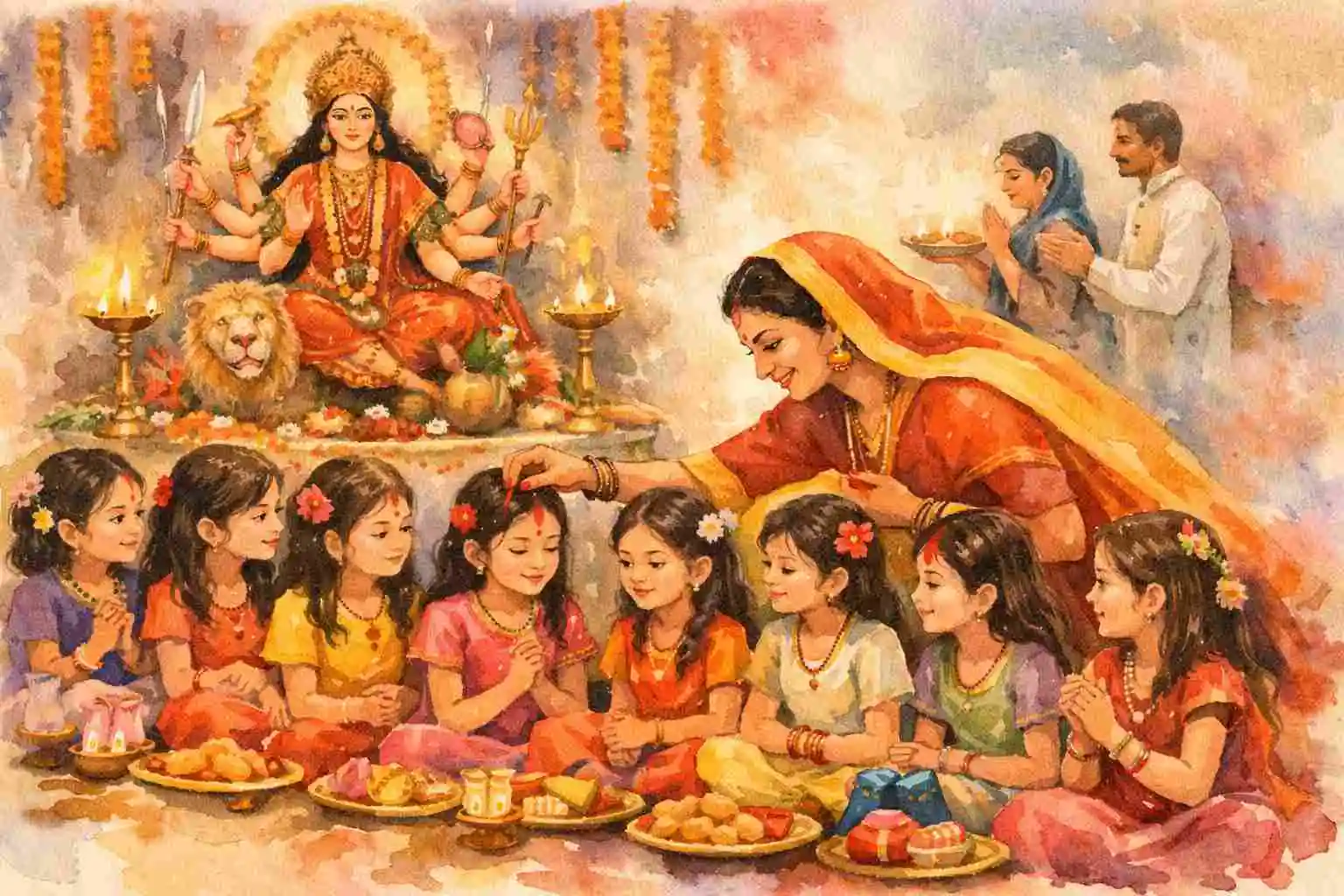
In Delhi, where people lived in the same neighborhood, kanjak ceremony during Navratri was more than just a ritual—it was a celebration of trust and belonging.
Navratri is a nine-day festival honoring the Goddesses, celebrated twice a year at the change of seasons—at the end of spring and autumn. Kanjak, or kanya-pujan, is the ceremony on the eighth day when pre-pubescent girls are honored as the embodiment of life-giving energy, treated like goddesses with gifts and offerings.
Early in the morning, children would wander from one house to another, welcomed with food, coins, and blessings. The festival was less about formal invitations and more about an unspoken understanding—that every home was open, every child was safe, and every family was part of the larger whole.
The order of the list of houses to visit would go something like this.
- Sahni Aunty, since she was a teacher and left early.
- Next-Dr. Aunty, she had to work too, but slightly later than Sahni Aunty
- Thakur aunty, Malhotra aunty, Khullar aunty, the Tanejas, the Kukerejas, the Chadhas –both top and bottom floor– were all homemakers, so we could be a little late. Or all of them, along with Chachiji next door, could personally deliver the prasad along with money and gifts, right to our house.
- Since the Sahnis, Doctor Sobtis and Chachiji (the Alluwaliahs) lived in the same building, we began with their houses.
Just to be clear, we were not related to Chachiji by blood, but through our parents’ hearts. Our parents called them Chachaji and Chachiji, and so did we.
That was the life in the 70s, 80s, 90s and possibly even until early 2000s.
Embodied as Kanjaks, we’d confidently enter with our steel plates.
“Kya Khusbhoo aunty.” We’d say talking a long whiff of the aroma “What’s that aroma aunty?” one girl would ask, eyes wide with curiosity.
“Halwa-puri, beta, the same as always.” would be the warm reply.
Why bring our own plates, you wonder? For practicality. We never had time to eat it all at each house, since there were several houses to visit. Each home received 9–11 kanjaks, so we lightened the hostess’s burden by bringing our own plates, sparing her the trouble of collecting them afterward.
Among the children, there was a special joy: “I got five rupees from Sahni aunty!”
“Oh and the red nail polish from Malhotra aunty!” The exchanges were full of innocence, the thrill not in the money alone, but in being known, expected, and cherished by familiar faces—all before rushing off to school.
While the lanes in the neighborhoods echoed with the chatter of girls, the boys sulked with drawn faces, with questions and comments like “How much did you girls make today? We are friends, right?”
‘Remember I touched your feet’ was best line, as the boys would wag their fingers as reminders, “Bless us with your bounty.”
Most of us did not know the full stories behind the festival—its mythology or rituals. All we knew was that on the morning of Ashtami—the eighth day of Navratri—before Ram Navami in spring (month of Chaitra) and Vijay Dashmi in autumn (month of Ashwin), we were invited to every house in the neighborhood, for what we called, ‘pampering.’
Ashtami before Ram Naumi was rushed because we had school. The day before Vijay Dashmi was included in our Dusshera holidays so we were relaxed. It was knowing that we were always counted in the celebration. The festival also allowed us to see the insides of some of the neighbors who were either not too warm or had children much older, so we hardly visited them. During Navratri we were welcomed like goddesses. All the uncles and aunties knew us by name and by face. We felt at home starting from when we got off at the busstop at main street which was a good five-minute walk away from our block. Almost everyone seemed to know us. We joked that our heads were hurt from nodding too many ‘namesteys’ on the way. Our parents’ generation understood that families can only flourish in a community. As Wendell Berry and Robert Nisbet note, community—the smallest unit of health—supports the family. Without its scaffolding, families collapse under their own weight. In our neighborhood, community was a practice. TV was rare, and the internet did not exist. Yet we were connected. That security cannot be found in an online community or WhatsApp groups.
Last year, after a long time, I was lucky to spend Navratri in Delhi. The neighborhood is quite different now. Every house has raised walls, the yards have either shrunk or are non-existing, because things-with-four-wheels have filled bottom floors of most houses. All, except two, families in our childhood only had things-with-two-wheels. Every house has an elevator, something we rarely encountered as children. The bottom floor of Chadha house has been rented to a doctor, the Malhotras modest house is now four-floor high, three of which are rented and we have no clue who lives there. Dr. Aunty, Sahni, and Chachiji moved out long time ago. Since then, the house has been reconstructed twice and the only reason we ever speak to any of the four families that live in the complex is when leaves from curry tree that grows in our yard dares to enter their balcony. We don’t know each other’s first or last names. But we all know much about which serial comes on which channel at what time. Some of us have compared the names of celeb children too. We all have opinions on Trump, Zelensky and Putin.
Priorities.
Today, in Delhi’s high-rise apartments, the ritual has thinned into something hollow. Since families do not know each other, the girls invited on kanjak are strangers to the hosts. Before anyone jumps and says that is the best way to honor Kanjaks, I must share that every Navratri people took extra prasad to temples and distributed food and money among street children. Every family shared their abundance with their house-helps, and others not so privileged. But the community thrived over and above all charity. Partaking of food with the less fortunate was not a replacement for community.
So, I was left with an empty feeling after I celebrated last Navratri in Delhi. The young woman who works as kitchen help in our house summoned a few ‘unknown’ girls to get ‘some halwa and money’. Some older women held their babies up, as an indication that they were eligible too to participate in the festival. The moment the ‘kanjaks’ whom we did not know stepped in the door they hailed loudly, ‘Bol Sheraan Wali Maata Ki Jai’. One girl sang a line or two of from a bhajan devoted to the mother. It felt performative, like some artists paid to perform in a jagarata (the night long singing).
The whole incident evoked a sense of distance and sadness. We did not know the names of the girls, nor did we ask how they were doing in school. We washed their feet mechanically.
Then came the biggest hurt.
“No, no, I do not like Sheera.” A young girl refused to accept halwa. She just wanted poori and Channa. Since we did not know them, we could not discipline them, “You never say no to prasad.” And hearing them call halwa “sheera” felt strangely unfamiliar.
In the next few minutes, we found out that some of the girls were not even Hindu. But one does not differentiate between rich or poor, Hindu or Muslim, especially on a festival. All girls are seen as goddess incarnate. Except the girls had never learnt the stories, knew nothing about the ritual, nor were a part of the neighborhood. They only knew that they were supposed to perform (the ritual), receive (goodies, and money) and deliver (product of blessings)—like a vending machine.
Before the girls left, they reminded us that we were forgetting something.
‘Don’t y’all want our blessings?”
We smiled, even though, that is something we never said to our uncles and aunties. We got on our knees, they clapped our backs, hailed the goddess and left.
Later that day we would find some scarves that they received along with prasad on the street outside our house. Instantly I was reminded how prized those red and gold scarves were for us. We used those red and gold scarves as accessories, in our home shrines or dressed our dolls in them. Halwa was either eaten by other family members or repurposed in stuffed paranthas.
With these new, unfamiliar children all we did was complete the formality of the ritual. They knew which gifts they wanted and thought we expected them to behave in a certain way. The girls stayed for less than five minutes before darting off to another house. There was no sacredness to the ritual on their side, no familiarity from our side, and no lingering emotion after they left. The once-vibrant ritual between neighbors of shared joy, has now become a transaction—an obligation served on plastic plates. Where the festival once reminded us that every child belonged to every home, today it risks teaching the opposite—that we are strangers behind our doors. The delight of Kanjak has been replaced by hesitation, and what was once an affirmation of trust now often feels like a hollow ritual.
But this piece is not about creating a pessimistic scenario even though the shift reflects a deep loss of community. Sometimes those who are awakened from a slumber are clearer in their goals. If earlier community was formed organically, then now it needs to be cemented with a heightened consciousness. With a realization that when not performed in a community, ritual loses its power to bond people in a community.
Thinkers like Durkheim have emphasized that rituals lie at the heart of social cohesion. Swami Vivekananda stated that a religion that endures must have both philosophy and ritual. The act of coming together to perform rituals make a community vibrant and ensures its longevity.
Its time we re-vision ourselves as an organic component of a larger whole than individuals driven by self-interest—which has been the trend for the last two decades. A community functions as social and spiritual padding. Evil, delinquency, and other socially maladaptive behaviors appear in the cracks of a weakened community. The decline of stable family life is often preceded by the disbanding of communities followed by fracturing of joint families.
Who are we going to blame now? The internet? work culture? other religions? Perhaps the question is no longer who to blame, but what we’re willing to rebuild.
Don’t let the signs of your progress such as efficient internet, high rises, or four-wheel drives be the reason for dissolution of communities. Instead, use these developments as bridges.
If due to within India migration we now live in more multi-ethnic, multi-cultural societies where Bengalis, Punjabis and Tamilians do not celebrate Navratri the same, we can use these traditions to teach each other unique ways of celebration. But we will have to start with knowing our neighbors, sharing rituals, even if we come from different communities. Let Telugus celebrate Kanjak the Punjabi way, Punjabis invite children of their Tamilian neighbors to play Holi and let the Marathis partake in Pongal celebration. Recapture that sense of community, let children feel seen and known. Adults must demonstrate through camaraderie that sharing rituals, food and smiles–turns the monotony of regular life into the joy of being part of something larger than ourselves—a shared sense of belonging within a community.
This Navratri, make an effort to truly know the children in your neighborhood. Learn their names. Share stories, food, and rituals. Create new ones together.
Know thy neighborhood.
It’s a gift that you give to the next generation. If earlier the community was by default. Now it must be intentional. Begin this Navratri.
Because — It’s really all about the Community!
Leave a Reply