
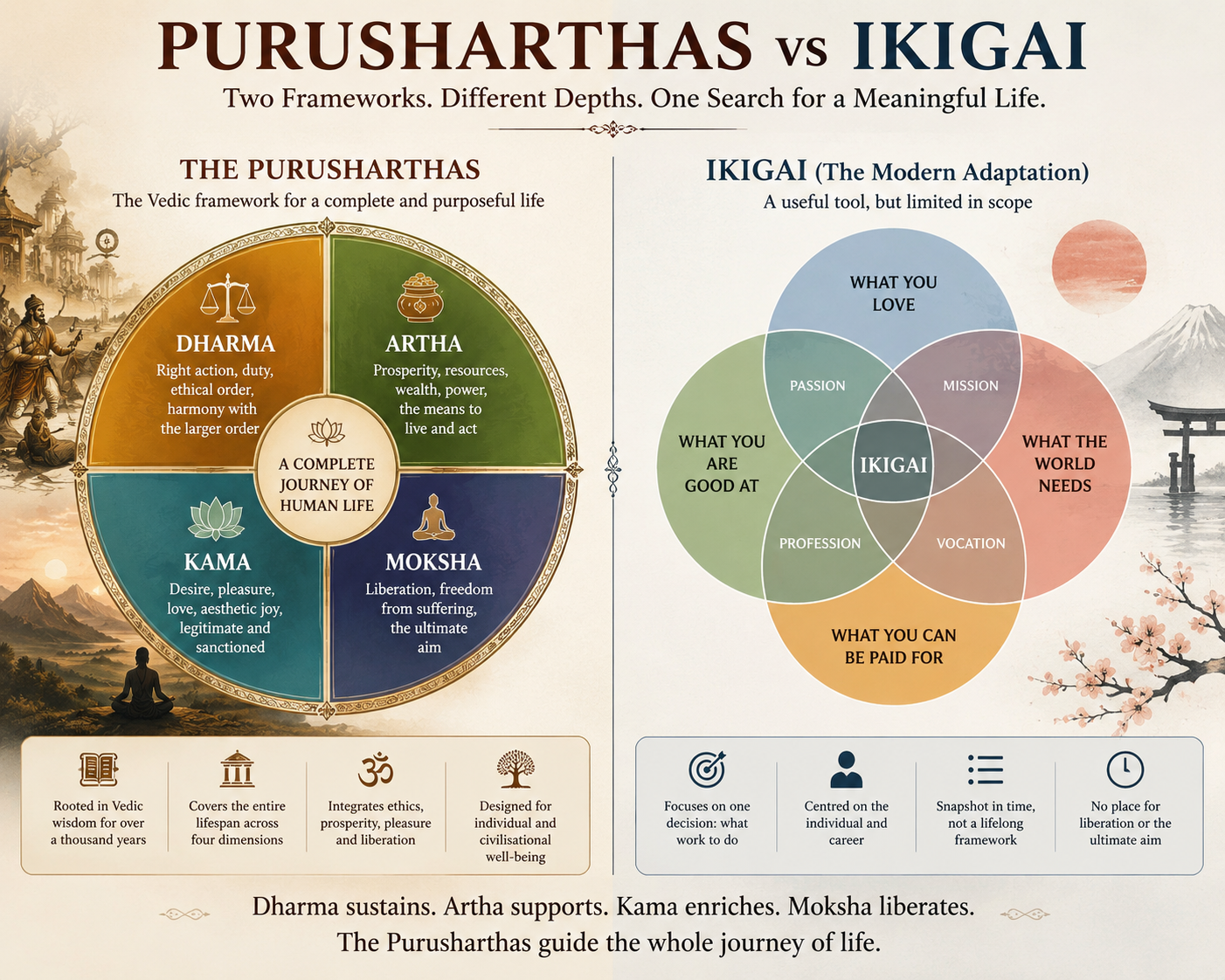
Somewhere in the last decade, “Ikigai” became the answer to every question about meaning. What should I do with my life? Ikigai. Why do I feel empty despite the seven-figure salary? Ikigai. How do I find purpose? Draw four overlapping circles, find the sweet spot in the middle, and call it a philosophy.
I want to be fair to Ikigai. And I want to be honest about what we gave up when we traded the OG Purusharthas for it.
Because here is the thing nobody says out loud: the Purusharthas – the four aims of human life that Vedic civilisation codified as the operating architecture for a meaningful existence – are so much richer, so much more complete and so much more honest about what being human actually involves. Calling Ikigai its equivalent is a bit like saying a map of your neighbourhood is equivalent to Google Earth.
Both are useful. But they are not the same thing.
What Ikigai actually is and isn’t
The famous four-circle Venn diagram is not traditional Japanese Ikigai. It is a 21st-century Western reframing.
The original Japanese concept, dating to the Heian period around the 10th century CE, was something far quieter and more personal. “Iki” means life; “gai” means worth or value. Ikigai in its original form was simply your reason for getting up in the morning. It could be your grandchildren. A garden. The smell of coffee. A craft you have practiced for forty years. It was never a career-optimization framework. It was a cultural acknowledgment that small, daily joys constitute a life worth living.
What the Western self-help industry did was take this gentle Japanese concept, bolt on a career-planning grid, market it with a sunrise aesthetic, and sell it back to the world as ancient Eastern wisdom about purpose.
Japanese researchers who study Ikigai and longevity are consistently puzzled by the Western version. The people in Okinawa with the strongest sense of Ikigai aren’t optimising the intersection of passion and income. They are tending to their communities, their vegetable patches, their morning routines. That is the original. The Venn diagram is the export product.
What the Purusharthas actually are
The four Purusharthas – Dharma, Artha, Kama, Moksha – appear in the Vedic corpus in a form that scholars estimate predates most extant philosophical traditions by centuries. By the time of the Mahabharata and the Arthashastra of Kautilya (roughly 4th century BCE), they were already an established, sophisticated framework. Vedic roots trace further back, into the Rig Veda itself, into the Upanishads, into the early Dharmashastra literature. We are talking about a system developed and refined over more than a thousand years by some of the most rigorous philosophical minds in recorded history.
The Purusharthas as a complete framework appear firmly in texts that predate Ikigai by over a thousand years. The Heian period that produced the original Ikigai concept (794 CE) came after Adi Shankaracharya had already written full commentaries on the Brahma Sutras. The Purusharthas weren’t just older; they were already ancient when Japan’s Heian courts were first using the word “Ikigai.”
Now, what do they actually say?
- Dharma: right action, ethical order, duty, one’s role in the larger fabric of existence. Not just personal ethics but the principle that holds communities, ecosystems and cosmic order together. Dharma is what makes Kama and Artha sustainable. Without it, desire becomes addiction and wealth becomes exploitation.
- Artha: prosperity, resources, material security, political power, the means to live and act in the world. Again, money not shamed, not spiritually bypassed, not treated as an obstacle to enlightenment. Sanctioned. Kautilya’s Arthashastra – one of the most sophisticated texts on statecraft, economics and governance ever written – is a Purushartha text. The tradition looked at wealth and power, took them seriously, and wrote a masterclass.
- Kama: desire, pleasure, love, sensory and aesthetic joy. The Purusharthas do not tell you to suppress desire or feel guilty about it. They sanction it. Desire is one of the four legitimate aims of human life. The Kamasutra is not a scandalous outlier in the tradition or a sex manual, it is a full Shastra, a text of knowledge, about one of the four Purusharthas. The tradition looked at desire, took it seriously and wrote a technical manual for it. Ancients were far more tolerant, wiser and open-minded than us.
- Moksha: liberation. The ultimate aim. Not career success. Not even happiness. The complete dissolution of the conditions that make suffering possible in the first place.
The structural comparison
Western Ikigai = One-screen app
Covers one decision: what work should I do. Four variables: love, skill, need, income. No metaphysics. No ethics. No concept of liberation. No framework for old age, grief, failure or death.
Purusharthas = Full-stack architecture
Covers the entire lifespan across four dimensions simultaneously. Includes ethics, economics, pleasure and liberation in one integrated system. Embedded in a larger metaphysics of karma, atman and dharmic order. Designed for multi-generational civilisations, not individual career decisions.
Look at what Ikigai’s four circles don’t contain. There is no equivalent of Moksha. No acknowledgment that the ultimate aim of a human life might be something beyond finding fulfilling, well-paid work. There is no equivalent of Dharma as a cosmic principle. Duty here means only “what the world needs,” which in practice means “what the market needs,” which is a spectacular reduction of a concept that once meant the ethical thread holding reality together. There is no framework for how these aims interact, constrain each other, or evolve across a lifetime. Ikigai gives you a snapshot. The Purusharthas give you a map of the entire journey, including the parts no one wants to put on a poster.
The Ikigai-Purushartha mapping people make and why it flatters
When contemporary thinkers map Ikigai onto the Purusharthas – Kama is “what you love,” Artha is “what pays,” Dharma is “what the world needs” – it feels satisfying. Look, the ancients knew it too! The frameworks rhyme!
But this mapping, while not wrong, hides a sleight of hand. It makes the Purusharthas look like a slightly older version of Ikigai rather than what they actually are: a system of which Ikigai captures, at best, two of the four pillars, in shallow form, with the most important pillar – Moksha – missing entirely.
Mapping Ikigai to Purusharthas is a bit like noticing that a child’s drawing of a house has walls, a roof, and a door and concluding that it therefore maps onto a building blueprint. Yes, the elements rhyme. No, they are not the same level of thing.
Moksha’s absence is not a small omission. That is the entire point. The Purusharthas are not a framework for finding a fulfilling career. They are a framework for understanding what a human life is ultimately for and the answer, in the Vedic tradition, is liberation. Everything else – desire, wealth, duty – is legitimate and real, but it is scaffolding. (Perhaps that’s why we have established Dharma Shastra, Artha Shastra and Kama Shastra but not “Moksha Shastra”. Because the last step is to step out of the game! And that’s why it’s the most important thing!)
Are we getting dumber or just more distracted?
Why did we trade the Purusharthas for Ikigai? Or more precisely – why did a civilisation that produced the Purusharthas, the Yoga Sutras, the Arthashastra, the Upanishads, need to import a simplified Japanese concept to talk about the meaning of life?
The charitable answer is cognitive load. Modern life has fractured attention so comprehensively that sustained philosophical study – the kind of slow, multi-year immersion in a Shastra tradition that the Gurukul system was designed for – has become structurally difficult. We live in an environment of information abundance and wisdom scarcity. Ikigai fits on a slide deck. The Purusharthas require a year of serious reading to even begin to understand properly.
The less charitable (and I think more honest) answer is that we stopped taking our own tradition seriously before the rest of the world had a chance to. The 19th and early 20th century colonial encounter with Western epistemology convinced a generation of Indian intellectuals that their own philosophical inheritance was either too religious to be universal, or too complex to be practical, or too Hindu to be shared without controversy. So they set it down. And into that vacuum came Ikigai, Stoicism, Zen – all real traditions, all with genuine wisdom, all considerably younger and considerably shallower than what was already sitting in the library.
If humanity were at the same philosophical altitude as the sages who codified the Purusharthas, or higher, we would not be settling for four-circle Venn diagrams. We would be producing frameworks of equivalent depth for the 21st century: integrating quantum cognition, climate ethics, digital consciousness and civilisational purpose into a single architecture. Instead we are printing “Find Your Why” on motivational merchandise. That gap is worth sitting with uncomfortably.
Leave a Reply