
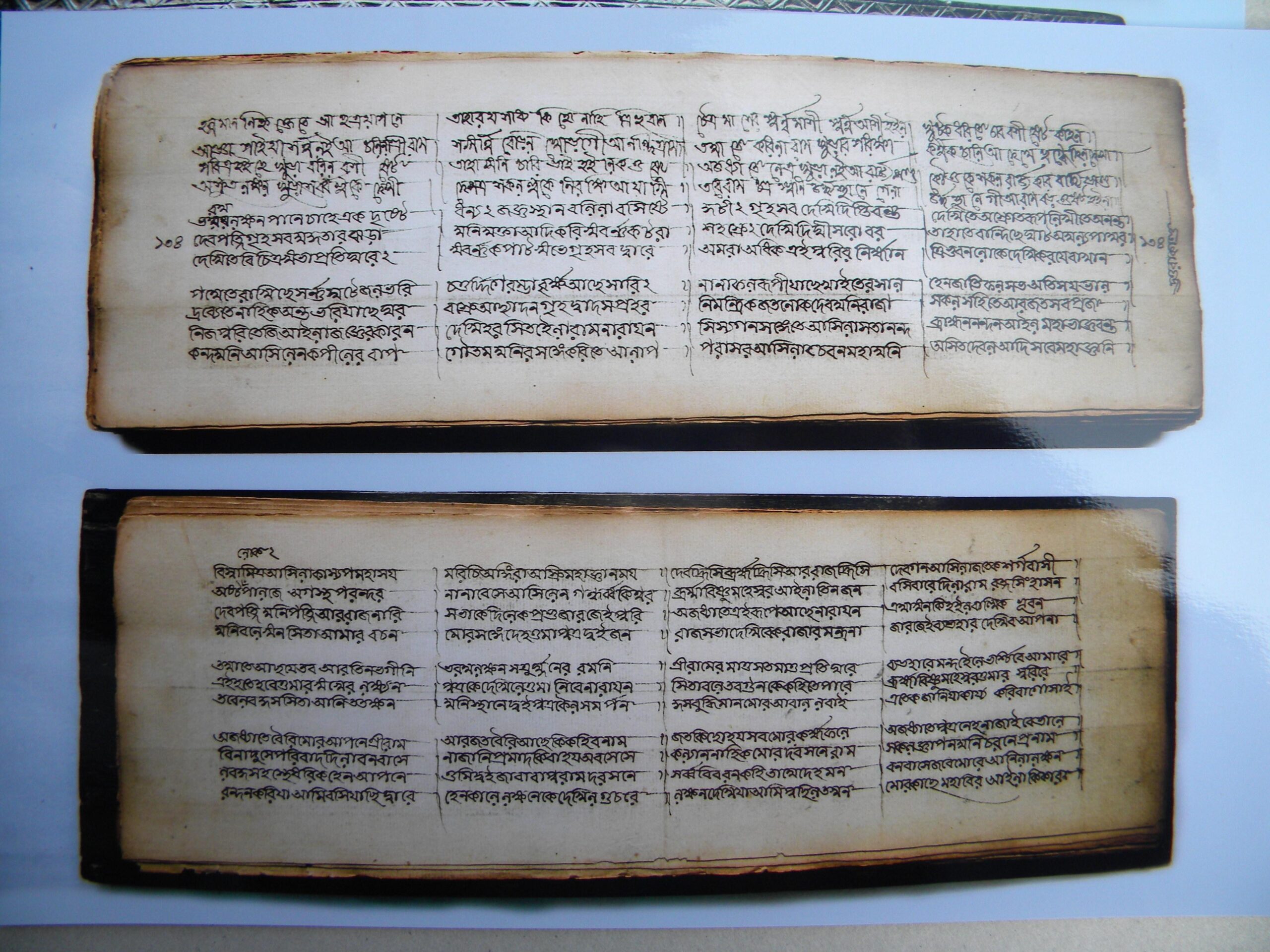
The domain of Indic languages stretches from the Pakistani provinces of Sindh and Punjab in the west, to the Assam and Bengal in the East. In “classical” times, languages from this family served as the vehicles of two major world religions. The scriptures of Hinduism are in Sanskrit, while the sacerdotal literature of Buddhism is in Pali and Sanskrit.
Sanskrit, in some sense, plays the role that Latin and Greek do in the European languages. The immediate descendants of Sanskrit were the now extinct Prakrit and Apabhramsha languages, which have evolved into the modern Indic vernaculars. Thus, for Indic languages, Sanskrit is both a classical language as Latin is to English, and it is a direct ancestor, as Latin is to the Romance languages.
However, in the late medieval and early modern era, sizeable and significant Islamic literatures also emerged in these languages. More native speakers of the Sindhi, Punjabi, Bengali and Kashmiri languages are Muslim rather than Hindu. Among those who speak these languages, there is a tendency to draw upon Persian and Arabic as Islamic classical languages, causing the literary streams of Hindu and Muslim to separate and diverge. The most famous case of such a linguistic phenomenon is certainly that of Hindi and Urdu, which are ordinarily regarded as two distinct languages, but which are referred to by linguists by a single hyphenated word, Hindi-Urdu.
Less well-known is the existence of two streams of Bengali literature. An Islamic stream seems to have emerged out of the original unity, and after a period of separate but parallel existence, seems to have merged back in the mainstream. The process has not been without some concomitant social tensions and historical grievances, which manifest as frequent claims in the literature. Their persistence of these claims in the literature further fuels this sense of grievance. In this paper, we will attempt to establish some chronologies, and to provide some background to contextualize, if not refute, these claims.
The first of these ideas is that literary activity in the vernacular languages in India started only with the advent of Muslim rule, which supposedly broke up “the Brahmanical monopoly of knowledge and literary activities and a general freeing of Hindu intellect from the bondage of the caste system.”[1] According to this view, prior to that, “No vernacular language could have found a scope for free literary expression under the Brahmanical system which preceded the coming of the Muslims and which interdicted the study of any but the Sanskrit language”. He concludes that “some well-known Sanskrit works like Ramayana and parts of Mahabharata were translated into Bengali during Muslim rule.”[2] This idea which encapsulates a widespread prejudice against the Brahminical (i.e. Hindu) culture can be dismissed simply by taking note of several translations of India’s epics into the regional languages of India, centuries before contact with Islam:
- Harivara Vipra, one of the court poets of King Durlabhanārāyaṇa of Kamatā (in Assam) had already composed his Babrubāhanar Yuddha, based on the Aśvamedhaparva (the fourteenth book of the Mahābhārata) as early as the 13th[3] Mādhava Kandalī, who enjoyed the patronage of King Mahāmaṇikya (14th century AD), translated the Rāmāyaṇa into Assamese verse, predating the (known) Bengali version of the Rāmāyaṇa by more than a century.[4]
- The Vikramarjuna Vijaya, a Kannada version of the Mahabharat was composed in the middle of the tenth century. Nannaya had already started the translation of the Mahabharata into Telegu in the 11th century. It was completed in the 13th century by Tikkanna.
T.W. Clark, who observes what he calls a “blank period” in Bengali literature following the Islamic conquest of Bengal ca. 1200 CE, nevertheless concludes that literary activity must have continued even if its record is not preserved, because the compositions that emerge in the 14th century do seem to be the result of a long development.[5] Even the lack of surviving Bengali translations of the epics (diagnosed by M.M. Ali as caused by the Brahminical neglect of the vernaculars) might be a result of the unsettled conditions following a devastating military takeover. Such a phenomenon is well-attested in Persia where there were “two centuries of silence (دو قرن سکوت)”[6] following the Arab conquest.
Also, the patronage extended to Bengali during the rule of the Muslim Sultans, on closer examination, often turns out to have been extended by regional courts and lesser noblemen, who may not have been directly connected to the Sultans. The first Bengali Muslim poet, Shāh Muḥammad Ṣaghīr (composer of Yūsuf Julaykhā) said of the first translation of the Mahābhārata (which is often supposed to be have due to the patronage extended during the Sultanate):
“Kavindra composed the Mahābhārata at the order of Lashkar Parāgal Khan. Both Hindus and Muslims read that book in their respective houses, and none remembers the name of Khodā and Rasūl (God and His Prophet).”[7]
This would seem to imply that the immediate patron supporting the translation may have been a Hindu, or a recently converted Hindu who still continued his pre-Islamic traditions, and that the readership must have consisted of Hindus or neo-Muslims of Hindu origin.
Summarizing his study of the early Muslim poets of the Bengali language, T. W. Clark concludes that “a Muslim poet can in general be distinguished from a Hindu poet by the subject matter of his works; but he cannot be distinguished by the language he wrote in”.[8] The language that Hindu and Muslim poets used were both the standard literary Bengali. While Perso-Arabic terms entered the Bengali language along with elements of Islamic culture, Muslim writers did not use them any more than Hindu writers did. Clark reaches the conclusion that:
A statistical test-check has revealed that the only passages in the early literature of Bengal which have a more than average Perso-Arabic vocabulary content are to be found in the works of Hindu poets only.
A second idea that frequently occurs in the literature concerns the process of linguistic standardization that took place in Calcutta at Fort William College after its establishment in 1800. It is indeed true that a very formal Sanskritized style of writing became current which acquired the name sādhu bhāṣā. A frequent claim is that the Bengali language was deliberately shorn of its Islamic aspects, as in this accusation by Syed Ali Ashraf:
The Hindu Pundits were employed by Fort William College authorities to remove words of Arabic and Persian origin from the Bengal language and replace them by words of Sanskrit origin. A false theory was propagated that Sanskrit was the origin of the Bengal language. This led to the creation of a literary language that was intended to reflect Hindu culture and not Muslim culture.[9]
Here Syed Ashraf doubts that Sanskrit was the origin of Bengali. However, the Bengali used by the early Muslim poets were full of Sanskrit words. Let us hear Saiyad Sultān, a Muslim poet of the 16th century, who wrote:
“Whatever language God created for a man that language is his greatest treasure …… The people who cannot understand their own language criticize me and say that I have composed pāñcālī, i. e. what I have written is like the poetry of the Hindus. When they read my book they call me a traitor because I have Hinduised the language of Ketabs.”[10]
Yāre yei bhāṣe prabhu karila srjan / Sei bhāṣ tāhār amulya rattan //…. Ye sabe āpnā bol na pāre bujhite / Pāñcālī racilun kari āchae doṣite/ Monāfek bale more kitabeta paḍi/ Kitāber kathā dilum hiduyānī kari //”
It is obvious that the earliest specimens of Muslim Bengali literature already bore the impress of the Sanskrit language. In this short excerpt, we can tick off the following Sanskrit words: bhāṣe, prabhu, srjan, amulya, rattan, Pāñcālī, katha.
A somewhat more nuanced diagnosis is made by Clark, who argues that “the literary dialect of Bengali [which] came into existence was purged of the so-called vulgarities of the colloquial language … and also of vocabulary elements of Perso-Arabic origin, even though many of these had been naturalized over several centuries,” and further that:
The merit of Bengali works was assessed according to the preponderance in them of Sanskrit words, tatsamas and new borrowings, and by their skill in employing those syntactical compounds known in Sanskrit as samās. Longer verbal and pronominal forms were preferred to the shorter forms which were current in the spoken language. Sādhu bhāṣā became became in its extreme form a esoteric jargon comprehensible only to scholars of Sanskrit, and far removed from the language of speech.[11]
Clark points that this pedantic style of writing was difficult even for its own targeted readership, and after the 1850’s, Bengali authors made a compromise between the two styles, and a ‘middle way’ prevailed. However, the compromise was not acceptable to some elements in the Muslim community, who were offended by the removal of the Perso-Arabic words, and retaliated by increasing the number of Perso-Arabic words in their own writings. By the 1840’s, their own Bat[a]tala Press in Calcutta had issued a number of books, with a vocabulary that was very different from colloquial Bengali. (In 1854, this mixed dialect was named Musalman Bengali by James Long.)
Clark takes the view that in the medieval period, either there had been a rapprochement between Hindus and Muslims at the linguistic level, or more probably, the Hindu and Muslim currents of language had never fallen apart. He admits that the Bengali language consists overwhelmingly of words of Sanskrit and Prakrit origin; however, he still thinks that, by the 18th century, it had a ‘mixed character’. He bases his conclusion on a passage from the writings of a Brahmin named Bhāratchandra Rāy, in which he proposed to write in a “yabanī miśal bhāṣā”, because it was the language of ordinary use. The word yabanī being used to indicate people of Muslim background, this would seem to indicate that the current language of the time had a significant Perso-Arabic admixture.[12]
This conclusion would be hasty. Bhāratchandra Rāy being a person trained in both Sanskrit and Persian would have been at home in the Perso-Arabic vocabulary. However, the Muslim masses in the 1840’s would have been very similar in their culture to the earlier Hindu communities from which they had been drawn. In fact, it was only the 1872 census that revealed that the Muslim community had a majority in the districts of Rajshahi, Dacca and Chittagong, and that Muslims formed 48 per cent of the population of Bengal.[13] The first English magistrates who came in contact with the people of Bengal had concluded that the Muhammadans comprised only one per cent of the population of Bengal. William Adam, the Scottish missionary who had been charged by the colonial authorities to study the native system of education in Bengal had noticed in 1835 that while the population of Rajshahi was two-thirds Muslim, officials regarded it to be a Hindu district.[14] Indeed, the existence of a Muslim majority in these districts came as a surprise to the Hindu elites, and even to the Muslim elite themselves.
The upper classes among the Muslims were reluctant to regard the vast masses of the indigenous Muslims as real Muslims. Rafiuddin Ahmed quotes a sharif observer as writing that the atrap are not real Muslims, but it would be politically expedient to treat them as such. Another sharif would write in 1895 in the Moslem Chronicle:
In the last census report it has been stated that more than fifty per cent of the inhabitants of the Nuddea district are Mussalmans; but are our readers aware what form of Islamism the bulk of the Nuddea people profess? Nearly all of them have Hindu names; their manners and customs are those of the Hindus; they celebrate the pujahs; they have a caste distinction too.[15]
That these masses of indigenous people whose culture was no different from that of the Hindu castes they had been drawn from, were linguistically distinct from the Hindus is an extremely unlikely proposition. We can let Dr. Md. Enamul Haq have the last word:
The predominance of Sanskrit words in the Bengali language can scarcely be called a Hindu trait. We have already seen that the literary language of Hindus and Muslims during the medieval period was Sanskritised Bengali, which later came to be known as “standard” Bengali. The “Muslim Bengali” or Dobhashi Bangla is basically the same language as “standard” Bengali. The ‘Dobhashi Bangla’ movement in the 18th-19th centuries purporting to eject Sanskrit words from Bengali, and bring it closer to Urdu, produced no substantial results.[16]
EndNotes:
[1] History of the Muslims of Bengal, Survey of Administration Society and Culture, vol 1b, Muhammad Mohar Ali, (Riyadh: Imam Muhammad Ibn Sa‘ud Islamic University publication, 1985), p. 855.
[2] Ibid., pp. 856-858.
[3] History of Assamese Literature, Birinchi Kumar Barua, East-West Center Press, Honolulu, 1965, p. 10.
[4] Ibid., p. 11.
[5] Encounter and Growth in Bengali Literature: A Survey of Medieval Bengali Literature, T.W. Clark, in Bengal: Literature and History, Edward C. Dimock, Jr. (ed.), Michigan State University, East Lansing, Michigan, 1967, p. 11.
[6] دو قرن سکوت (Two Centuries of Silence) is a famous book by Abdolhossein Zarrinkoub. Though partly superseded by modern scholarship, its point is more or less correct.
[7] Social History of the Muslims in Bengal (Down to AD 1538), Abdul Karim, Dacca, 1959, pp. 81-82.
[8] Clark, op. cit., p. 16.
[9] The Impact of Islam on Modern Bengali Poetry, Syed Ali Ashraf, p. 218, in The Postcolonial Crescent: Islam’s Impact on Contemporary Literature, John C. Hawley (ed.), Peter Lang Publishing, Inc., New York, 1998.
[10] Quoted by M. E. Haq in his article, Kabi Saiyad Sultān, published in Sāhitya Pariṣat Patrikā. Calcutta, 1941, Vol. 41, No.2.
[11] Encounter and Growth in Bengali Literature: A Survey of Modern Bengali Literature, T.W. Clark, in Bengal: Literature and History, Edward C. Dimock, Jr. (ed.), Michigan State University, East Lansing, Michigan, 1967, p. 84.
[12] Clark, op. cit., p. 85.
[13] The Bengal Muslims 1871-1906: A Quest for Identity, Rafiuddin Ahmed, Delhi, Oxford University Press, 1981, p. 1.
[14] Muslim Community in Bengal: 1884-1912, Sufia Ahmed, Dacca, Oxford University Press, 1974, pp. 2-3.
[15] Rafiuddin Ahmed, op. cit., p. 7.
[16] Muslim Bengali Literature, Md. Enamul Haq, Pakistan Publications, Karachi, 1957, p. 192.
Leave a Reply