
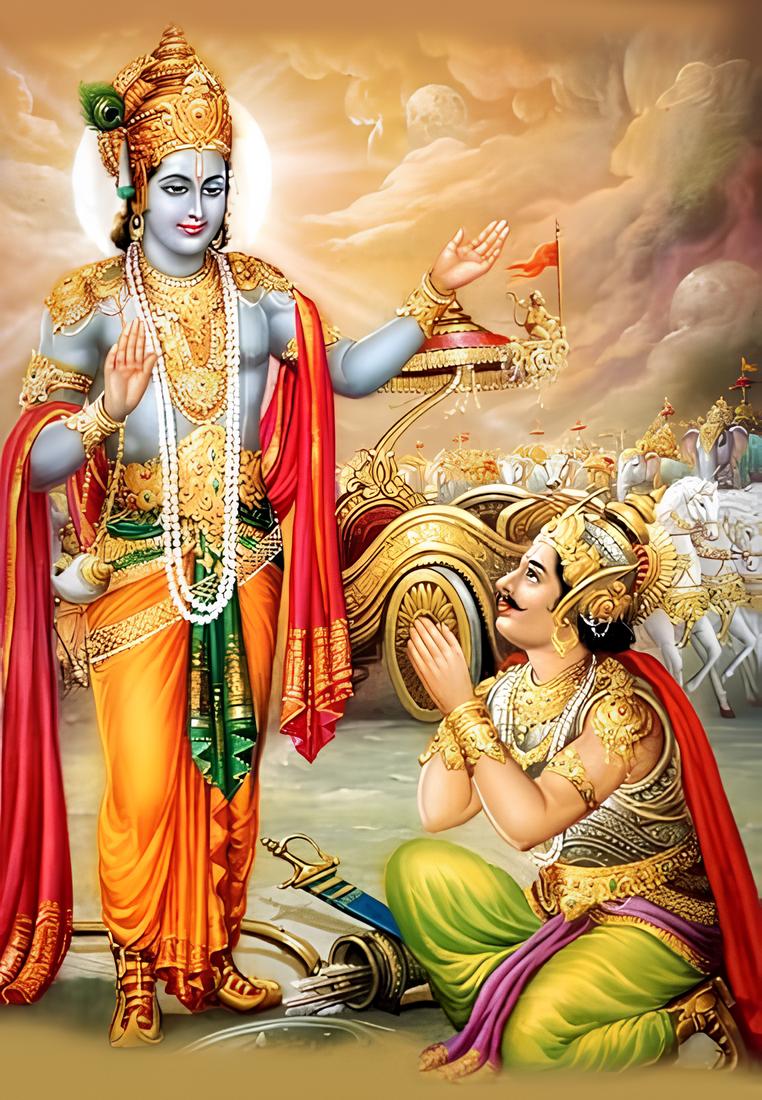
The Mahabharata occupies a unique position in the Indic civilizational imagination. It is neither merely an epic nor only a religious text; it is a comprehensive framework through which Indian society has historically understood power, morality, conflict, and inner life. For centuries, kings and householders alike have turned to the Mahabharata not for moral absolutism, but for guidance in navigating ambiguity. Unlike doctrinal systems that impose rigid binaries, the Mahabharata presents a world where ethical decisions emerge from context, responsibility, and consciousness rather than abstract ideals.
Seen through an Indic lens, the Mahabharata is best understood as a civilizational manual—one that reflects how Indian society conceptualised dharma, exercised authority, and grappled with the psychological consequences of action.
The Mahabharata Beyond Mythology
Modern discourse often reduces the Mahabharata to mythology or religious literature, stripping it of its civilizational depth. This reductionist approach fails to recognise that the Mahabharata functioned historically as a cultural regulator. It shaped social norms, political ethics, familial structures, and even jurisprudence.
Unlike linear historical texts, the Mahabharata preserves civilizational memory through narrative complexity. Its stories encode social anxieties, moral dilemmas, and philosophical debates that remain recognisable today. The epic does not offer utopian solutions; instead, it documents how societies function under stress—when ideals collide with ambition, kinship with power, and ethics with survival.
This narrative realism is what makes the Mahabharata civilizational rather than merely theological.
Dharma as a Contextual Principle
At the heart of the Mahabharata lies dharma, yet it is never presented as a static rulebook. Dharma in the epic is situational, relational, and often tragic. Characters repeatedly confront moments where every available choice violates some moral expectation.
This Indic understanding of dharma differs sharply from absolutist ethical systems. It acknowledges that moral clarity is rare in complex societies. Rulers, warriors, elders, and women are all shown wrestling with conflicting duties. The Mahabharata does not sanctify outcomes; it interrogates intentions, awareness, and responsibility.
In contemporary society, where legal frameworks often struggle to keep pace with ethical complexity, this model of dharma offers a profound alternative—one rooted in discernment rather than dogma.
Power and Its Moral Burden
Power in the Mahabharata is never neutral. Kingship is portrayed not as privilege but as burden. Authority brings obligation, and failure to uphold that obligation results in societal decay. The epic repeatedly demonstrates that power divorced from ethical restraint leads to catastrophe.
From an Indic civilizational perspective, power is legitimate only when aligned with collective welfare. Personal ambition, dynastic entitlement, and political manipulation are shown to corrode institutions from within. The Kurukshetra war itself is not glorified as victory but mourned as civilizational failure.
This treatment of power stands in contrast to modern political narratives that prioritise dominance and success. The Mahabharata insists that the true cost of power is borne by society at large, not merely by its rulers.
Human Consciousness at the Centre
One of the Mahabharata’s most distinctive features is its psychological depth. Characters are not archetypes of virtue or vice; they are conscious beings shaped by fear, desire, loyalty, and doubt. The epic anticipates modern psychological inquiry by exploring how internal states influence external actions.
Guilt, remorse, rationalisation, and denial are all examined with remarkable nuance. The Mahabharata recognises that ethical failure often arises not from ignorance but from emotional entanglement. This insight is deeply Indic, emphasising inner awareness as the foundation of right action.
In an age increasingly attentive to mental health and emotional intelligence, the Mahabharata’s emphasis on self-knowledge feels strikingly contemporary.
Krishna and the Philosophy of Action
Krishna’s presence in the Mahabharata represents not divine intervention but philosophical clarity. His teachings do not promise moral comfort; they demand conscious engagement with reality. Action, according to this framework, is unavoidable—but attachment to outcomes is optional.
This philosophy offers a civilizational response to existential anxiety. Rather than withdrawing from the world or chasing validation, individuals are encouraged to act with awareness, responsibility, and equanimity. This approach integrates spirituality with social duty, rejecting both escapism and material obsession.
Such a worldview is particularly relevant in modern societies grappling with burnout, alienation, and ethical confusion.
Society, Family, and Collective Responsibility
The Mahabharata treats family not as a private unit but as a microcosm of society. Inheritance disputes, sibling rivalry, and marital tensions are portrayed as catalysts for broader social breakdown. The epic suggests that unresolved domestic conflict inevitably spills into public life.
This civilizational insight challenges modern assumptions that personal issues remain private. The Mahabharata argues that ethical erosion begins at the relational level—within families, institutions, and communities—long before it manifests politically.
Responsibility, therefore, is collective. No individual exists in isolation; every action reverberates across the social fabric.
War as Civilizational Trauma
The Kurukshetra war is often misunderstood as a heroic battle between good and evil. In reality, the Mahabharata frames it as a tragic necessity born of prolonged moral failure. Every attempt at reconciliation collapses under ego, pride, and political calculation.
The aftermath of war is marked not by celebration but by grief, emptiness, and existential questioning. This portrayal aligns with an Indic understanding of violence as civilizational trauma rather than triumph.
In a modern world where conflict is frequently sanitised or justified through ideology, the Mahabharata’s honest depiction of war remains deeply instructive.
Knowledge, Debate, and Intellectual Pluralism
The Mahabharata is not a monologue; it is a dialogue. Philosophical debates, ethical disagreements, and interpretative plurality run throughout the text. No single voice is granted absolute authority.
This intellectual openness reflects the Indic civilizational commitment to inquiry. Truth emerges through dialogue, not decree. Even revered figures are questioned, criticised, and re-evaluated.
Such pluralism offers an important counterpoint to ideological rigidity in contemporary discourse. It affirms that disagreement is not a threat but a path to deeper understanding.
The Mahabharata in the Modern Indic Context
Today, the Mahabharata continues to shape Indian consciousness—often unconsciously. Political rhetoric, social values, and moral instincts frequently draw upon its narratives and symbols. Yet superficial readings risk reducing its complexity to slogans.
A civilizational engagement with the Mahabharata requires resisting simplistic interpretations. It demands slow reading, contextual understanding, and philosophical humility. The epic does not provide easy answers; it cultivates ethical maturity.
In this sense, the Mahabharata remains a living text—not because it is ancient, but because it evolves with the reader’s consciousness.
Conclusion: A Civilizational Text, Not a Relic
The Mahabharata endures because it reflects life as it is—conflicted, uncertain, and morally demanding. It does not offer salvation through obedience but through awareness. As an Indic civilizational framework, it integrates dharma, power, and human consciousness into a unified vision of responsible living.
In a world facing ethical fragmentation and cultural amnesia, the Mahabharata offers continuity without rigidity and wisdom without dogma. Its relevance lies not in nostalgia, but in its capacity to guide societies through complexity with moral seriousness and intellectual depth.
To engage with the Mahabharata is not to retreat into the past—it is to confront the present with clarity.
Leave a Reply