
Context and Background: A few days ago, I was getting late for work, so in a hurry I applied toothpaste instead of shaving cream over the shaving brush. As I started using the brush on my cheeks and chin, I wondered why it is not creating foam, I realised my mistake and applied shaving cream on the shaving brush, the shaving cream combined with toothpaste which was already applied gave me a feeling of an ice cool sensation which was fantastic. Had I been a manufacturer of Shaving Cream, I would have jumped with joy, thinking that I have created a new product, even though accidently. Later that day during the lunch time, I was watching highlights of an old one-day match on my phone and I enjoyed Virendra Sehwag playing Upper Cut shot. On giving a serious thought to the upper cut shot, I went into flashback and the visuals of India’s tour to South Africa-92-93 series started rolling in my mind. I remember very well the then young Sachin Tendulkar slashing an Allan Donald’s delivery outside the off stump, the ball taking the top edge of the bat and going pass over the slips for a boundary. The South African commentator said “If you must slash, then slash hard”. This is probably how the Upper Cut shot was accidently invented.
The only common thing between the above two examples i.e. the cooling sensation due to the use of toothpaste and the upper cut shot is that both have been due to an ‘Accident”.
Many major inventions and discoveries which benefited mankind have happened due to an accident. The list is very long but just naming ten of them here:
- Penicillin—- Alexander Fleming (1928)
- X-rays—Wilhelm Roengton (1895)
- Microwave Cooking— Percy Spencer (1945)
- Vulcanized Rubber—- Charles Goodyear (1839)
- Coca-Cola—– Dr. John Stith Pemberton (1886)
- America —– Christopher Columbus (1492)
- Post-it Notes——Spencer Silver (1968-1974)
- Teflon (PTFE)—-Roy Plunkett (1938)
- Safety Glass—- Edouard Benedictus
- Anaesthesia—–Horace Wells/ Crawford Long.
The pertinent question which arises here is that if accidents have played such a major role in human development and its history then there has to be some definition, reason and philosophy behind this magnificent phenomenon. Let us explore this through various levels of understanding
Level 1: Definitions as laws
The first level consists of definitions drawn from dictionaries and legal usage. In this sense, definitions as law, for they reflect the concept of accident as it appears to human perception rather than
As per the Oxford English dictionary, one of the meanings of the word Accident is “Anything that happens without foresight or expectation; an unusual event, which, from some unknown causes; or is an unusual effect of a known cause; …the unforeseen course of events”.1
Supreme Court of India in Union of India vs Sunil Kumar Ghosh defines accident as “happening of something which is not inherent in the normal course of events, and which is not ordinarily expected to happen or occur”,2
In another judgement Supreme Court of India defined accident as “An accident is not the same as an occurrence, but something that happened out of the normal or ordinary course of things. An effect is said to be accidental when the act is not done with the intention of causing it, and its occurrence as a consequence of such act is not so probable that a person of ordinary prudence ought, under the circumstances in which it is done to take reasonable precautions against it. The idea of something fortuitous and unexpected is involved in the word ‘accident.”3
Black’s Law Dictionary defines an accident as “Something unforeseen, unexpected, unusual, extraordinary or phenomenal, taking place not according to the usual course of things or events, out of the range of ordinary calculations; that which exists or occurs abnormally…”.4
On analysing the aforesaid definitions, we can safely state that this phenomenon called Accident consists of three key elements
- Unexpected occurrence of an event.
- Unintended occurrence
- Cause of the event not known
Hence a simpler definition could be “An accident is an unintended outcome that arises from an action or situation, not because it was planned, but because its causes were not fully known or anticipated at that time.”
So far, we have examined everyday examples and historical discoveries that arose out of accidents; it therefore now becomes necessary to turn towards philosophy because while law seeks to identify an accident and determine its consequences, philosophy goes deeper to examine how such events arise, what causes them, and why human intention often fails to control outcomes.
Level 1 tells us what an accident is, but not why it is so.
It remains at the level of description. Hence, level 2 is required to
explain the reality behind it.
Level 2: An Event Appears Accidental Because of Ignorance
An event appears accidental because its causes, though real, are not fully known. The accident disappears as knowledge increases.
The Isha Upanishad captures this epistemic (cognitive) nature of accident with particular clarity by describing the truth as veiled rather than absent.
“The face of truth is hidden by a golden vessel.O Pushan( Efflugent Being)! Uncover (Thy face) that I, the worshipper of Truth, may behold Thee”5.
A close scrutiny makes it clear that this verse explicitly speaks of truth being covered whereas the covering is not non-existence, but a veil, while ignorance is shown as obstruction of vision, not absence of reality, therefore the knowledge is unveiling, not creation.
This aligns exactly with the idea that Accident appears because reality is veiled, not because it is absent.
Adi Shankaracharya while explaining Bhagwat Gita’s Verse no 9.1 writes, “..Knowledge, complete knowledge-nothing else-, the direct means to liberation (from ignorance)..”.6 This aligns with the idea that knowledge leads to the elimination of ignorance which was hiding the truth.
Aristotle considered Chance or Accident as ignorance of knowledge. He gives the following example of an accident
“ …(A man) may dig his plot for the purpose of planting it and may find a hidden treasure. In such cases the action is directed towards one purpose, but accomplishes another. And this we attribute to Chance or Fortune. In these cases the final cause (e.g. desire for the crop) has no normal relation to the effect (discovery of a treasure), though the action incidentally caused that discovery. The efficient cause of the discovery of treasure) though the action incidentally caused that discovery. The efficient cause of the discovery, then, viz. the digging in that place, quite definitely and directly led to the result, and is exactly the action which would have been dictated by the desire to secure the treasure had the man known it was there;..”7
Aristotle illustrates the epistemic nature of accident by observing that a man who digs the ground for planting and unexpectedly finds a treasure does so by chance, whereas the same man act would not be accidental if performed with prior knowledge of the treasure’s presence.
Aristotle is showing that
- The physical cause is the same (digging)
- The result is the same (finding treasure)
- The difference lies only in knowledge and intention
Therefore:
Accident is relative to the agent’s knowledge, not to the structure of reality.
David Hume was also a proponent of ignorance–based definition of chance.
“There is no such thing as chance in the world, our ignorance of the real cause of any event has the same influence on the understanding and begets a like species of beliefs or opinion”.8
The aforesaid definition of Chance by David Hume is explained this notion through the example of probability, showing that what is called chance does not arise from the absence of causes but from ignorance of them. Probability in Hume’s account, measures degrees of belief formed under incomplete knowledge of causal connections. Thus chance is reduced to an epistemic condition rather than an objective feature of events.
In other words it means that Accident exists only because causes are hidden from knowledge. Hume treats chance as merely the effect of ignorance of causes.
Karl kautsky, the Marxist theorist was of the view that “Accidents can not only make path longer or shorter, but they can make it more or less thorny.”9
Kautsky, here means that the goal or direction of the process may remain the same i.e., accidents do not necessarily change the destination, but they can change the difficulty, the cost and the suffering involved.
In simple words:
Accident alters how something happens, not always what happens.
The illustration of the upper cut, discussed at the outset of this article, may be understood in Kautsky’s sense of accident. The intention remains unchanged, which was to hit the ball to the boundary and the intended result was achieved. Yet, in the course of play, a new method of striking emerged. The destination remained the same, but the path altered, becoming more or less advantageous under particular conditions. The accident lay not in the failure of intention, but the unforeseen modification of the method by which the intended end was achieved.
Friedrich Engels stated that what is maintained to be necessary is composed of accidents and…The so-called accident is the form behind which necessity hides itself…10
In simpler terms Engels means to say that history looks accidental while it is happening but later appears necessary. Therefore, Engels falls in this category which is called Accidents arising out of ignorance, because as per him, accidents appear accidental due to limited human knowledge and once the process is understood, necessity is revealed. This aligns with core principle of this category that accident disappears with fuller knowledge.
British Philosopher, F.H. Bradley defines chance as “the given fact which falls outside of some given whole or system.”11
So according to Bradley, what is called chance is not n isolated or uncaused event, but a fact that appears accidental only because it is not integrated into a particular whole or system within which we are interpreting it. Bradley treats chance as a fact that seems accidental only because it lies outside the system or whole within which it is being considered.
Therefore, Bradley would have explained that the toothpaste accident appears accidental only because the paste fell outside the conceptual system governing the original experiment; once that system expanded, the accident disappeared.
Taken together, these accounts show that an accident is not the absence of cause, but the presence of limited knowledge. What appears accidental does so only because the relevant connections, processes, or systems are not fully known at that time of action or observation. Once these connections are understood and incorporated within a wider framework, the accident disappears and is seen as necessary outcome of the causes already at work. Accident, therefore, belongs not to the event itself, but to the standpoint from which it is judged.
Accident as Surplus within Purposive Action
This type of an accident occurs not because of failure or ignorance of the intended result, but through the overflow of effects produced by a deliberate human action. In this view an agent acts with a clear purpose and successfully achieves what was intended; yet the same action also brings about an additional and unforeseen result. This extra outcome is described as accidental, not because the surplus effect was neither aimed at nor anticipated. Classical and modern thinkers who adopt this approach treat accident arising within purposive causation itself; where one and the same produce both the intended end and an unintended end and an unintended by-product.
Let us understand this Accident as Surplus within Purposive Action from an example which is found in pharmacology:
Sodium Valporate/valporic acid (marketed, for example, as Encorate Chrono 300/500) was originally developed and prescribed for the treatment of epilepsy. In the course of its clinical use, it was later observed that the same drug was also effective in stabilising mood in patients suffering from the bipolar disorder. The original therapeutic aim was thus achieved, yet an additional and unintended benefit emerged from the very same intervention. This secondary effect was accidental in relation to the original purpose of the drug, and would not have been described as such had its mood-stabilising properties been known from the outset.
Robert K Merton in his theory of Unanticipated Consequences argues that deliberate social actions achieve their intended goals but also produces extra, unforeseen results. He calls these a “surplus” of unintended consequences and treats them as a separate category of analysis.12
If we closely scrutinise this, “Accident as Surplus” then we find that this is just a subset of Level 1 i.e. Accidents arising out of Ignorance, because the action resulted in attaining the desired result and apart from the desired result a surplus was obtained which was unintended. Here also we can say with all surety that this happened because the cause of the surplus was not known and now when the surplus was obtained and studied then the cause was established which was unknown at the time when the action was taken for the first time. So we can safely say that John Stuart Mills was correct in his analysis that this surplus is not a random accident but it is natural and scientific.
John Stuart Mills in his magnum opus “A System of Logic” says that Science traces one cause to its many/variant effects. Mills accepts actions not only produce primary end but also collateral secondary effects. He accepts these “collateral benefits” as real and worth studying, not random accidents. Mills denies that collateral benefits are accidents, he accepts them as natural, scientific, and worth studying.13
Foreseen/Anticipated Accidents and Foreseen/Anticipated Accidental Surplus
In the preceding paragraphs, we examined unanticipated accidents and unanticipated (unforeseen) accidental surplus i.e. cases where the outcome lay wholly outside the agent’s horizon of knowledge at the time of action. There is, however, another form of chance or accident that requires separate attention where there are situations in which the outcome is anticipated. Here the agent acts with awareness that the intended action may also produce an additional result which means either an anticipated accident (a foreseen but undesired deviation) or an anticipated surplus (a foreseen but unintended gain). These cases are philosophically more complex, because ignorance is no longer total; the role of chance must be assessed in the light of foresight, probability, and the nature of the object upon which the action operates.
One of the early thinkers who wrote about this Double Effect Principle was Thomas Aquinas. He explains this in his magnum opus Summa Theologica (II-II, Q-64; A7) “Nothing impedes an action to produce two effects, which only one is intended (“in intention), while the other one is not intended, and not according to what is outside intention, which is an accident. Self defense might produce a double-effect: one, the conservation of the own life; the other killing the invader. Thus, the intended action, i.e. preserving oneself life, is not licit since it is natural to preserve it as far as possible”.14
Example 1: Foreseen/Anticipated Accidental Result
To Illustrate let us imagine a situation where a golfer strikes a golf ball and during its flight the ball hits a bird in mid–air. The bird came out of nowhere, the golfer had no idea about the bird while striking the ball, therefore it was an unintended and unforeseen accident but if there was a bird sanctuary situated right beside the golf course and birds in large groups often used to pass through the golf course then the Golfer would have thought about this in his mind that while striking the golf ball, he has to avoid the birds getting hit by the ball. Still if the ball hits the bird, then the result was an anticipated accident or foreseen accident.
Example 2: Foreseen/Anticipated Accidental Surplus
During angiography or heart bypass surgery, doctors often know in advance that the patient’s creatinine level is high. Because of this, there is a foreseen risk (foreseeable collateral effect) that the kidneys may be damaged due to contrast dye or surgical stress.
Now suppose that the heart condition is successfully treated (intended primary effect), but kidneys damage actually occurs (secondary effect). This kidney damage is not intended, clearly anticipated and expressly warned about before the procedure.
Distinction between Chance and Accident
At this stage, it must be clarified in the strictest sense such that both the unintended, anticipated results as well as unintended, anticipated surplus are not ‘accidents’, but instances of ‘chance’. Where an effect is anticipated, even if unintended, it cannot properly be described as accidental. The foregoing examples thus enable a principled distinction between accident and chance, notwithstanding the fact that many philosophers have used the two interchangeably. Accident refers to outcomes that are unforeseen, whereas chance is wider in scope, encompassing both foreseen and unforeseen possibilities. In this sense, accident is best understood as a subset of chance rather than its equivalent.
Level 2 explains why events appear accidental, but it does not explain how they are actually generated.
Ignorance accounts for appearance, not for the generation of the event.
The real cause behind the result still remains unaddressed.
Therefore, it becomes necessary to move to level 3.
Level 3: Divine Grace
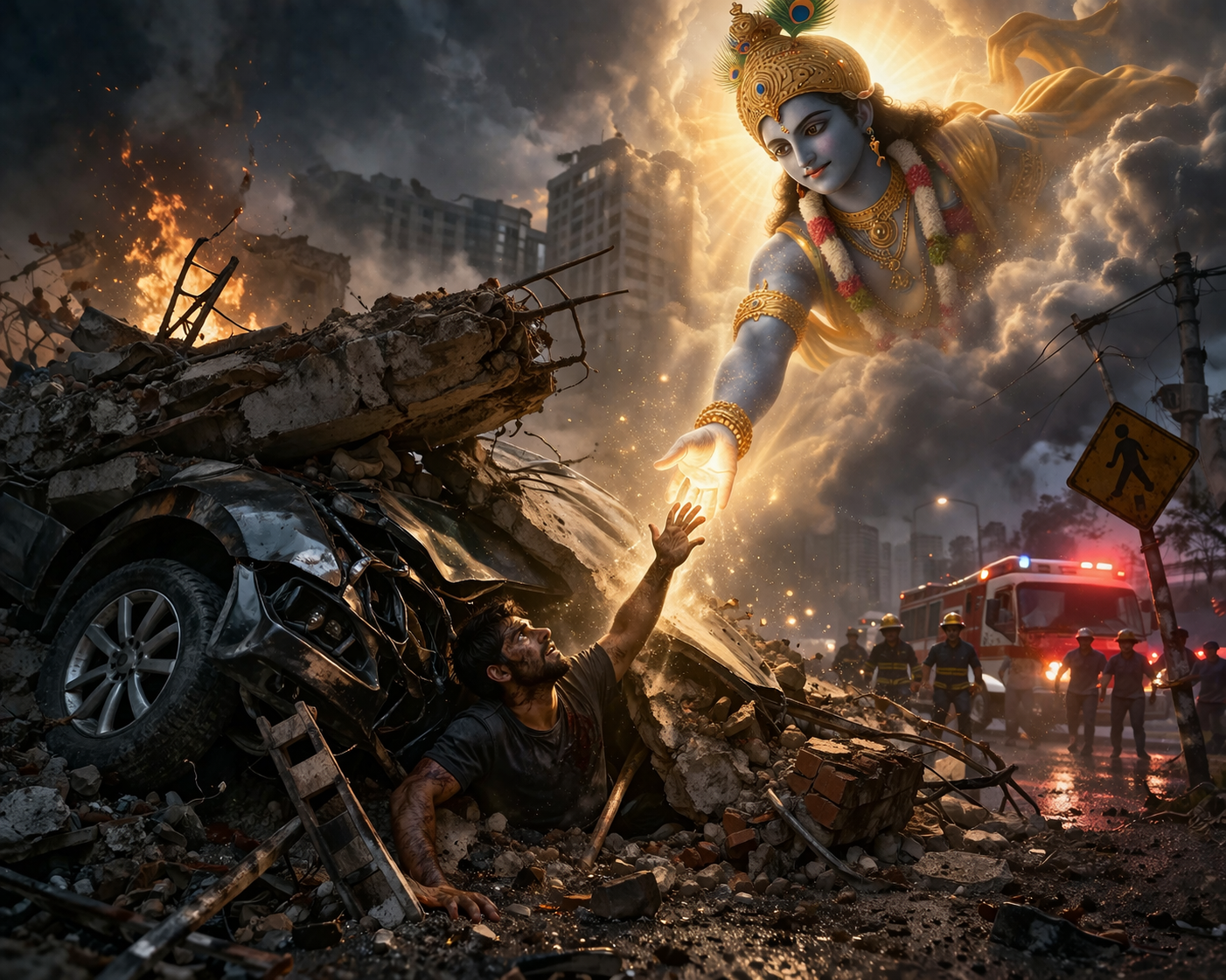
So far, we have examined unanticipated results, unforeseen surplus, anticipated accidents, and foreseen surplus within the framework of natural causation. We now turn to a fundamentally different level i.e. ‘Divine Grace’, unlike accident or chance, which operates within the limits of human foresight and natural sequence, Divine Grace refers to the intervention or assistance of a higher will that completes, rescues, or elevates human effort beyond its proportionate capacity. It is not merely an unexpected event, nor simply a favourable outcome; it is the attribution of fulfilment to transcendent agency rather than to natural causation alone.
The conception of Divine Grace reaches its strongest metaphysical expression in the Vaishnava theological position articulated by A.C. Bhaktivedanta Swami Prabhupada in his commentary to the Srimad Bhagavatam (8.6.39). Drawing upon Bhagwat Gita (9.10), “Whatever actions and reactions occur within the cosmic manifestation all take place under the superintendence of the Supreme Personality of Godhead”.15 He argues that nothing is accidental; what appears as chance is merely nature acting under divine supervision. In this framework, material causation is not autonomous but derivative. The language of accident reflects epistemic limitation, not ontological independence. Thus, Divine Grace is not an occasional interruption of natural order but the continuous superintendence of it. What human beings describe as coincidence or unforeseen surplus is, from the standpoint, subsumed under a higher intentionality, Divine Grace therefore reconfigures causation itself; it does not merely supplement natural sequence but governs it from within.
“Nothing is accidental. Everything is done by the Supreme personality of Godhead as the Lord Himself confirms in Bhagvad-Gita (My aegis Nature brings forth the whole creation, consisting of both sentient and insentient beings)”16.
Since Accident as a surplus of purposive action has already been ruled out at an independent level and has been put in level 2 and Chance has been differentiated from accident in the previous paragraphs, the framework reduces to three fundamental conditions which are definitions (Laws), Events appear as accidental because of ignorance and divine grace generates accidents. Ignorance represents the state in which the living beings remains covered with illusion, mistaking partial knowledge for completeness. In such a condition, effort and reasoning operate within limitation. The transition from ignorance to true clarity cannot be self-generated, for that which is covered cannot remove its own covering. Illumination therefore presupposes grace. Knowledge, in its fullest sense, emerges not merely from the subsiding of illusion through divine intervention. Here is the English translation by A.C. Bhaktivedanta Swami Prabhupada of the verse 1.3.34 from Srimad Bhagvatam which explains this beautifully.
“If the illusory energy subsides and the living entity becomes fully enriched with knowledge by the grace of the Lord, then he becomes at once enlightened with self-realization and thus becomes situated in his own glory.”17
In Confessions Book 7, Chapter 10, St Augustine of Hippo describes God as the inner Teacher illuminating the mind; truth is not derived from senses but from divine light enabling discernment of unchangeable realities. This aligns with Srimad Bhagavatam1.3.34, where grace dispels illusion for self-realisation.18
Thomas Aquinas expands Augustine’s divine illumination, where God appears as changeless light “above the mind”, into a systematic framework in Summa Theologica I-II, q. 109, a.5. He teaches that grace doesn’t merely reveal knowledge but actively transforms the will (“God operates in us, without us”), infusing virtues to obey divine commands that human nature alone cannot fulfil. This mirrors Bhagvatam 1.3.34, where the Lord’s kripa instantly dispels illusion, enriching the soul beyond effort for restored glory.19
Tulsidas expresses this idea very directly in the Ramcharitmanas when he writes, “Hoihi soi jo Ram rachi rakha, Ko kari tark badhave sakha”,20 meaning what the lord has ordained alone will happen; who can alter it by argument? The verse conveys that human reasoning and debate cannot ultimately change the course of events. Intellectual efforts may multiply explanations, but understanding, ignorance lies not only in lack of knowledge but in the belief that reason alone governs reality. True clarity comes when one recognises that the unfolding of events depends upon a higher grace rather than human calculation.
A similar idea appears in the interpretation of the Bhagavad Gita given by Ramanujacharya. According to this view, true knowledge does not arise merely from intellectual effort but from divine favour. In the Vedanta Sutras, with the commentary of Ramanuja by George Thibaut, the Lord declares; “To them ever devoted, worshipping me in love, I give that means of wisdom by which they attain to me. In mercy only to them, dwelling in their hearts, do I destroy the darkness born of ignorance with the brilliant light of knowledge” (Bhagavad Gita X,10-11).21 Knowledge here is presented not as an autonomous human achievement but as a result of divine grace removing the ignorance.
Synthesis:
The discussion began with the ordinary meaning of accident as understood in law and common usage, drawing upon standard definitions from dictionaries and judicial formulations. In this sense, accident refers to what appears unexpected or unintended from the standpoint of human observation. This level may be described as the apparent or practical understanding of the accident i.e. what seems to happen without design.
Moving beyond this, the first category examined the philosophical ground of accident as ignorance. What appears accidental is often nothing but the result of incomplete knowledge of causes. The same reasoning was applied even to purposive actions producing additional effects; such outcomes are not truly accidental but only appear so due to limitations in human understanding.
However, this explanation, though sufficient at one level, does not fully account for phenomena such as discovery and sudden insight. The mere absence of knowledge cannot generate a new result; it can only explain why the result appears accidental. This leads to the third level which is Divine Grace. Here the cause of the event is not ignorance but higher agency. Ignorance explains the appearance of accident, but grace explains its occurrence.
The final position, therefore, is that while action(karma) must be performed, knowledge gradually removes illusion, and through devotion or surrender (bhakti or prapatti), the ultimate truth is realised. What appears as accident at the human level is thus reinterpreted as part of a deeper order in which ignorance conceals and grace reveals.
Footnotes
- Oxford English Dictionary, Vol 1,pg 55, Philological Society, Reprint 1970
- Union of India vs Sunil Kumar Ghosh 1984 (4) SCC 246
- Sukhdev Singh v Delhi State (SC). 2004 (1) GCD 75 (SC)
- Blacks Law Dictionary by Henry Campbell Black, Sixth edition,11th Reprint 1997
- Isha Upanishad, 1.15, English Translation by Swami Paramananda, Boston 1919
- Srimad Bhagavad Gita, English Translation of Sri Shankaracharya’s Commentary by Swami Gambhirananda, Project Gutenberg pg 362
- Aristotle, Physics, Vol 1, BookII, Introduction to chapter IV pg 138-140, English Translation by Wicksteed-Cornford
- David Hume , An Enquiry Concerning Human Understanding Section VI, Part 1,pg39
- Kautsky :-Max Eastman, Marxism; is it science? (London, George Allen & Unwin, 1941) pg 85
- Engels :- Ludwig Feuerbach and the end of classical German Philosophy, Selected works of Marx and Engels II, pg 351
- H. Bradley, Appearance and Reality (10th impression, Oxford: The Clarendon Press, (1946), pg 344
- Merton Robert K, “ The Unanticipated Consequences of Purposive Social Action”, American Sociological Review Vol 1, No 6, 1936, pg 894-904
- John Stuart Mills : A system of Logic, Ratiocinative and Inductive.. Book 6, Chapter XII, Paragraph 6, Gutenberg Project(online)
- Summa Theologica (II-II,Q.64,A7) by Thomas Aquinas. The Double Effect Principle: From Thomas Aquinas to its current meaning, ceur-ws.org pg 3 , Mario Macias CEUR Workshop Proceedings pg 121
- Bhagavad Gita(9.10) quoted in Srimad Bhagavatam 8,6.39, Translation and Purport by Bhaktivedanta Srila Prabhupada, SB 8.6.39 Vedabase.io
- cit.
- SB 1.3.34 Vedabase.io
- The Confessions of St Augustine, Book 7, Chapter 10 pg 128, Translated by J.G. Pilkington, M.A., International Collectors Library, American Headquarters, Garden City , New York.
- Summa Theologica [I-II, Q-109, Art 5] , Project Gutenberg (online)
- Ram Charit Manas by Goswami Tulasi Das, Bala kanda ,between Doha 51 and 52
- Vedanta Sutras , Commentary of Ramanuja, Adhyaya 2, Pada 3, page 489 Translated by George Thibaut, Oxford, Clarendon Press 1904, Sacred Books of the East Vol XLVIII
Leave a Reply