
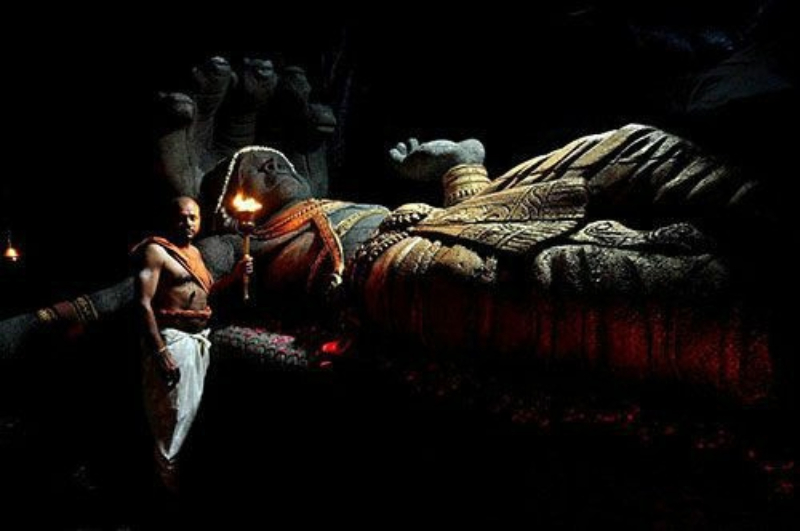
The ancient Shilpa Shastra lays down ground rules for materials, Talamana (iconometry) and shastra (iconography) of construction of vigrahas. Moorthies are commonly made in stone, wood, metal or stucco (mixed plaster with incense blend). In Kerala few temples have a special and traditional method of vigraha making – Kadusarkarayogam. Sri Padmanabhaswamy is not the only temple built with Kadusarkarayogam technique, several maha Vishnu and Devi temples in Kerala are made with this technique. Anathapuram Lake temple (moolastanam for Padmanabha), Thriuvattaru, Malayalapuzha Devi, Madayikavu are a few popular temples.
As a child, growing up in Sri AnathaPadmanabha Swamy’s Thiruvananthapuram, I have heard the word “Kadusarkara Yogam” used by my granduncles and grandparents. It is only recently that I had the chance to learn the details from my cousin TK Ananda Padmanabhan who has been discussing this with Shilpis, tantris and researchers for over a decade to help in the restoration of Sri PadmanabhaSwamy moolavigraham.
Kadusarkara roughly translates to a “medicinal mud”. You will see as we go through the intensive process, that it requires skilled, patient and exceptional shilpis with knowledge of ancient art of Bimba making. This requires the bimbam to be made in the location of consecration within the temple aka the GarbhaGriha, which is also unique to this method. We had Ramalalla of Ayodhya carved out to precision in Karnataka and pranaprathista done in Ayodhya, but Kadusarkara Vigrahams are built stage by stage in the GarbhaGriha.
The deity is built in stages like a human with each stage replicating the development of the different systems of the human body – skeletal, muscular, nervous, derma involving six stages completed sequentially.
The primary stage is setting the framework or the “Shoola Vigraha” – making of the skeleton involving measurements (talamana) specified in tantric texts. Measurements are done with a pasam or rope. A scale is fixed, and the pasam is used to demarcate the various parts of the bimba such as the chest, waist, legs, arms and feet. The base material is a good, strong tree with high quality texture and trunk. Traditionally locally grown and strong trees such as Black Ebony (Karingali), Devatharu, Sandal are used. After the main structure is laid down, areas of feature details such as palms, feet, ears and nose are constructed with copper plates and wires. Stage one completes the building of Shoolam(skeleton).
The next is the “Ashta-Bandana Lepana” for fixing the Shoolam. Ashta-Bandhana Lepana would loosely translate to “8-part mixture of sticky gum”. The lepana is mixed using a part of common gum (thiruvatta Pasha), 3 parts of Kundirikkam, 5 parts of gulgullu, 1 part of jaggery, 8 parts of resin from Chenchalyam. This mixture is also mixed with 3 parts of red ochre earth with equal parts of oil and ghee. The lepana must be in the consistency of honey so it can flow and bind with the Shoolam. So the mixture is boiled in an earthen pot. The lukewarm honey Asta Bandana lepana is now slowly poured over the shoolam to bind.
While we can compare the first two stages to the skeleton and ligaments of the human framework, the nervous system of the vigraham is “Naadi Bandhana”. Technique uses materials very native to the coastal area of Kerala and trees native to the western ghats. So I can say with a degree of confidence that this is a very native method of vigraha shastra to the southern coast of Bharat. Naadi is built with coconut fiber as its primary material. Human sapta naadi will be replicated using a fine fiber of hardened coconut which is meticulously made by removing the husk and extra fiber. It is then washed and cleaned several times to cure it. The Naadi is built by twisting the strands of fiber from left to right in three separate spirals. These three constitute the Ida, Pingala and Sushmna Nadis. The Sushmna naadi runs from the crown of the head to the spine. This is the central Naadi and is often referred to as Saraswati naadi in Ayurveda. This is a primary and significant naadi. To the left of the Sushmna naadi the Ida naadi is placed. “Idam” is also the Malayalam word for left. On the right the Pingala Naadi is placed. They are also referred to as Chandra and surya naadi respectively. The three vital nerves. Then four other Pusha – associated with ear and perception, Yashwini – overall right side branching out to the rest of the sthoola, Shankini – left ear, perception and runs through to the central core and Kuhu – down to the perpherials are made. They run through the Shoola Vigraham originating in the head. They represent the sapta Naadi. We can now relate to the divinity in the Human form as the vigraham evolves.
The “Mrth Lepanam” is the next process. This is complex and involves several ingredients from different terrains and across the desam. This stage is akin to the muscular system, significant and adds the form and structure to the vigraham using Mud paste. Soil from Dry (Jangala desam), Marshy (Anoopa Desham) and Desert (Maru- Bhoomi) are collected separately, cleaned and mixed. While this is kept aside separately, three different concoctions are made too.
The karungali concoction is made using the medicinal bark of Black Catechu tree and Maruthu (Arjuna Tree bark). Nalpamara a common ayurvedic concoction made of four Ficus trees – clusters of Athi, Ithi, peepal Tree (arrayal) and Hiptage (Peral) are made. Third is a red lac resin made from the scarlet secretions of the Laccifer lacca tree. The concoction is made after several rounds of purification and heating.
Now the soil is mixed with specific concoctions in earthen pots and allowed to cure for 10 days. After the curing the mud dries. The dried and cured mud is further treated with fruit kashayams ( a name for water based medicinal concoctions) of Thripahala, Amala and Bhibhithaki. The mud is allowed to further cure in this for 10 more days, dried and redried again.
At this stage 1 portion of river sand is mixed with 1/8th part of the cured mud and mixed thoroughly. Then barley powder, ground wheat, leaves of medicinal plants, fine gold & silver thread are added with coconut water, gum from various trees (guggula, Kunthirikkam, sal tree, pine) are mixed along with mangala dravyams such as honey, cow milk, curd, dry ginger, milk, ghee, jackfruit, saffron, several powdered roots and kasthuri are added.
This is mixed with sand from – crab hole, farmers plough, bull’s hooves, elephant’s tusks, ant hill, vegetable farms, ganga river bed. These sands are added in specific quantities to the existing mixture slowly. To make the dried mud and mud mixtures into a gum or resin, this is mixture with the resin of Illupa tree. Illupa wood was the original material used in the making of Sri Padmanabhaswamy vigraham before the fire destroyed it. The sand is cooked for 5 days in the resin. Coconut husk, gum of bael fruit and jackfruit are then added. This is applied to the vigraham to bring the shape and form to the bhimham as desired and described by Shilpa shastra.
I find this stage extremely inclusive of all possibilities that exists – mud from all terrains and usages, medicinal plants and gum from all native trees, flowers to fiber, from roots to fruits it contains all. Now that the form is complete the next stage is the simplest – fixing the skin of the vigraham.
In this stage a fine silk cloth resembling the inner layer of the derma is fixed on the Mrth lepanam with a help of gum.
What protects the Vigraham for years is the application of “Kalkkam” – A medicinal mixture. The Kalkkam is prepared by hand pounding and bringing to perfect glue like consistency the mixture over several days. In a gum made of sesame oil, and triphala, jackfruit and koovalam sand from river, black sand, black stone, gravel from river bed are mixed. This mixture is pound on the granite stone, the pounding creates heat, and as it gets heated it would be cooled, before it can be repounded. This process is repeated for 30 – 40 days till a perfect glue consistency is obtained. This is coated on the vigraham. With the Kalkkam the Shilpa builds the ornaments, yagyopaveeda, the finer features of palm, face, feet and vastrams.
While the Mrth lepanam is an ingredient intense process, the Kalkkam is time and labor exhaustive process. The building of the virgrahams using this ancient technique requires over 100 unique ingredients in pure form. The bhimbha made with this technique are not subject to abhisheka.
The energy and prana of the deity is invoked by tantric rituals. Interestingly, in Thiruvananthapuram the Garbhagriha houses Sri Padmanabha, the presiding deity reclining on 18 feet Adisesha embedded with 12008 salagrama bound together with Kadusarkara yogam. Sridevi, Bhudevi, Bhrigu, Markandeya, Diwakara (Agasthya), Saptha Rishis, Surya and Chandra are all made using the same technique. A remarkable feature is that Brahma rising from the Naabhi of Padmanabha (not commonly found in many Vishnu temples including Srirangam, Thiruvallur etc) is careful bound using Kadusarkarayogam. We can see the durability and flexibility of using Kadusarkara for the detailing vs Stucco or stone vigrahams. Between the plaster used for stucco and kadusarkara, the latter provides strength, flexibility and tension needed to incorporate the lotus stem rising from the navel of Sri Padmanabha, the lotus and Brahma seated on the lotus.
Natural wear and tear are possible on the vigrahams if proper care and timely maintenance are missed. The Thiruvattaru temple houses 22ft AdiKeshava Perumal mirroring SriPadmanabhaswamy, the temple performed a full restoration of the Moolavigraham and completed the kumbhaishekam on July 6, 2022. Due to the damage on the mrth lepanam and kalkkam of Sri Padmanabhaswamy, the Kerala High Court has ordered the temple to commence restorations. The temple is mulling over restorations plans.
References:
Kadu-Sarkara Yogam: Acient Technique of Making Deities – P Jayasimha, Research Scholar
https://sattology.org/content/katu-sarkara-yogam-the-ancient-technique-of-vigharha-making/
Kadu Sarkara Yogam – https://threadreaderapp.com/thread/1276395953197477890.html
Interviews and discussions notes between Thiruvattar Shilipis, Ananthapuram Tantri and TK Ananda Padmanabhan
History of Ananthapura Temple – https://ananthapuratemple.com/history
Glossary of Traditional vocabulary
| Asta | Eight |
| Naadi | Nerve |
| Bimbha, bimba | Idol |
| Garbhagriha | Sanctum |
| Pasha | Rope, |
| Devadaru | Cedrus deodara |
| Thuiruvatta Pasha | Common Gum, Pinus Roxlrerghir |
| Kundirikkam | Boswellia Serrate |
| Gulgulu | Commiphora Mukul |
| Chenchalyam | Shorea Robusta |
| Kashayam | Decoction, concentrated extract, tea |
| Karingali | Acacia catechu |
| Maruthu | Terminalia Panicululata, Arjuna |
| Athi | Ficuses Racemosa |
| Ithi | Ficuses Gibbosa |
| Arayal | Ficuses Religiosa |
| Peral | Ficuses bengalensis |
| Amala | Gooseberry, Embilica Officinalis |
| Bibhitaki | Terminalia bellirica |
| Kunthirikkam | Indian frankincense |
| Guggula | Commiphora wightii |
| Sal tree | Shorea Robusta |
| Illuppa tree | Bassia Longifolia |
| Bael fruit | Aegle marmelos |
| Abhisheka | Holy bath |
| Prana Prathista | Life-giving ceremony, consecration of deity in the idol |
Leave a Reply