
Recently, I had the privilege of interacting with a popular and well-established spiritual guru. It would be an understatement to say that he has millions of followers, the world over. In the waiting room, before meeting His Holiness, I was instructed to ask him a question about something that bothers me. I simply complied. I asked him this – if complete detachment from pleasure and material arrangements was a sine qua non for engagement with higher-order thinking? I, of course, elucidated the same with an example from my own life. To this question, His Holiness responded, almost dismissively, saying “ Everything will be fine, just chant the holy name”.
I was deeply disappointed with the answer, for it not only attempted a diagnosis where none was asked, but also almost validated the disdain the spiritual world shows, at least in discourse, towards thoughts or ideas rooted in acquiring instant, material pleasure. However, after some contemplation, I would like to present a few thoughts on what might act as a skeletal response to the question His Holiness was posed.
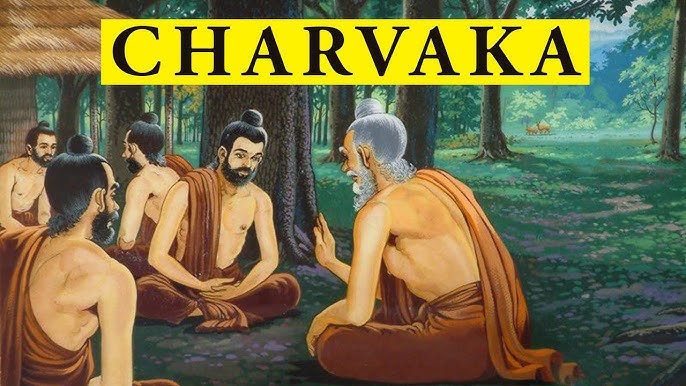
The Sarva Darshana Sangraha of Madhvacharya famously states, in its chapter on the Charvaka school of thought, the following –
“While life remains let a man live happily, let him feed on ghee even though he runs in debt ;
When once the body becomes ashes, how can it ever return again ?”
These lines may lead one to think that the Charvakas have a self-ordained license-to-kill (figuratively and literally). For how can a man that predicates his justification of pleasure in the occurrence of that pleasure itself, be considered moral, which seems to be the exclusive domain of the ascetics. In this piece, I seek to offer a different perspective – one where hedonistic materialism in the case of the Charvakas, may still have a functional moral element. Before engaging in that endeavor, a disclaimer is in order. It is fully true that the Charvaka idea has been preserved poorly and has been passed on since its genesis in a debilitative manner. Original texts, upon which reliance can be placed, are almost non-existent. However, these limitations may not be of great challenge to us as I do not intend for this piece to be academic, peppered with references. I only rely on the essence of the Charvaka thought, which is identifiable without great difficulty.
The Charvaka school is infamously attributed with indulgence, excess, immorality, and social deviance, as it is commonly understood that a true Charvaka may do anything to experience pleasure. I say that this attribution is not only a superficial understanding of the philosophy, but it also runs the risk of demonising the goal of pleasure.
Pratyaksha (perception) is central and supreme to the Charvakan philosophy. Simply put, the only way to acquire true knowledge of anything is through one or more of the five physical senses. It is very important for us to understand this epistemological base, as it is the essence of the philosophy.
The logical corollary to the epistemology of the Charvaka is that supernatural, intangible, imperceptible (through physical means) concepts such as the divine, afterlife, Karma, and rebirth are all false and not worthy of consideration. It is important for us to know that the primary goal of the Charvaka is not to denigrate the supernatural, but to merely state that it is beyond him, as an entity, to establish its truth, and therefore he will not let it influence his existence in any manner.
It is natural for us to therefore say, that a man who exists and acts with no regard for the metaphysical aspect of life is a dangerous man; a dog not on a lead. To this I say, if morality is what takes a man from being dangerous to civil, the Charvakas face no problem as moral action without God is possible. In fact, the Euthyphro Dilemma discussed by Socrates acts as a catalyst to a deep examination of the same. To say that moral action and an obligation to do right is a function of divine commandment is to presuppose not only the existence of God but also an accurate understanding of all of His commandments. It must then be true that any action we take must be with reference to the approval of the divine, in order for it to be moral. To me, this is a difficult position to countenance.
Notwithstanding any legal or social obligations, human action need not always be prescribed. Does one help a group of children retrieve a ball from underneath a car because of the divine commandment that one must help thy neighbor? Or simply because he experiences the pleasure of witnessing the resumption of the game?
A lack of reverence to divine commandment does not ipso facto render all action immoral or perverse; there exists an intrinsic compass that guides the human towards some sense of measure and judiciousness. For example, divine commandment may turn the Nelson’s Eye to the concept of travel. Does that stop us from travelling? Or singing its praises? Do we not continue to travel because we know the beauty and value that lies therein?
To that extent, a parallel may be drawn between the Charvaka philosophy and the moderateness of Epicureanism, although the latter was propounded at least a couple of hundred years later. I can only say that it would be antithetic to the benevolence and magnanimity that is often associated with the divine, if the pursuit of morality is only possible with reference and tribute to it.
The Charvaka philosophy is often criticised on a plethora of grounds such as the ones discussed above. However, in my opinion, these criticisms are misplaced. The reasons are two-fold.
Firstly, most criticism towards the philosophy commit a category error because they rely on metaphysical concepts such as the pursuit of enlightenment, realization of the soul, dharma based on divine commandment, and afterlife. The Charvakas simply do not operate in this field and therefore, if the validity of these concepts cannot be proven to their physical perception, a criticism based on them may also not be right.
Secondly, criticism also presumes that a Charvaka only derives pleasure out of nefarious acts or through socially prohibited conduct, completely foregoing the possibility of pleasure being derived from bona fide acts. One can pick up any surviving phrase attributed to the Charvakan school and see that pleasure was intertwined with excess in terms of food and drink, and other similar individual aspects of life. Ejusdem Generis would dictate that morally and socially prohibited actions such as murder, rape, robbery and other similar crime were not contemplated – the ghee was to be eaten on borrowed money, not stolen.
None of this is to say that the Charvaka philosophy does not suffer from infirmities. It suffers from many, especially epistemological. This piece is to only shed light on the error that one commits when one demonises the broader goal of perceptible pleasure itself. To conclude, the Charvaka philosophy perhaps gives us a framework within which one may pursue only material pleasure, with no reference to any divine teaching, without being chastised as immoral or lowly.
Leave a Reply