
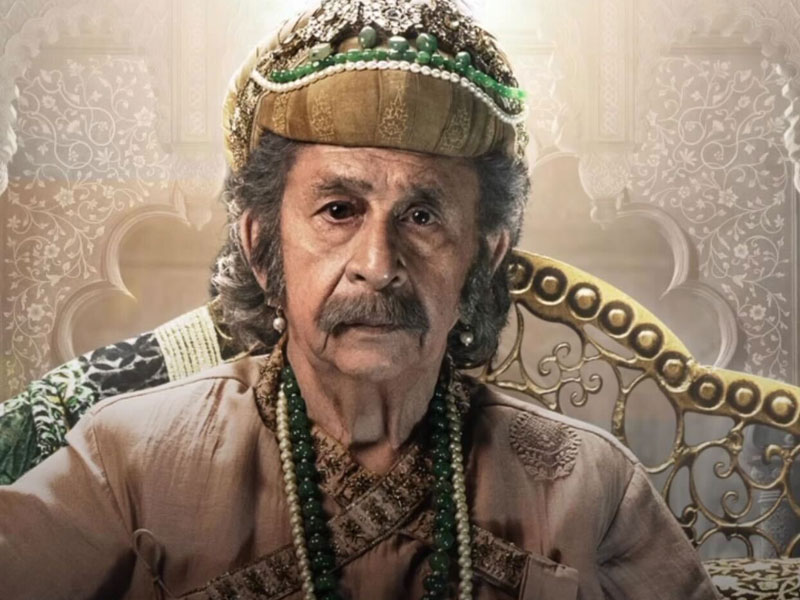
(This essay is part of an extensively-researched series of stand-alone articles that use the statements and activism of ‘progressive’ celebrities who also belong to minority communities to structure and analyze how the ‘secularism narrative’ operates in India. The first two essays–Minority-Progressive Celebrities: Part 1 ‘The Reform Agenda’ and Minority-Progressive Celebrities: Part 2 ‘Changing Landscape’–are published and available (with no paywall) on Pragyata. The remaining essays in the series will be published on multiple platforms including Firstpost, Pragyata, and the author’s Substack.)
For those of us who grew up middleclass in pre-Liberalization India, Naseeruddin Shah was a star unlike any other. He played ordinary people onscreen but with such magnetism that it left an impression. Our families, entirely clueless about Urdu poetry, watched Mirza Ghalib on television almost as avidly as they did Ramayan and later Mahabharat. We sat through every ‘art film’ he was in, loved Masoom and Jane Bhi Do Yaaron, were Jalwa fans, and always rewatched Junoon when it was on TV. We also cheered on silently when Shah gave ‘honest’ press interviews calling out the Indian film industry, trashed its big names, and spoke passionately about acting. Occasionally, he even spoke out on national issues and we faithfully took note. In recent years, however, as Shah became even more outspoken we came to see that we had underestimated his acting brilliance. His greatest role, it appears, was playing the measured, intelligent man while in truth being a self-important, uninformed, and untruthful gaslighter. Shah’s famously sulky public image, it became increasingly clear, was put to two major uses: gaslighting the film industry that brought him wealth and fame; and gaslighting middleclass Hindus into taking his communal politics for ‘secularism.’
I recall a television interview where Shah lashed out at long-time collaborator, Govind Nihalani, and accused him of promoting Islamophobia. (As this claim is based on memory, I am happy to withdraw it if shown to be incorrect, but I seriously doubt it will come to that.) The movie that so incensed Shah was Nihalni’s Dev (2004), a ‘communal hatred stoked by Hindu and Muslim politicians’ story with a secular policeman and a misled Muslim youth for protagonists. And how did a film that showed ordinary Muslims as victims, showed the police systematically killing Muslims, and had a Hindu-fundamentalist-cop for an antagonist manage to offend Shah? By letting Om Puri, who played the antagonist, speak the anti-Muslim dialogues and Amitabh Bachchan–the far weaker actor in Shah’s opinion–the ‘secularism’ dialogues.
This, it seems, is the level of self-censorship Shah expects for him to bestow the ‘secular’ label upon a long-term colleague. The irony of this is striking as much of ‘secular’ and ‘minority-progressive-celebrity’ (MPC) handwringing in recent years has been about pressure from Hindu groups to self-censor. So Shah’s outburst, which may appear to be merely emotional on the surface, must also be looked at in terms of what it set out to achieve.
The likely purpose of the outburst, even if it was instinctive, was to shame Nihalani for straying from the culture-industry’s ‘purge agenda.’ The dominant agenda in post-Independence India that undermined Hinduism, pushed Western ideologies, and always showed minorities and minority culture in a positive light. While it passed itself off as a ‘reform agenda’ or ‘secularism,’ all its elements and proponents from colonial times onward saw Hinduism as a nuisance ideally done away with. ‘Purge agenda,’ therefore, is a more appropriate term for it.
So Nihalani’s film, while entirely sympathetic to Muslims, showed radicalized Muslim characters and faults on both sides. And in so doing, transgressed the unspoken ‘noble minority’ rule. Shah’s condemnation was, therefore, both an expression of anger and an expectation that filmmakers internalize and adhere to the purge agenda or risk being called ‘Hindutva-vadis,’ Fascists, ‘communalists,’ or worse. That is, it was an expectation of self-censorship.
The Vagaries of Shahi Censorship
In a recent article, I discussed the importance of the fiction-writing convention of revealing the villain’s worldview through dialogue. Trained-actor Shah certainly knows that the villain gets wonderful lines in these scenes–in fact, Shah chose to play Shylock for his debut schoolboy role. So it’s telling that Shah had his outburst about Dev and not about Nihalani’s earlier film Drohkaal–which Shah also starred in–where the young Naxalite, played by Ashish Vidyarthi, tells good-cop Om Puri: ‘a violent, anti-people State not only perpetrates violence, it also generates counterviolence.’ Perhaps Shah felt that Naxal-sympathies, which many ‘progressives’ sport, were aligned with the purge agenda.
In 1999, Shah himself gave a villain-worldview speech in Sarfarosh, where he played a Pakistani ghazal singer. But this movie also had a discriminated-against-but-noble Muslim cop; and the one bad Indian Muslim character was offset by a bad Hindu, an astrologer to boot. These elements probably ticked enough purge-agenda boxes to make it acceptable. Even so, Shah was on the defensive when a ‘progressive’ Indian TV anchor objected to a Pakistani singer being portrayed as a terrorist! Shah’s views on anti-Pakistan messaging, even in times of conflict, seem to have changed since–more on this later.
A Wednesday Flip-Flop
Shah’s more recent griping about Neeraj Pandey’s A Wednesday is an intriguing tale in itself. Shah now reads a ‘hidden message’ in the movie’s four terrorists being Muslim. He claims to have confronted the writer-director Neeraj Pandey on why instead of–or perhaps in addition to–Muslims he had not written in Liberation Tigers of Tamil Eelam (LTTE) terrorists or Naxalites. So vivid is Shah’s recollection of this that he says Pandey denied there was anything political about it and scoffs at the director’s denial.
But didn’t he just claim it was in hindsight that he saw a hidden message? So did he perceive a bias back then itself? If so, why was he in the film at all?
Pandey has denied that Shah brought up any such thing during filming. He added: ‘he said in the past that he didn’t want to change a word about (sic) the script because he liked it so much, then saying this doesn’t make sense.’
Could Shah’s retrospective resentment of A Wednesday really just be about a minority-progressive-celebrity (MPC) making stuff up to feed the grievance factory? I’m inclined to think it is, and you don’t have to take my word for it.
Om Puri reportedly commented (in 2008-09) that A Wednesday was ‘provocative.’ Shah’s response at the time: ‘Okay, so what was Ghajini? Next they will say Barah Aana is provocative because it shows three victims of social imbalance fighting it out in their own way. I’m sure they will think we are propagating negative views in the guise of a social yarn. If our society could be so easily inspired by cinema, it would have been an utopian society[…] All those who say that A Wednesday was provocative are faux intellectuals.’ I suppose that makes Shah one who not only wishes he was a faux intellectual in the past but falsely recollects having been one!
That Shah’s whinging about A Wednesday is contrived is clear in other ways as well. The film clearly played on the hijacking of Indian Airlines flight IC 814 to Kandahar by Pakistan-based terrorists and a series of jihadist-linked bombings across India that followed in the early 2000s. The film sets itself up as a terrorists-for-hostages swap story and ultimately pulls off a vigilante twist. The movie’s backdrop is unmistakably that of the Kandahar hijacking and the bombings that followed–the film wouldn’t work in another context. This could hardly have been a secret. While Shah is not remotely as smart as he believes he is, he is certainly not as dumb (he prefers ‘naive’) as he’s trying to play now.
A Wednesday isn’t about the antagonists being Muslim, it is about anger over the hijacking by jihadists based in Pakistan, their receiving protection from an Afghani regime that was hostile to India on the basis of Islamic fundamentalism, terrorists being released as a result of the hijacking, terror groups bombing India in the aftermath, and the Indian Government looking helplessly on. Also, while the LTTE did assassinate former Prime Minister Rajiv Gandhi using a human-bomb, it did not target Indian civilians with explosives or take them hostage. Naxalites did take government officials hostage, killed security forces with explosives, and even perpetrated atrocities against rural civilians and tribals, but they did not target urban civilians with major bombings. In the face of India being the victim of Pakistan-sponsored jihadist hijackings and terror attacks, is an Indian filmmaker not allowed to make a film about it? Instead of giving vent to such national traumas, are filmmakers to dilute them by throwing in other causes and threats? Should storytellers self-censor to that extent to placate the likes of Shah?
That seems to be Shah’s expectation. In 2024, Shah starred in the Netflix series ‘IC 814: The Kandahar Hijack,’ which perhaps treated the story with the ‘sensitivity’ he expected. The show was criticized by the likes of former Indian external-spy arm Research and Analysis Wing (RAW) chief A. S. Dulat and journalist Vir Sanghvi for ‘serving as propaganda for Pakistan’s spy agency, the ISI’ by suggesting it wasn’t involved in the hijack. Incidentally, both Dulat and Sanghvi are harsh critics of the present BJP government. The show was also criticized for the empathetic portrayal of the hijackers and laying excessive blame on the Indian Government’s handling of the crisis. A near-exoneration of Pakistan and the laying of blame upon the Indian government–is that to be the ‘reform agenda’ for the 21st century?
Shah’s Border-Transcending Love
Shah’s indignation at the blocking of Diljit Dosanjh’s film Sardaar Ji 3’s release in India for starring a Pakistani actress, is in a similar vein. He claimed it was an attack on Dosanjh by the ruling Bharatiya Janata Party (BJP) and that Dosanjh had ‘agreed to the cast [including a Pakistani actor] because his mind is not poisoned.’ This was in the aftermath of Hindu tourists being communally identified and killed by Pakistani terrorists (in April 2025), but Shah’s priorities were all too clear: ‘What these goons want is to put an end to personal interaction between the people of India and Pakistan. I have close relatives and some dear friends there and no one can stop me from meeting them or sending them love whenever i (sic) feel like it.’ That Shah quickly made it about himself is not surprising, what is disturbing however is that his expression of transcending love for Pakistanis didn’t come with a word of sympathy for the victims of the Pahalgam atrocity and their families.
A few questions arise here. One, why should Shah have an issue with casting being politicized when he politicized the casting of Nihalani’s Dev? Two, does Shah believe being anti-Pakistan–an inveterately and unrepentantly malevolent actor towards India–is the same as being anti-Indian-Muslim? His statements suggest he does.
That Shah didn’t suffer any severe consequences for this outburst–and one agrees it is good he didn’t–at a time of soaring tensions with Pakistan is testament to India’s tolerance. The very tolerance Shah and his like claim is dead. Of course, Shah playing the free-speech absolutist–which he is not but plays one on occasion–might argue that the film being blocked is itself a curtailment of speech. This will be discussed shortly.
On Sadaar Ji 3 itself, Javed Akhtar’s view was this: ‘I think the government and the censor board should look at the situation with a little sympathy. And say that don’t do this again, but since you made this film before, then release it.’ A measured response even if one that I disagree with. The decision to cast a Pakistani actress isn’t about the producer’s ‘mind not being poisoned’ but about community-specific messaging.
Pakistani actors starring in Indian films has long been controversial and risky; and it came to a virtual stop after the 2016 terrorist Uri Attack that killed 19 Indian soldiers. (In fact, there is also strong opposition to reviving cricketing encounters with Pakistan even at multilateral events.) So the casting of a Pakistani actress, rather than being accidental or due to a dearth of Indian talent, appears to be a calculated move to draw in Pakistani domestic and diaspora audiences–perhaps even the Khalistani-fringe of the Sikh diaspora. If that is the case, the producers are free to profit from these other markets–as indeed they have–but should realize that at a time of conflict access to the Indian market is a privilege and not a right.
Shah’s Love for Freedom of Speech (ish)
Freedom of speech is not absolute in India, but this is neither new nor exclusive to BJP rule. To suggest otherwise is a political act. The movie, Kerala Story, about a woman luring other women into becoming ISIS (Islamic State of Iraq and Syria) recruits, was banned by the West Bengal State Government in 2023 until the Supreme Court of India overturned it. Even then, hardly any theatres screened the film in Opposition-ruled states like Bengal, Kerala, and Tamil Nadu. The governments and theatre owners cited ‘law and order concerns’ to justify the official or unofficial bans. Would Shah care to tell us which ‘goons’ are behind this intimidation and censorship? Will he clarify in his next freedom-of-speech public-service-announcement (PSA) if this suppression is part of ‘the country we dreamt of’? Incidentally, Vivek Agnihotri’s film, The Bengal Files, faced similar suppression recently (in 2025).
When Shah did speak of Kerala Story, he said: ‘We seem to be heading the way of Nazi Germany where, in Hitler’s time, the filmmakers were co-opted, attempted to be co-opted, by the supreme leader to make films praising him and what he has done for the countrymen, and running down the Jewish community’[…] ‘[w]orthwhile films like Bheed, Afwaah, Faraaz, all three collapsed. Nobody went to see them, but people are flocking to see The Kerala Story, which I have not seen, and I don’t intend to see it as I have read enough about it.’
I too haven’t watched these ‘worthwhile’ films, and don’t intend to see them either as ‘I’ve read enough about them’ to know they’re propagandist–only on Shah’s side of the divide. (Incidentally, one of these filmmakers, Anubhav Sinha, also made IC 814.) And no, I don’t accept the ‘Shahi firmaan’ decreeing these films to be ‘true’ or ‘worthwhile.’
The Shahi Double Standard
Observe that Shah’s lament is about the box-office failure of these films. That shows that films critical of the BJP’s ideology and governance were released and freely shown, just not to commercial success. Would Shah care to finance local-language films in Bengali and Tamil equally critical of the state governments and their ideologies? In fact, would he like to speak out as stridently against aggressive, language-based chauvinism in Karnataka and Maharashtra, the latter even being where he lives? I suspect not, because Karnataka is ruled by the Congress, and the parties pushing the chauvinism in Maharashtra are opposed to the BJP. Incidentally, all the states suppressing Vivek Agnihotri’s films just ‘happen to be’ ruled by the Indian Opposition. That Shah, and other MPCs never speak out on such freedom-of-speech matters is a dead giveaway that their laments, while couched in idealist, moralist, and ‘secular’ language, are politically and communally-driven.
The Shahi Moral Seat (or High-Chair?)
Shah, who finds offense in anything but positive depictions of Islam or Muslims, is entirely tone-deaf when it comes to Hindu sentiments. For instance, he declares that Slumdog Millionaire’s ‘ethos were (sic) real’ even though its deeply offensive depiction of Hindu gods and marauding Hindu mobs upset many Hindus. One has no objection whatsoever to Hindu excesses being shown as every Muslim life is precious and harm done to even a single Muslim on religious lines is deplorable. But for Shah to have any moral authority at all, he would have done well to recall that Hindus were also killed in the riots that were supposedly depicted in Slumdog Millionaire and a number of citizens of all religions were killed in the allegedly retaliatory bombings that followed. For Shah, who was even moved to sign a mercy petition of the Bombay Blasts convict, Yakub Memon, to show no sympathy for Hindu victims (in Mumbai then or Pahalgam now) suggests an indefensible offense by omission. It also gives Muslim fundamentalism a free pass.
Shahi Even-handedness?
Omission is a subtle tool of prejudice but there are others as well. For example, Shah claims that the Pakistani-film Khuda Kay Liye was as ‘important’ a film as Manthan because he considers religion to be ‘one of the most harmful things to happen to humanity.’ One would assume he plays an atheist in this film, but Shah actually plays an Islamic scholar (or cleric) who declares that all or most of the social ills in Islamic societies (treatment of women, prohibition against music, and so on) are social, not theological, and the result of misinterpretations of Islam. One has no problem with such a view, but then, why is expecting similarly redemptory statements about Hinduism considered chauvinistic? And why is a modern, liberal understanding of Islamic doctrine considered the appropriate response to Islamic fundamentalism when the supposedly-appropriate response to Hindu fundamentalism is not similarly based in Hinduism itself but in ‘purge-agenda’ solutions like rejection, rebellion, or so-called ‘secularization’? Of course, no clarifications are asked for or expected of Shah, and he is allowed to go on claiming that playing a cleric who praises Iqbal and Jinnah in the very speech mentioned above is an Indian progressive achievement!
Conclusion
The test of being a moral voice is speaking out even against one’s own allies on principle. Has Shah stirred (lifted his little finger, perhaps?) to criticize Udayanidhi Stalin’s hate-speech against Sanatana Dharma, or closer home to the film industry, Anurag Kashyap’s hate-speech against Brahmins? None of the MPCs have.
The likes of Shah have used the ‘reform agenda’ as a cover to demand that the Hindu voice be purged from ‘polite society.’ The ‘purge agenda’ is easily weaponized by misusing terms like secularism, and it provides people cover when they are called out for Hinduphobia. What Shah and his ilk are making isn’t a moral argument but a powerplay–one centered around communal political power.
So Neeraj Pandey’s quip that Shah’s comments about A Wednesday were about ‘promoting something’ is true but naive if it assumes that a film or show is the product being promoted. It was and remains an attempt to enforce a system of self-censorship that gaslights the majority community, insulates minorities from comment, and creates a politically and communally-motivated sense of moral emergency when not in political power.
Leave a Reply