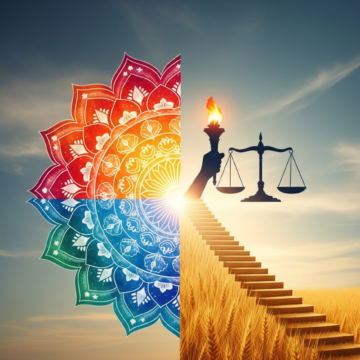
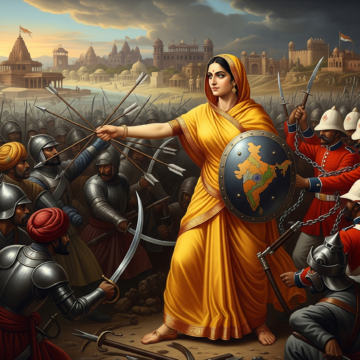
A cobra once promised a Sadhu never to bite, only to be beaten by villagers who mistook its restraint for weakness. The Sadhu reminded it: “I asked you not to bite, but did I ask you not to hiss?” The parable mirrors Hindu society’s larger civilizational problem of mistaking non-violence for inaction in the face of aggression. True Ahimsa was never about surrender — it was resistance rooted in Dharma, with Shatrubodh (enemy-awareness) as its guiding strength.
Year: 2025
That! Who or What is Worth Worshipping?
In post-Christian Europe, many no longer subscribe to traditional theology or atheism, instead calling themselves “Something-ists” or “spiritual but not religious.” This vague belief in “Something” echoes ancient Indian thought, where the Vedic word Tad—“That”—points to the Absolute beyond description. Found in the Ṛg-Veda, Upaniṣads, and Bhagavad Gītā, Tad represents the witness-consciousness, the essence beyond qualities. The clearest enunciation of Tad, at once one of the profoundest Vedic phrases is the assurance Tat tvam asi, “that thou art” in the Chāndogya Upaniṣad. Thus, what seems modern is rooted in one of humanity’s oldest insights into the ultimate reality.
Dharma and Development : A Civilizational Balance
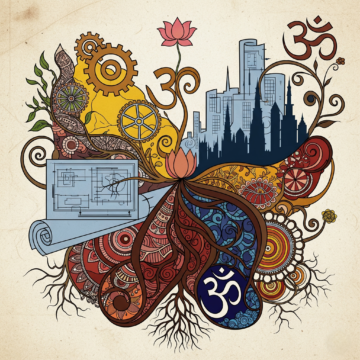
When development is not rooted in culture, a nation is reduced to just a geographical landmass. Development and culture are not mutually exclusive in the Indian civilizational context. Sanatana Dharma doesn’t ask us to choose between development and devotion to faith — it asks us to integrate them. Its Purushartha framework enables human fulfillment in every aspect of life, with Dharma as the guiding principle. From the Ram Mandir to the Kumbh Mela, what critics dismiss as distractions are often engines of economy, culture, identity, and belonging.
Secularism in India – Rooted in Sanatana Dharma
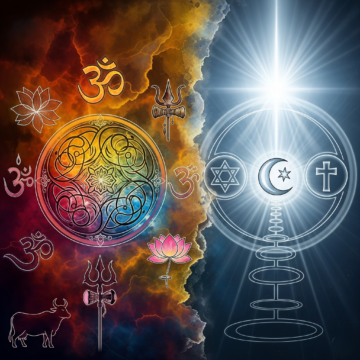
India's secularism is grounded in the civilizational ethos of Sanatana Dharma and emphasizes mutual respect over strict separation of state and religion. Sanatana Dharma doesn’t just preach tolerance and inclusivity; it embodies it. Unlike Western secularism, which arose from religious conflict, India’s approach fosters coexistence. India's secularism is not just political, it is civilizational.
Tirupati – A Sacred Legacy of Devotion and Divine Grace
Nestled in the sacred hills of Tirumala, Tirupati is more than a pilgrimage — it is a living legacy of devotion and divine grace. From ancient Pallava endowments to the grandeur of the golden roof of the sanctum sanctorum donated by Krishna Deva Raya, its history is etched in every gopuram. Always reverbating with the chants of “Govinda”, for millions in South India, it is not just a temple, but an inseparable part of life’s journey.
Bonalu – The Living Goddess Traditions of Telangana
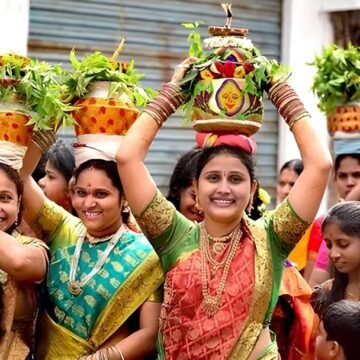
Bonalu is more than a festival—it’s the heartbeat of Telangana’s devotion to the Mother Goddess. Rooted in ancient village traditions and the worship of Grama Devatas, it transforms Hyderabad into a living tapestry of devotion, ritual and culture. From trance-induced prophecies to the fierce dance of Pothurajus, every moment is an embodiment of Shakti — both protective and powerful.
Harihara, Bukka, and the Birth of Vijayanagara
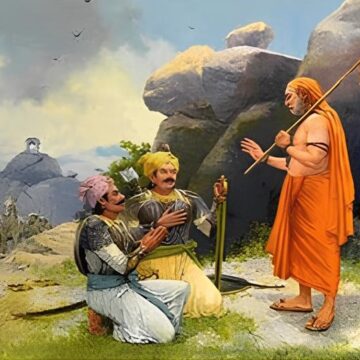
At a time when Muslim invasions had devastated much of North India and were sweeping into the South, two brothers—Harihara and Bukka—guided by the sage Vidyaranya, laid the foundation of the Vijayanagara Empire in 1336. More than a kingdom, it became a bastion of Hindu dharma, shielding the South for over two centuries. This is the story of its origins and enduring legacy.
The Limits of Equality: A Dharmic Appraisal of Modern Political Theology
Modernity universalizes Enlightenment ideals of equality, recasting Dharmic order as moral failure. But in Dharma, justice lies not in sameness, but in harmony—each being acting in accordance with its Svabhāva and Svadharma. The caste system, far from being a hierarchy of worth, was a framework of reciprocal duty, now misunderstood and maligned through colonial and liberal lenses. True reform lies not in dismantling tradition, but in reclaiming its wisdom with renewed understanding.
Bhārat’s Flag, Anthem and Name
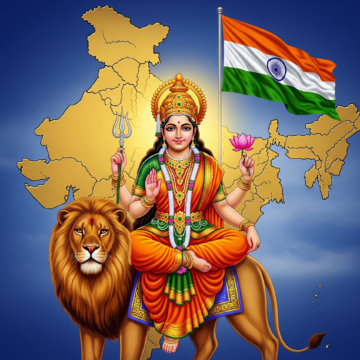
In this article, Dr. Koenraad Elst reflects on how India's national symbols—its flag, anthem, and the very name Bharat—are deeply rooted in Hindu tradition. Elst argues that despite the secularist intentions of Nehruvian India, the Dharma Cakra in the flag, the reference to Ma Durga in the anthem, and the nation taking its name from King Bharata, reveal a cultural continuity that cannot be denied: that India, by heritage and spirit, remains a Hindu Rāṣṭra.
Roots in Exile
In the wake of the massacre of Hindus in Pahalgam, Anjali George pens this poem ruminating on exile, identity and the quiet power of resilience. Weaving together stories of communities forced into exile, whose histories have been erased or silenced, the poem explores how faith, culture and memory survive displacement and how the uprooted still find ways to take root again.